Friday, June 23, 2006

Announcing the Daily Star Trek Quote Challenge

I've wanted to do this for a while. Someone recently left a rude comment that I should cut out the Star Trek stuff, so I decided that it's time.

Most days between 9 a.m. and noon (Eastern Time, times will vary), I'm going to post a Star Trek quote. To win, simply be the first to leave a comment with who said the quote (and to whom, if applicable), the episode or movie name, and the series (update: not necessary, really, it should be obvious from the character and name). Sources will come from TOS, TNG, DS9 and all movies. Difficulty will vary, but I won't post anything too easy or too obscure. While I can't offer any physical prizes, you can win bragging rights. I'll keep track of the winners and post a tally at the end of the month. However, if someone wins a majority of the year, I'll come up with a physical prize to recognize such Trek nerdiness.

Daily Star Trek Quote Challenge for 6/23/2006: "But sometimes you just need to trust yourself and turn it all off. Even the gypsy violins."

Today I must disqualify my friend Steve Tomer, who recently reminded me of this one. I was embarrassed at not recognizing it for several seconds. Steve and I watched so much Star Trek in junior high and high school that at one point we could quote entire scenes verbatim.

Official rules:

No purchase necessary. Void where prohibited. Batteries, computer hardware, computer software and Internet connection not included. Some restrictions may apply. The Eidelblog shall in no way be held liable for incidental or consequential damages resulting from use of its product, including, without limitation, damages for loss of business profits, business interruption, loss of business information or other pecuniary loss. Some states do not allow the exclusion or limitation of incidental or consequential damages, so the above limitation or exclusion may not apply to you.

Monday, October 03, 2005

I did it, a little reluctantly

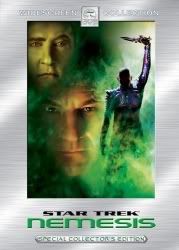
I ordered the Star Trek: Nemesis Special Collector's Edition, which is scheduled for release tomorrow, October 4th.

I'm buying it strictly because I own all other Trek movies, and because I want to see the deleted scenes. As a movie, well, I liked it enough to see it just once in the theatre, and I think only twice on premium cable. I found Nemesis a mediocre attempt that fell flat in action, which is what made First Contact so fun, and it failed in the character interplay that makes The Voyage Home a joy to watch. Both reasons are why The Wrath of Khan is the greatest of all Trek films.

Nemesis should have tried to excel in either action or character drama; instead, it tried for both, failed, and was overall tepid. This reminds me of my father's occasional complaint about our favorite restaurant in the Philippines, the Prince Albert Rotisserie in Manila's Intercontinental Hotel. If the food happened to be mediocre one night, at least the mini orchestra would be excellent and compensated for it; or vice-versa. Once in a great while, both would be mediocre on the same night. On the other hand, the Prince Albert's Irish coffee always was. Nemesis is like Irish coffee made from weak beans and cheap whisky, served at room temperature: there was a good recipe to follow, but the ingredients used were poor. The idea behind Nemesis was good, but it wasn't developed that well.

It was painfully obvious when I saw Nemesis for the first time that it copied several previous Trek elements, especially the final battle and Data's Spock-like heroics. The intrusions into Troi's mind became a plot device, but I think they were needlessly disturbing, more than in the TNG episode "Violations" (with the Ullians, one of whom was like a telepathic Jack the Ripper). I think I'd have preferred a blatant rip-off of The Undiscovered Country: "Doctor, would you care to assist me in performing surgery on a torpedo?" There also wasn't enough screentime for LeVar Burton, Michael Dorn or Gates McFadden (my favorite of all Trek women, and I usually prefer brunettes!).

Ah well. The deleted scenes (which are actually on the original DVD release, or will there be more?) might be, as Data would say, "intriguing." Did any of you think I was going to quote Spock and say, "Fascinating"? My expectations are not that high.

Saturday, May 14, 2005

"Enterprise" finale

I watched the finale tonight. I never liked "Enterprise" from the beginning, but I felt obligated to watch it, as I've seen every other Trek finale when it aired (except TOS, which was before my time). I give the penultimate episode a B, and the final episode a C. A C doesn't mean a bad episode, just a mediocre episode that isn't noteworthy. These are examples of how my ratings work. An A means a memorable episode like "TOS: The Doomsday Machine", "TNG: The Best of Both Worlds", "DS9: Duet", or "Voyager: Endgame". I thought the Voyager finale was the very best Trek finale (edging out DS9's) and one of the best Trek episodes ever.

Peter Weller was good. Acting was ok. Special effects were pretty good, par for Trek. The plot was ok, though the end was a bit predictable, and the crisis was perhaps too easily ended. Still, it was a good conflict initiated by a pretty good villain.

The final episode was ok, but I wouldn't bother watching it ever again. I found the story a bit contrived, if not pointless. Scott in Phil Welch's chat (which Phil set up for the readers of Jackie Passey's blog) observed out that during the Pegasus recovery mission, wouldn't Riker would have been too busy to use the holodeck? Good point. I suppose Riker might have taken a break to gallivant around in a fantasy, but would he have really chosen such a program, burdened by the potential consequences of his treaty violation?

Jonathan Frakes and Marina Sirtis were passable, but heavens, they look old. What I found funny was the variety of camera angles employed to hide Frakes' chin, especially during the cooking scenes. He was shot with his head pointed slightly down, or over his shoulder so that it hid his chin, or very brief shots where viewers might not really notice.

Sirtis certainly has not aged well, as Scott and Phil so well described...


And on a final note, the new "Enterprise" theme song is just as awful as the first. I liked all the other theme songs, especially DS9's second version with emphasis on the brass.

Monday, April 25, 2005

Star Trek economics

Please check part two for more on Star Trek economics.

I have always enjoyed "Star Trek" immensely, with the exception of "Enterprise", which I greatly dislike even down to the theme music. I still must smile, though, at the inconsistencies of the Federation's economics. Without money, without prices, Mises would question how the Federation could make any rational economic decisions -- from what textile to use for uniforms to how many starships and of what class.

In the Eastern Time Zone, Spike TV has been broadcasting two episodes of DS9 at midday, then two TNG afterward. The second one today, "Shakaar", is one of my favorites. It really elicits hate for Kai Winn (admirably played by Louise Fletcher), but it also has underlying themes of economics and personal liberty. DS9 is my favorite of the Trek series, in part because its portrayal of life is more realistic. The episodes are character-driven like the original series, but there are none of the silly utopian elements of TNG. There are Bajoran farmers trying to make a living, Ferengi capitalists interested in profit, and real warfare with real political intrigue.

"Shakaar" begins with Major Kira and Odo worrying about Kai Winn, a dangerous plotting woman (who reminds me of Hillary Clinton) looking to become First Minister in the upcoming elections. Kai Winn made a surprise visit to the station, asking Major Kira to go to a particular farming community on behalf of the Bajoran provisional government. The Bajoran government had lent a couple of its soil reclamators to some farmers, among whom is Shakaar (the former leader of Kira's resistance cell during the Cardassian occupation, and her future love interest). The government wanted the reclamators back, because it could put them to better use in a farming project elsewhere.

Shakaar refused to give them up, because the Bajoran government had (apparently) agreed to let them have the reclamators for a certain amount of time. Kira tried to explain that the other province could grow more crops with the reclamators, and that Bajor could start exporting crops. This is very true. The same resources elsewhere could produce far more crops, and Bajor could export those. Trade them for things that Bajor could not make as easily. Shakaar refused, wondering how Kira could talk about exports when the Bajorans still needed to worry about feeding themselves. But he missed the point of trade. As Ed Leamer once testified before the U.S. Trade Deficit Review Commission, American companies like Microsoft and Boeing provide cheap textiles and plastic toys for Americans. How? Well, they create other things that we trade to other nations, who can produce cheap textiles and plastics, but not computer software and aircraft.

This brings up something sticky, that the farmers are relying on the government to provide him with the means to make a living. But Bajor was recovering from years of Cardassian occupation, and it's possible that the Federation and others had given reclamators and other equipment to the Bajorans to help with reconstruction. The equipment would have been given to the provisional government, whose bureaucrats would decide which provinces would get what equipment.

Shakaar was wrong about trade, but he was right about the only thing that really matters: freedom. The government had made a deal and had no right to repossess the reclamator, even if it was for the "greater good." Kai Winn said to Sisko that Shakaar was "defying the law," then exploded, "This isn't about soil reclamators. This is about the future of our society!" Like so many central planners, like rulers with a "vision," Winn felt that she knew best for her people, that she alone knew how to guide them to prosperity. This necessarily means that anyone opposing her idea of "progress" is a criminal. In fact, all Shakaar wanted was that the Bajoran government stick to the terms under which it lent the equipment to the farmers -- the rule of law, not of men. Shakaar did "resist arrest," it is true, but he was merely resisting unlawful arrest when he had committed no crime.

Recall the Patrick Henry quote that I put on the right side: "You are not to inquire how your trade may be increased, nor how you are to become a great and powerful people, but how your liberties can be secured; for liberty ought to be the direct end of your government." Without liberty, without the freedom to live your own life so long as you do no harm to others, prosperity and national prominence are meaningless.

Monday, September 24, 2007

Let's try a new game: the Daily Star Trek Vidcap Challenge

I just didn't have time to continue the Daily Star Trek Quote Challenge. Also, it was coming down to whoever Googled the quote fastest, so let's try something a little different.


Name the episode, series and season number. We'll start off with a softball (pun intended) for the first one.

Thursday, September 28, 2006

An announcement -- good news

And I thought I was busy before. Work was taking a lot out of me, apparently more than I thought. For a few months I've generally needed to sleep much earlier than the usual 1, 2, 3 a.m. to which I was accustomed. A few nights ago, I stayed up until 2 a.m. to complete a proposal, and I was amazed to make it through the next day. Last night I got nearly eight hours.

It's not official yet, pending final approval from my Chief Compliance Officer, but hopefully that's just a formality. Starting very soon, I'll be freelance writing for Intrade. You may be more familiar with it as TradeSports. Most people think Intrade in terms of "betting," which strictly speaking is true, but stock markets are also about "betting" in the general sense of the word. However, Intrade and similar venues are more properly termed prediction markets. My friend Chris Masse specializes in them and has a lot of good stuff on his site.

I'm indebted again to Don Luskin, and to John Delaney, Intrade's CEO, for this opportunity. Mr. Delaney recently asked Don if he knew someone who could do a once-weekly newsletter, analyzing recent political developments in the 2006 elections and the "action" in the related futures contracts. Don recommended me, so a few nights ago I put together a rudimentary sample, and things appear ready to go.

Each newsletter will be about one or two pages' worth, including charts, and I'll rotate through the more prominent contracts. The coverage may seem superficial to those familiar with prediction markets, but there are a couple of important factors: it's a newsletter, not an op-ed or academic paper, and Mr. Delaney also wants it to help introduce people to prediction markets and illustrate how the processes work.

It will be principally weekend work, I think, so hopefully soon I can get a hold of my schedule during the week so I can blog more often. It's been so long since I thought of a good Trek quote, let alone put up a Daily Star Trek Quote challenge.

Tuesday, August 15, 2006

Daily Star Trek Quote Challenge, 8/15/2006

- Then our first step will be to eradicate its population. It's the only way.

- You can't do that.

- Why not?

- Because a true victory is to make your enemy see that they were wrong to oppose you in the first place...to force them to acknowledge your greatness.

- Then you kill them?

- Only if necessary.

- I had no idea.

- Perhaps the biggest disappointment in my life is that the Bajoran people still refuse to appreciate how lucky they were to have me as their liberator. I protected them in so many ways, cared for them as if they were my own children. But to this day, is there a single statue of me on Bajor?

- I would guess not.

- And you'd be right.


Whew, I've been busy at work before, but I have been positively swamped since Monday last week. Sorry for not stopping by, Lord Boner, to exchange greetings over morning tea.

With Israel and Hezbollah each claiming victory, and I think it's real defeat for Israel at Olmert's hands, I couldn't help but think of a certain Trek megalomaniac's definition of victory.

Wednesday, August 02, 2006

Daily Star Trek Quote Challenge, 8/2/2006

This is all I have the energy to post tonight, I'm afraid. Today was quite draining, in no small part from just a few hours of sleep last night. New York has been really hot for the last several days (Central Park today peaked in the very upper 90s with a heat index of 106), but last night was particularly bad. Even with a strong air conditioner and a fan blowing directly on me, I was miserable all night. Well, after analyzing my general lack of sleep for the last month, even on weekends, tonight I'd better get some rest. There have been so many important things to do at work, and my tasks today sapped nearly all of my stamina.

So, today's Daily Star Trek Quote Challenge:

"Sleep, Data...sleep."

OK, that one is too easy. How about:

- Do you think the other Federation worlds are going to sit back and let their President be replaced by a military dictatorship?

- Hardly a dictatorship, ____.

- Overthrowing a legitimately elected President and giving Starfleet direct control over the government? Sounds like a dictatorship to me, and I'm sure I won't be the only one who thinks so.

- There'll be some dissenters at first, but they'll fall in line once they realize strengthening Earth is the first step toward strengthening the Federation.

Sunday, June 25, 2006

Daily Star Trek Quote Challenge, 6/25/06

Daily Star Trek Quote Challenge for 6/25/06:

- You will never attain the twenty-four levels of awareness.

- Twenty-four? That's quite a challenge.

- Indeed. Twenty-four is the gateway to heroic salvation.


To win, simply be the first to leave a comment with all characters involved in the quote here, and the episode or movie name. Quincy won the first since I didn't make the rules too clear. Starting now, the winner will be the first to give a full one, so be careful giving partial ones as they probably will give hints.

Tuesday, April 26, 2005

More Star Trek economics

Quincy had a good reply to my previous post "Star Trek Economics". I was going to add this as a comment, but with the length I thought I'd add it as a post in itself.

Labor itself is a commodity like everything else. As Austrian economists argue, the price system allocates resources to where they are needed most. And as I noted, Mises in particular said that without a price system, rational economic decisions are impossible to make. Do you need more doctors than teachers, or more physicists than chemists? With no salaries (just another form of prices), there's nothing to direct people toward careers with a labor shortage. Just like the Federation wouldn't really know the optimal number of Galaxy Class starships versus science vessels, its various planetary societies wouldn't really have a mechanism to determine the right proportion of architects, artisans, scientists and Starfleet personnel. Not everybody works for Starfleet, like Vash, who's basically an antiquities privateer. Her goal of profit was part of why that Ferengi found her so attractive.

Supposedly the Federation, courtesy of pattern replicators and nearly unlimited energy (antimatter), has eliminated poverty, war and disease within its borders. According to "First Contact", it happened within 50 years of Zephram Cochrane's first warp flight. But I don't think that nations will ultimately beat their swords into plowshares, or that crime will be nearly eliminated, even with unlimited energy and nearly unlimited resources. I don't think eliminating "want" will sufficiently suppress the dark, "evil" element of human nature.

Moreover, if everyone lives equally and has all material needs provided for, why would anyone want to take a more difficult job? Why not be a peaceful man like Boothby, living a fairly easy life without much exertion, instead of a Starfleet crewman or officer? What incentive did Geordi have to become chief engineer, instead of remaining a junior officer stationed at the helm? Is it really a sense of personal achievement?

Ah, but admirals travel in luxurious suites, while ensigns apparently have to share quarters (episode "Lower Decks"). So everybody is not equal, after all. There is indeed a material incentive to improve yourself, beyond the "bettering oneself" that Picard told Lily in "First Contact". It's one of those inconsistencies about TNG's utopia.

At least in DS9 you see people like Sisko's father. Joseph has an actual business going, with a genuine concern about customers -- he genuinely needs them. If the Federation provides basic needs for everyone, why should he care about being successful? Would he work so hard, especially preparing food by hand, if it were only personal satisfaction? Why not work just a few hours a day?

And in the episode where O'Brien was "in the zone" regarding darts, why would that Vulcan officer (who won by default when O'Brien tore his shoulder) bother to collect his 15-to-1 winnings? What does he spend it on, or are there actual capitalist systems within the Federation?

In the episode "Encounter at Farpoint", Dr. Crusher bought a bolt of cloth. She said to charge it to "Beverly Crusher, Chief Medical Officer, USS Enterprise." They were in a mall, implying lots of similar shops and other "capitalist" vendors. But it's an actual Federation space station, not just a non-Federation world they happened to visit.

Thursday, August 10, 2006

Daily Star Trek Quote Challenge, 8/10/2006

- I agree. We're at war.

- There's been no formal declaration of war.

- Not from our side, but certainly from theirs. They've attacked us in every encounter we've had.

- They have declared war on our way of life. We are to be assimilated.

- Even in war, there are rules. You don't kill civilians indiscriminately.

- There are no civilians among the Borg.


I've been meaning to do this one for a couple of days now. Today made it a must.

There was great irony in the protest that "You don't kill civilians indiscriminately." The Borg themselves didn't care about killing indiscriminately. Also, just as there are no civilians among the Borg, the Borg do not see any civilians in the races they attack -- much like the jihadists' belief that there are no civilians among us Westerners.

Was this latest thwarted plot really no more than a small group of hooligans? Larry Kudlow says no, and I always shared the sentiment that this is a clash of cultures: one culture that loves freedom, and one culture that seeks religious tyranny for all. We are fighting extremists like Osama, Zawahiri and Zarqawi. Zarqawi's January 2006 audiotape proved that it's not "interference" in the Middle East that riled up jihadists, but jihadists' desire that Islam dominate the world. Worse, we are fighting so-called "mainstream" groups who share the same goal.

A little later in that Trek episode was another appropriate line: "It comes down to this: we are faced with an enemy that is determined to destroy us, and with whom we have no hope of negotiating peace. Unless that changes, we are justified in doing anything we can to survive." Yet the United States continues to refrain from using its full might: our military actions are planned so carefully to minimize civilian casualties, meaning our people sometimes die because we didn't automatically assume everyone's a terrorist.

On the flip side, it's easy to tell who the bad guys are. They're the ones who don't give a damn about civilians and in fact primarily target civilians. Contrary to what that putz Bill Maher claims, the bad guys are the ones flying airplanes into buildings so they can kill civilians. The bad guys are those who, just to kill a couple of good guys, blow themselves up in the middle of dozens of children (whose only crime is receiving candy). U.S. military personnel have killed civilians, but by accident or aberration. When the jihadists kill civilians, it's standard procedure.

My European history teacher in high school described World War II as the one war where the lines between good and evil were clearly delineated. But what is "evil"? The Declaration of Independence has a specific list of George III's abuses, which may not be on the level of sending six million innocent people to gas chambers, but George III was a tyrant, and all tyranny is evil. It must be. It's certainly not good, and there's no gray area here. One man held such power, such sway over politicians and military personnel and mercenaries, that he could subjugate colonies a few thousand miles away.

Our friend Billy Beck pushes the Cold War's start date back to the late 18th century, indicating a very protracted, mostly non-combative conflict between those who love freedom and those who worship the state. I personally wouldn't use "Cold War" to describe it, not because it isn't accurate, but because most people wouldn't understand that we've been fighting the dark forces for a long, long time.

I believe that if World War II had the clearest lines between the good guys and bad guys, we are witnessing the same today. This war is nearly 1400 years old, with such bitterness ripened over the last 500 years that there's still talk of retaking southern Spain. And if you ever had any doubt as to exactly what they want, look in the upper right corner:


That picture was taken this last July 18th, right outside the Israeli consulate in New York City. What hypocrisy that they will take advantage of a freedom that they deny to others when they can!

"We seek peaceful coexistence"? No, more like:

- Your culture will adapt to service ours.

- Impossible. My culture is based on freedom and self-determination.

- Freedom is irrelevant. Self-determination is irrelevant. You must comply.

- We would rather die.

- Death is irrelevant.

Monday, March 27, 2006

"Pushing cars after Katrina": the ease of depending on government

"The state is the great fictitious entity by which everyone seeks to live at the expense of everyone else." - Frédéric Bastiat, 1848.

"Pushing cars after Katrina." - Perry Eidelbus, 2006. (I'll explain this at the end. Star Trek reference.)

The aftermath of Hurricane Katrina has demonstrated the tremendous ease of dependency on government...because other people pay for it. It's been several decades since Americans really got accustomed to losing part of their right to property, in the name of helping others: FDR's New Deal sparked the real growth of paternalist government, necessarily meaning that people no longer have the right to keep their earnings, because big government would tax them heavily and give to others. We are not willing, but we have become accustomed to it.

For background, these are my previous entries regarding the rebuilding. Compared to what New Orleans is doing to the federal government, the billions that Saddam skimmed from Oil-for-Food is small potatoes. When there are so many individual recipients, it's easy for them to take advantage, and hard for the rest of us to notice just how much must be taken from the rest of us:

The finest government other people's money will buy
The finest government other people's money will buy, part II
The finest city other people's money will buy
Ray Nagin, New Orleans' non-racist racist

Some of you may have read about Donna Fenton, who was profiled a few weeks ago in the New York Times. It's a typical Times "human interest" sob story: someone is trying to rebuild her life, and it's a Times article, meaning she's doing it via other people's coerced money. Then the woman had the nerve to complain that there wasn't enough money and that it wasn't coming fast enough! How about her loan application to the Small Business Administration, when she had just barely arrived in New York "with a change of clothes and a tapped-out bank account"? What was her business plan, or was she looking to spend the money on herself? I see in the picture that she sports a leather jacket in excellent condition, she appears more than well-fed, and she's "shopping." You'd think that since she's not being given money to live like a king, she'd exercise some discretion in spending. But no, she's not shopping for food: look closely, and it's some sort of knick-knack store. With such fiscal discipline, the woman ought to run for Congress!

Then in the sixth paragraph is a small mention of her "job that pays about as well as the one she held managing two restaurants in Biloxi," and her husband's part-time job. But wait a minute: in the first part of the article, she had complained about having to call government agencies "start[ing] in the morning...sometimes until 3 o'clock the next morning." Is this for we're giving money to Katrina "victims" for, so they can have jobs on the side, then burn through our money buying non-essential items? We shouldn't be surprised. In one infamous case revealed last year, the federal government had given millions of our dollars, "victim compensation money," to a 9/11 widow and daughter. The two then blew through almost all of it by enlarging their Long Island home, traveling the globe, staying up late to buy designer handbags over the Internet, and fund boob jobs for friends and even strangers.

In Fenton's case, are we giving her money so she can insult our intelligence by downplaying her job, then claiming she makes calls to government agencies until 3 a.m.? Think about it for a second: just how many different numbers could she call, so how many times could she call in a day and not waste time? She said she knows them all by heart, including which ones are not helpful, so a rational and honest person would only bother calling the numbers that lead somewhere. Did we give her a check for $1565 so she could all but throw it back in our faces? What gall must someone have to say "That doesn't go far"? It reminds me of the guy who rides the subway, peddling a newspaper, claiming to be a vet and that "the government doesn't give me enough."

Coincidentally, $1565 doesn't seem to go that far for me. Maybe because I pay taxes on it first, or maybe it's because I'm actually working for my checks and am dismayed how much is taken from me to support others that ought to be working -- or work and still demand the rest of us "help"! While Fenton wants "enough money to move into a new apartment in New York, so she can begin anew the life that Katrina ripped apart," what about the rest of us who work honestly and do not live off the coerced sweat of others? Ronald Reagan, rest his soul, no doubt turned in his grave at the emergence of the 21st century welfare queen.

Incredibly, Fenton's story doesn't end there. The Times had to issue a correction (appended to the end of the article) once she was arrested and charged with welfare fraud and grand larceny. She allegedly never even lived in Biloxi, Mississippi, nor was she another "Katrina refugee." She's allegedly (and I keep using that word lest she somehow weasel out of the charges and look for people to sue for libel) committed another of uncountable Katrina scams, ripping off taxpayers all across the country. And The Times got duped because it was so eager to advance its agenda of redistribution of wealth. Like Dan Rather, will it maintain that the story was "fake, but accurate" because of "Katrina victims" genuinely in need?

For every scammer, there are those from the Gulf Coast who unquestionably were in genuine need after losing their homes (if not everything they had). They are not fools. Now that they're dependent on government, now that they know we the taxpayers are a golden goose (they know not to kill us, though, unlike the fable), they'd rather take the easy way out. In recent weeks, "Katrina victims" have complained that FEMA is cutting off the funding for their hotel rooms. By what right can they complain when no one is taking money from them? They are merely being denied easy access to taxpayers' money, but no one is denying them the ability to find a job.

New Orleans homeowners are even complaining that until the release of new federal maps of flood-prone areas, they won't know how much flood insurance they'll need to rebuild. Notwithstanding no part of the U.S. Constitution makes the federal government responsible for that (or any other purely state matter), since when must the government be responsible for determining such information? What does it matter, anyway, if the federal government designates an area as a flood plain?

Well, it matters who pays for it. Insurance companies' actuaries traditionally determined risk, but they cost money to hire, which gets passed on to the insured in the form of higher premiums. However, if insurers can get government to create the maps, they might save enough overall that it won't matter if government is wrong. (See my recent entry on how markets work with imperfect information.) Naturally, the insured just love this because their premiums will be lower -- at everyone else's expense. And even if the federal maps are wrong, well, the federal government has set a new precedent in how much it will take from the many to give to the few (the few who knew they lived in flood plains but expect the rest of us to bail them out). George W. Bush's willingness to act like a 1980s Democrat has proven that Katrina marked the latest age in the Era of Big Government.

There are even New Orleans residents who complain that nobody is removing the cars that were destroyed by flooding. Why don't the people on a block band together and hire a junkyard driver to take them away? I'll give them a free clue: if the cars haven't been claimed by now, they never will, or they won't be claimed for so long that it's not worth keeping them. Then again, we're dealing with "the state," the monstrosity of which Bastiat warned. These people want the government to clean up the cars in their driveways, not just the ones on the street, which means the expense is borne by everyone else. And since everyone else is responsible for storing the junk cars that nobody wants, they don't have to worry about the expense.

"Darmok" is one of my favorite Trek episodes, and admittedly it's very odd because of how the Tamarians speak in metaphors. Someday, perhaps "Pushing cars after Katrina" will be our own metaphor for forcing taxpayers to bear your own burdens.

Labels: ,

Wednesday, April 25, 2007

The real reason ABC dropped Bill Maher's show

ABC dropped "Politically Incorrect" soon after Maher's idiotic comment about American military forces being "cowards" (because we use cruise missiles versus jihadists who commit suicide). More fundamentally, ABC dropped his show because Maher is a fool.

Case in point: I had finished watching the latest Sopranos episode tonight on HBO On Demand, and when I switched to the main HBO channel, I caught Maher blabbering about the "Karl Rove attack arm" of the White House. He claimed that "previous administrations" never used these "tricks" such as "outing a spy" and firing federal prosecutors, because "they had too much integrity."

Say this in your best Captain Kirk voice: "Right." (From the scene in Star Trek VI where he answers Chang and Kerla with the dryness of a properly made martini.) If Maher believes his own rubbish that previous administrations never resorted to political tricks and games, he's either incredibly stupid or incredibly naïve. I lean toward the former.

I'm not saying the Bush administration is guiltless, but these are ridiculous accusations when there are worse things to worry about. Valerie Plame was so well-known as a non-covert CIA employee that the only resulting conviction was Scooter Libby for the trumped-up charge of "lying to investigators." That's the new trick these days, which worked all too well with Martha Stewart: when no other charge will stick, file a trumped-up charge of "lying to investigators," get a bunch of witnesses to give fuzzy testimony, and get a jury to convict based on how much they hate the person instead of whether the person is guilty of an actual crime.

Also, the nature of federal prosecutors' jobs is that they are employed at the pure pleasure of the executive branch. The firings need to be justified, well, as much as any of our superiors need to justify letting us go. And if the America people don't accept "performance reasons," then they can demonstrate it at the ballot box. The moonbats accuse the Bush Administration of firing prosecutors to shut down investigations of Republicans, conveniently omitting that, uh, Duke Cunningham was still convicted.

The firings are perhaps the biggest red herring yet about the Bush Administration. Let's be candid: Bush & Co. did well to push for tax cuts, but they've committed many sins against the Constitution, not the least of which is the NSA's warrantless surveillance. Gonzales has defended the wiretapping and should be booted for just his comments, since as the federal government's chief prosecutor he should be completely familiar and compliant with the Constitution. Or is the oath to "protect and defend the Constitution" meaningless?

Saturday, September 29, 2007

Happiness is

Sending this link about killer amoeba in Arizona waters, and my friend's immediate reply of, "It killed 20 of my people...including my beloved wife."

Except that he hadn't even read the link yet -- he was watching "Star Trek II" and ICQd me that line as pure coincidence.

Oh, and the reporter's name...Kahn. Close enough for another laugh!

Thursday, March 19, 2009

A delicious new definition of irony

I can't help but laugh at this: a bunch of explorers started a trek to the North Pole to get evidence about global warming, and bad winter storms not only stopped them but also prevented their latest (very much needed) supply plane from landing. And the idiots are still worried that "the Arctic could be ice-free in the summer by the end of this century."

Al Gore, go jump in a frozen lake.

Labels:

Monday, April 16, 2007

"It was raining in the city by the bay...the hard rain."

Brownie points to whoever can identify that Trek quote.

I was talking with someone tonight and joked about "coming down right now" to the Bronx to give her a little present I'd picked up earlier. She said, "How about you do that!" and was very serious. So, I figured, why not, even at 9 p.m. on a Sunday when I work the next day. We'd just get coffee and that would be it. There was one problem, though: the torrential rains hadn't let up all freaking day. Even now, coming up on 1 a.m., it's still coming down with howling winds.

Well, I take that back. The problem was with the idiot drivers who can't handle wet roads, not the rain itself. I had no problem at all going down I-684 at 75, flying by others seemed to have trouble maintaining 50. My car doesn't even have rain-rated tires. Now, the Hutchinson and Bronx River Parkways do flood badly in this kind of weather, and it's proper that they were closed, but what the frig was up with the mile-long backup going from I-287 onto southbound I-95? And as always, you have the goddamn morons who go as far as they can, then try to butt into the exit lane 50 feet before the ramp. There must be a special circle of hell just for them.

I spent 20 minutes waiting to get on I-95, then another 40 running around Purchase and eventually doubling back. I should have given up then and there and went straight home, but I thought I'd give the Sprain Parkway a try. It was wide and clear, but just before it joins the Bronx River Parkway, we were diverted onto Central Avenue. Eventually I doubled back and went home, which disappointed the two of us.

Friday, March 09, 2007

Return of the Daily Star Trek Quote Challenge

At least for tonight. I remembered this after thinking about what a friend reminded me that I said. "She's perfect."

In case anyone's forgotten the rules, name the characters involved in this dialogue, and the episode.

- ____, have you found that defocused area yet?

- I'm looking.

- Yeah, I see the way you're looking.

- What?

- Sorry, I've got my mind on something.

- I can see that.

- It's this girl they beamed up. She's perfect. Absolutely perfect.

- Now I know why you can't concentrate.

- I'll do better.

- OK.

- Warning. Resonant field applied.

- What is it? What happened?

- Nothing. I had it on the wrong setting.

- I suppose it had to happen. It usually does at this age.

- What usually does?

- Glands erupting with hormones. It happens to all of us.

- Just because I said I think she's interesting--

- You said, she was perfect. Come down. You're no use here for now. Come on down from there. Go...talk to her. Use the ladder.

Sunday, December 31, 2006

The easier, feasible alternative to Australia's water scarcity

Australia has instituted a complicated rationing system for punishing "excessive" water use. Large users won't have their water completely shut off, but you'll get enough pressure only for two liters per minute. A rather ridiculous statement in the article is, "The pressure in the taps will be barely enough for a glass to be filled." To be filled in what amount of time? A drop per minute can fill a glass -- it would take a very long time, of course, but it would eventually occur.

Had Australia's national officials merely read some Mises, they'd have known to use a price system instead: charge a certain amount of dollars per 1000 gallons. The meters are already there, so it would only require a computerized system to calculate a bill as opposed to an arbitrary figure of "excess." This way people who limit their water usage won't pay anywhere near as much as those who wash their cars, water their lawns and take frequent baths. The latter will still have the freedom to use all the water they want; they'll just pay for it.

Fundamentally, prices are information about an item's relative scarcity (at the margin, to be more specific), and they are far more fair than rationing because they allow certain people to use more of a resource if they are willing to trade more for it. This is evident today in New York City's practice of rent control, but it was already exemplified in the 1970s when price controls on gasoline were implemented: government mandated that everyone have the same chance at the same tiny, limited quantity of the resource, which only penalized those who needed more (for whatever reason) and were willing to pay more for it. Perhaps someone needs to make an emergency trek across the state, but if his gas tank is empty and it's not his day to fill up, he's out of luck. Perhaps a father wants to live in Manhattan and save time on his daily commute that he could then spend with his family. However, he must compete with others for housing made more scarce by rest-stabilized units. In fact, though he's willing to pay more for the convenience, rent control policies immediately disqualify him if he makes too much.

Worse, when government forcibly prevents higher prices, it prevents entrepreneurs from pursuing new ways of supplying the resource. "Rent stabilization" supposedly helps less wealthy individuals to afford expensive real estate (while allowing others to take advantage of the loopholes), but it creates an artificial shortage by discouraging others from creating new housing, making the situation even more desperate. Price controls on gasoline discourage new drilling, the pursuit of more efficient methods of refining and distribution, alternative energy sources, and true conservation.

I wonder if any Australian homeowners have already experienced a small, manageable fire that they tried putting out with a garden hose, only to have their water pressure reduced later (or in the middle?). Such an economic calculation becomes easy, almost instinctive, when prices are left free to adjust: you may not spend $20 to wash your car, but you will to put out a brush fire in your yard.

The drought has reduced Australia's agricultural output, pushing wheat prices to 10-year highs. How about this for a novel solution: if the U.S. and state governments didn't throw away $5 billion a year in subsidies (a conservative figure excluding the full range of tax breaks) so the ethanol industry so it could produce a mere 5 billion gallons, that's $5 billion American taxpayers would save, and the land could be used to grow wheat. In the end, everyone would benefit. Even if Australians didn't import American wheat, the additional production would help ease prices on the global market for everyone. Meanwhile, Americans wouldn't have tax dollars stolen from them and subsequently given to ethanol producers, nor would they pay such high prices at the pump (in no small part from the mandated switch to ethanol).

Incidentally, while some doomsayers are too quick to blame global warming borne of human activity, Barrie Hunt, a climate researcher with the Australian government has said the drought is a natural, cyclical phenomenon. In fact, at four years old, the current drought seems bad but is far from the longest:
"The longest sequence was 14 years in Queensland-New South Wales, 11 in the south-east and 10 in the south-west."

He said that each of those significant dry spells occurred at random times and had an unpredictable duration.

For example, the Queensland-NSW area went 800 years without a drought longer than eight years, "but there is another period of 462 years where you get five of these", he said.

"When people talk about it as a 1,000-year drought, they haven't got the information. They don't understand that according to natural variability we could get another one in 50 years or it might be another 800 years, and there's no way of predicting it," Hunt said.

However, he did not deny global warming risked raising Australia's temperatures, which CSIRO predicts will rise up to two degrees Celsius (3.6 Fahrenheit) by 2030 and six degrees Celsius (10.8 Fahrenheit) by 2070.
I suspect Hunt is at odds with the rest of CSIRO, which must be using one hell of a pessimistic model. Two degrees C in under three decades is a lot, even for Australia. But recall that only a few decades ago that scientists switched to global warming from the bogeyman of global cooling, also based on their climate models.

The most important quality to have is Hunt's skepticism, particularly his refusal to blame a single thing for what is a complex, unpredictable phenomenon. Like the discovery a few years ago of "global warming" 1200 years ago, based on growth rings of very old trees, he's going back hundreds of years to get the big picture. What was responsible for "climate warming" prior to two centuries ago?

Monday, November 27, 2006

Thou shalt not fear false prophets like James Wolfensohn

Wolfensohn, the former head of the World Bank, is warning that China and India's economic growth will leave the West -- particularly the United States -- behind.

First, I think Goldman Sachs' estimate of the U.S. economy is off. The U.S. economy need only grow at an average of 3% per year to exceed 46 trillion by 2050. With a mere 2.5% annual growth rate, it will reach $37 trillion in 2050 -- and 2.5% is pessimistic, considering the trend since the Reagan Revolution. Or maybe Goldman Sachs is assuming a Democrat-dominated federal government from now through 2050, one which taxes the country to hell and back...

I'm not worried. China and India cannot sustain their respective growth rates: eventually they will hit a wall because of their dependency on exports. Any business expands only when its customers' income increases (so that they can afford to buy more), and/or when its customers increase in number. In other words, you can manufacture all you want, but you make money only when people buy from you. The disparity between Asian and Western population growth rates therefore eliminates the possibility of the U.S. and other major trading partners being "left behind." Also, you cannot make money by supplanting your customers' livelihood when your customers cannot find other work to do. Right now, China and India have found the balance by specializing in lower-grade manufacturing, allowing Westerners to pursue higher-tech professions. This leaves everyone better off with overall increased wealth. As the Chinese and Indians prosper, they can buy goods from Americans, like software and high-tech manufactured goods, that they can't produce themselves as efficiently. The reverse would not work very well because of the vast population differences. With a lot of designers and only a few manufacturers, there won't be enough product made for anyone to make a living.

China and India can become economically dominant only through a fundamental change in what they produce: they must start innovating. They are great manufacturers, but not (yet?) good designers, and the latter is just not a significant trait of their modern economies. Should that change in the future and they start innovating, the West will still have not stopped its own development. At the Star Trek TOS episode "A Piece of the Action" (one of the greatest), Kirk, Spock and McCoy feared that the "very bright and imitative" Iotians would dissect McCoy's communicator and advance rapidly. However, they forgot that the Federation already had a massive head start of centuries. Even if the Iotians could grow beyond their mere "copycat" abilities, that would not inhibit the Federation from continuing its own technological advancements.

Similarly, I don't believe that China's military expansion is a threat to the United States. Though the Chinese military is expanding rapidly, the U.S. is still so far ahead in technology and the amount of equipment: because the U.S. military is not standing still in its own development, it would take China several decades before it had might at all comparable. As I've expressed before, I don't think China's goal is a direct conflict with the U.S. What it wants is enough of a military so that when it takes over Taiwan, the U.S. will do nothing because the conflict over one island will be too bloody for Americans to stomach.

I recently thought of an analogy that properly compares the growth rates of China and the U.S., because 10% and 3% are meaningless when the baselines are so different. Imagine that the Chinese economy is like a compact car going 55 m.p.h. one year, 61 the next, then 67, and so on. While it's accelerating faster than other cars in its class, it's still much slower than the rocket-propelled American economy doing 500. Also, the driver of the Chinese car is forcibly squelching his 12 passengers, who dislike the cramped conditions and would like a say in the direction of travel. Since the driver wields an SKS while the rest are disarmed, some of the Chinese passengers just want to get out and hitch a ride with the three Americans. The three Americans travel in style, and though they occasionally squabble, their vehicle runs very well.

Then there's the French Citroën. Nowadays it's traveling a little slower than China, but it can't accelerate any faster now, and the driver Jacque would rather placate the kid in the back instead of preventing him from again setting the trunk on fire...

Labels: ,

Monday, October 02, 2006

Five-Minute Star Trek