Friday, August 26, 2005

Face of the enemy

A funny thing happened on the way to the post office.

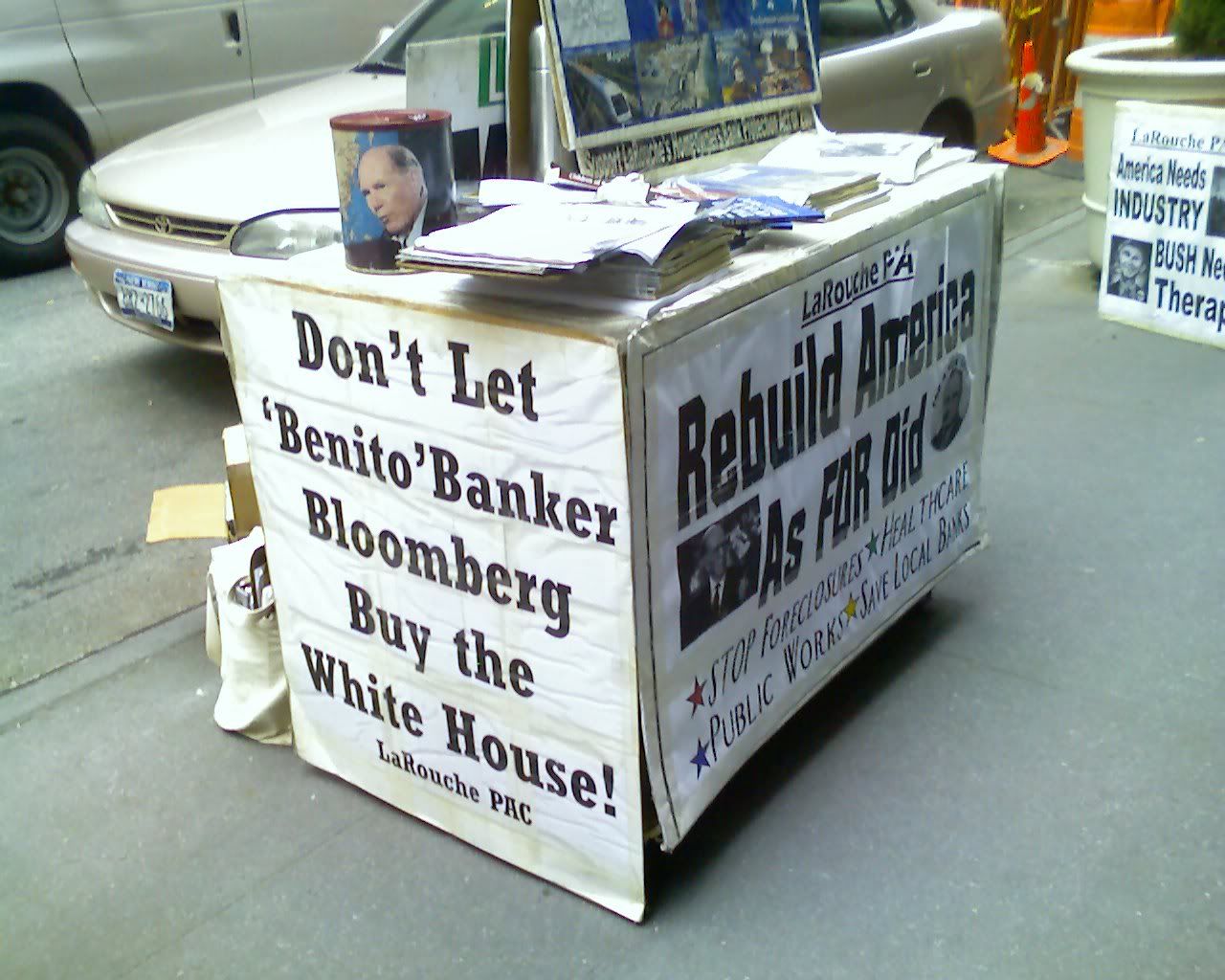
During lunch on Thursday, I took a stroll over to the one at 52nd Street and 8th Avenue. Just outside were two...Larouchers!

As usual, they had remarkably "intelligent" and "well-reasoned" signs, not to mention literature. (Ha!) It reminds me of when I encountered them outside the Great Social Security Debate between Michael Tanner and Paul Krugman.

These pictures turned out decently, considering I had only my camera cell phone.



Though this was in midtown, and not a bastion of ultra-liberalism like the Upper West Side, this was still Manhattan with plenty of anti-Bush liberals everywhere. You'd figure at least one would stop to look at the signs if nothing else, yet only one bothered to talk to the men in the five minutes I hung around, and she was already there when I started taking pictures. So think of the Larouchers' success as like the early scene in "Guys and Dolls" where Sgt. Sarah Brown fruitlessly asked passers-by for donations.
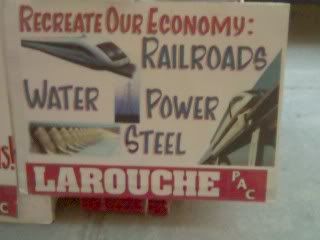


"Time to have some fun," I thought. First I asked one of them why would we want to push the American economy back to a state from decades ago, when it's clearly incompatible with the dynamics of the new world economy. The U.S. economy is no longer based on heavy industry, which is in fact a testament to its wealth: it's so advanced and efficient, a capital-rich economy, that it doesn't need to devote as much of its GDP to old-fashioned labor-intensive industries. (I discussed this topic in a previous entry, Are we becoming a service economy?)

He ignored me and went on bothering pedestrians for a half-minute of their time, which is too bad. I was ready to tear his arguments apart.

Shall the federal government "recreate" our economy by building more railroads, when the history of federally funded railroads has been atrocious? The Union Pacific, Central Pacific and other federally funded railroads eventually went bankrupt (a great reference is "The Myth of the Robber Barons" by Dr. Burt Folsom). Look at Amtrak today, constantly begging Chuck Schumer and the rest of Congress for handouts! No, heaven forfend we should ever get more Amtraks.

Shall the federal government "recreate" our economy via water power? First, water power where? Let's ignore the drier states. Here in Westchester, I live literally next to large reservoirs that supply NYC, but the nearest water source capable of generating significant power is, I believe, several hours north...in Niagara. So it's just ludicrous, especially for ones here in New York, for Larouchers to tout "water power" as a solution. Perhaps they mean the federal government can spend money building dams, which they say will generate jobs? If that's what they propose, they're wrong: as Bastiat taught us, each dollar spent by government means consumers have a dollar less to spend elsewhere. The same thing applies to building power plants: what the Larouchers are advocating is building power plants for the sake of creating jobs, not because the free market determined there's a need.

Shall the federal government "recreate" our economy by steel? How about tariffs on foreign steel? President Bush's were so successful that they cost more jobs in steel-utilizing industries than they saved in the steel industry. Or do the Larouchers want subsidies for domestic steel, though the taxes required for subsidies actually make no net difference to the consumer at best? The problem with subsidies is that the "best-case" scenario never happens: they discourage the most efficient production, meaning a net loss for society.

Since the first one wasn't interested in talking to me, I turned to the other. I asked him to explain why we should focus on heavy industry. He quickly said, "Don't you believe in eating?" Eating? Of course we all believe in eating. Ask Al Sharpton, and he'll probably tell you it's the only God-given right, whereas everything else is a "civil right."

The guy then said Americans "import most of our food." I shook my head and said, "That is simply not true!" He then replied, "Goodbye, sir." Did he realize I knew what I was talking about, that I wouldn't blindly accept his false information? So I pressed the issue: "Haven't you ever heard of the principle of comparative advantage?" I was about to explain why comparative advantage allows us to enjoy bananas, mangoes and other fruit from foreign countries, fruit which we can't grow enough of (if at all) domestically. My plan was to pin him with a question: "Why is it a crime to import food we can't grow ourselves, food that we enjoy, at affordable prices?" But he interrupted me again: "Goodbye, sir." I laughed and walked back to work.

While the U.S. does import more food than it exports, including fruit and vegetables, that is not the same as Americans having to import most of their food. This table from the U.S. Department of Agriculture shows that in 2003, Americans spent over $496 billion in 2003 for purchased food consumed at home. This is excluding food at restaurants and alcoholic beverages; I want to deal strictly with purchased food, leaving out the labor costs associated with "dining out."

Look at these trade statistics from the Bureau of Economic Analysis, tables 5 and 5a. In 2003, U.S. imports of food, feed (so we're talking animals as well as humans) and beverages (including alcohol) were roughly the same, $55 billion. Now, I'll make it even easier on the Larouchers and apply Americans' 2003 food purchases to the 2004 figures (the U.S. population has grown a little since then, obviously, and spending on food must have too). Too bad for the Larouchers: they're still wrong. In 2004, the U.S. exported $56.57 billion worth of food, feed and beverages, while importing $62.143 billion worth of food, feed and beverages. Regardless of which year's trade statistics you use, it's clear that Americans do not import most of their food.

Now let's use a bare-bones statistic from the USDA: Americans spent $709.4 billion on food grown and processed in the U.S. in 2002. After subtracting the calculated marketing costs of $577 billion, that leaves $132 billion for actual food. That still is far more than the food Americans import today. So even if we strip marketing costs from domestic food and compare it to the full price of foreign food (with all the costs of transportation and tariffs), Americans still don't "import most of our food," and the Larouchers are still wrong.

The real facts are that the U.S. exports more food than any other nation on the planet. California is especially a powerhouse of agriculture: the University of California Agricultural Issues Center released a paper in 1997 pointing out that "California exports more food and fiber than most countries, including such major exporters as Australia and Canada (1995 data)."

Even if a country imports most of the food it consumes, why is it so bad to import food in any quantity? One does not import unless the product is cheaper. If the product is cheaper, you can have more of it. Another word for that is abundance, the beautiful word that Bastiat discussed in his Economic Sophisms:
Do we not hear it said every day: "Foreigners are going to flood us with their products"? Thus, people fear abundance.

Has not M. de Saint-Cricq said: "There is overproduction"? Thus, he was afraid of abundance.

Do not the workers wreck machines? Thus, they are afraid of overproduction, or—in other words—of abundance.

Has not M. Bugeaud uttered these words: "Let bread be dear, and the farmer will be rich"? Now, bread can be dear only because it is scarce. Thus, M. Bugeaud was extolling scarcity.
"But," many will argue, "if a nation is too dependent on others for food, it would starve should its trading partners ever stop exporting food to it." But they forget that the trading partners would lose all earnings from not selling, even in the extreme case of a nation being 100% dependent on others for its food supply. Consider this: like most Americans, I am 100% dependent on others for my food supply. I do not grow my own crops, raise livestock or hunt animals, or have fruit trees that I may pick. What prevents my grocer from demanding very high prices? Because if he doesn't sell to me, he loses money on the destroyed sale. Thus selling to me is as much in his interest as it is in mine.

What if we develop a personal feud, and he refuses to sell to me at all? Then someone else can seize the opportunity for profit and sell to me. Thus Americans need not fear "dependency" on cheap goods from China (or anywhere else), because should China decide to stop selling to the U.S., many others (especially southeast Asian nations) would be happy to take China's place as a major U.S. trading partner. They'd be happy to seize the opportunity to earn money. They would likely have to sell for a little more, since had they been able to before, they'd have supplanted China. This still wouldn't lead to big shortages of goods in the U.S. or any other kind of economic disaster -- but it would be an economic disaster for China, that is, because it foolishly gave up the sale.

Wednesday, May 28, 2008

My memento of the Bear Stearns collapse

On my way from work to Grand Central, I often walk by Bear Stearns' headquarters. On the evening of last March 18th, the LaRouchers were out in force. I've kept forgetting for a long time to post this picture; click it to enlarge. All I had was my Motorola RAZR, but the picture still turned out very well.


I've previously blogged here and here about encountering LaRouchers. The one thing they did get right is opposing the bailout. But look at their insanity on these completely unrelated signs! Sadly, it isn't just ex-con Lyndon LaRouche and his followers who believe that government must "rebuild" U.S. industries. Plenty of Republicans and Democrats also believe that the government must "do something" to "revitalize" or "stimulate" the economy. They don't even differ much on which industry or industries should get "help."

But LaRouche is about the biggest nutjob of them all. He wants to revert the United States to early 20th century, if not 19th century technology. Railroads? Steel? Water power? It goes without saying, as Bastiat would remind us, that with every dollar the government takes from us to spend on industries we don't support as consumers, the rest of us in the private sector have a dollar less to spend on modern industries we do like: computers, media, airlines, etc. When we have the freedom to save and spend as we see fit, the natural outcome is that the most desired and/or most efficient goods and services will survive.

Labels: , , , ,

Wednesday, March 16, 2005

The great Social Security debate, part one

Update: please see part 1a, where I talk about getting Krugman's autograph! This was too good to wait until tomorrow.

Another update: part 2, where I detail the debate itself.

Update, 3/24/2005: NYSEC corrected at least two things in their transcript, without mentioning that they did so.


I didn't get back home to Westchester until pretty late. The cab ride back to Grand Central was quick, but my train didn't leave for another half-hour, and it wasn't an express. Now after a bit to eat and resting for a while with Glenmorangie (my favorite Scotch), I'm making this first entry. Tomorrow I'll talk more substantially about the debate.

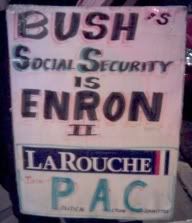
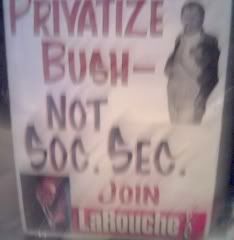
After crossing the street from Central Park, I knew I'd found the building. I was immediately accosted (no exaggeration, they were practically right in my face from the start) by people asking if I wanted to "help save Social Security." You have to see their signs to believe they're real:


(If the pictures didn't show before, they should now. If not, please try clearing your browser cache and then refresh this page.)

The first picture is ok, but I apologize for the blur in the second. All I had was my camera phone (a mere 1.2 megapixels), but you can at least see the gist of the signs. The second one shows Bush in an old-fashioned outfit that I didn't recognize offhand, so I asked, "King George?" The person replied, "Napoleon."

These people are from the Lyndon LaRouche Political Action Committee, which claims to be "not authorized by any candidate or candidate's committee." Obviously, though, they're Democrats. Go to Political Moneyline and check out the LaRouche PAC's expenditures: they're like a Mini-Me Soros who spent (wasted) untold sums last year against Bush's campaign, and they've even spent money for anti-Tom DeLay bumper stickers? Actually, they're worse than Democrats. Certainly not all Democrats are statists, but every one of these LaRouchers was definitely a statist.

My bull**** detector went off once I saw this on the back of a "brochure" (if you can call it that): "MOBILIZE AMERICA to defend Social Security -- defend America's Constitutional commitment to the General Welfare." What rubbish! It reminds me of a political science professor I once had. For a Ph.D. in history, she surely knew damned little about Constitutional law. She actually had the ignorance to claim, right there in class, "The Constitution gives Congress the power to tax and spend to promote the general welfare."

You know what I find ironic? These LaRouchers compare Bush to Napoleon and Pinochet, and George Schultz to Hitler and fascists. Yet LaRouche has a LaRouche Youth Movement. It's right there on the website; that's their name for it. Now who's more like Hitler? Call me a "digital brown shirt" for liking Bush, but what about these indoctrinated youth? Few of them probably know nothing substantial about any of the issues, except for the lines that parents, teachers and mentors have taught them to parrot.

For those unfamiliar with Friedrich Hayek, do yourself a favor and pick up a copy of The Road to Serfdom. I mean that literally, as it's one of the most wonderful books ever written. Pay particular attention to chapter 10, "Why the Worst Get on Top": Hayek explained how dictators come to power by manipulating the gullible, especially the young. Now take a look at the very name of the LaRouche Youth Movement. I rest my case.

All you need to know about LaRouche's politics you can glean from this speech, where he spouted horse**** like, "Roosevelt saved the United States from becoming fascist. The United States would have become fascist in the middle of the 1930s, but for Franklin Roosevelt's election, and the actions he took, beginning the day he entered office in March of 1933." That is unequivocally a lie or pure ignorance of history and politics. Roosevelt was a statist who succeeded another statist. It doesn't matter if you call it fascism, where you think you own private property but the state effectively owns it by exercising full control, and socialism, where the state admits it owns it all. Statism is statism.

Then LaRouche bragged about what he claims is an upcoming global crisis, "And I had to stop it. I had to be the equivalent of Franklin Roosevelt. Because there was nobody else in a leading position in the United States, or otherwise, who was qualified to do what I had to do." Gee, what modesty! What was that again, what Hayek wrote about individuals having only imperfect knowledge, that total knowledge is dispersed throughout society? In other words, no one person knows it all. Until now! Now we have a self-prophesied, self-annointed political Messiah in Lyndon LaRouche! Forgive me if I spit in disgust at that thought.

Oh, and LaRouche also said in the same speech, "Therefore, I was ruthless, as ruthless as required, and as ruthless toward myself, as toward others around me, and toward the Democratic Party and its leadership, and other relevant institutions..." I don't recall that Hayek specifically said in The Road to Serfdom that a dictator must have megalomania, which LaRouche certainly has. Hayek did say, though, that dictators must have a comparative advantage in ruthlessness, among other things.

All right, enough about the wackos and their fearless leader. I found the debate itself was overall...unconstructive. It reminds me of a Star Trek line, "We could talk all night and not convince each other." Social Security is just one of those issues. Tanner, Krugman and Marshall were all excellent and put forth great arguments, except that Krugman more than once used bad analogies. It was the same rhetoric we've heard all along, though. For example, I sent Donald Luskin a link the other day that I stumbled across. This article is from the November-December 1996 Mother Jones magazine, and though Krugman hadn't yet come on the scene, the article had Michael Tanner and Cato, the Economic Policy Institute, AARP, Chile as an example of privatization, and all the same rhetoric we hear today. In that article, Michael Tanner warned that there's really no trust fund, others said the trust fund will grow to nearly $3 trillion by 2018, and the EPI warned that investing fees are more expensive for low-income workers.

I sigh because over these last eight years, very little about the Social Security debate is really new information. We still know the "trust fund" will have to be dipped into starting in 2018, but Cato is still repeating the warning that the "trust fund" was invested in Treasury bonds, so they'll have to be redeemed either by higher taxes or unchanged taxes with spending cuts. We had eight years to start doing something, and our leaders blew it. I'll cut Bush a little slack, because he's had a lot of foreign policy to keep him busy. But what was Clinton's excuse in the late 1990s, when the U.S. economy was sizzling? He should have taken real leadership, even if it was to continue Social Security as it is. But he didn't, partly because he was too "occupied" in the Oval Office, if you know what I mean.

Back to the debate itself. The crowd at NYSEC, for the most part, was a bunch of liberals who, judging by when they cheered and applauded, wanted to preserve Social Security's status quo. I saw a lot of elderly, no doubt senior citizens who believe Democrats' lie that Social Security privatization means a cut in current retirees' benefits. There were also a lot of young people, and I had this feeling they were all so well indoctrinated in liberal statism, that they were there to hear why Social Security should remain as it is. The segment of society I didn't see many of: people in their 30s, 40s and 50s, i.e. the ones with the most to gain by Social Security privatization, and the most to lose when the "trust fund" must be redeemed by higher taxes.

The moderator, being from NYSEC, was completely liberal and not very good at all. Some, like me, had reservations about Bob Schieffer moderating that Bush-Kerry debate; in the end, I thought he did excellently. For crying out loud, though, this "Vered Mallon" was just pathetic. It was bad enough that her introduction did little more than extol the virtues of this liberal NYSEC organization: they want a "kinder, just world," "civil rights" and "women's reproductive rights." She said, "We are a community of faith -- our faith is in people," and added that they want to "pursue justice for everyone." Her bias was so evident that you couldn't have done worse asking Dan Rather to moderate during the 2004 presidential election debates. She gave credit to Democracy Now, The Nation and Democrats.com for supporting the debate. She even called them "vital organizations" -- what more evidence does one need of her and NYSEC's bias?

She mentioned that next month they're doing some event about Wal-Mart, no doubt bashing it. Geez. But I knew I was really in for it when she introduced Michael Tanner as from "Cato, a conservative think tank." I scribbled that in my notebook so furiously that the tip of my pen almost sliced through the page (I love the Uni-ball Signo RTs with the ultra-fine .38 mm tip). I was pleasantly relieved when Tanner got up to do his introduction, declaring that Cato is libertarian, not conservative.

Each of the three panelists was allowed five minutes for an introduction and summary of their positions. Krugman had an inscrutable look as the moderator babbled on, and his expression didn't change as Tanner got up for his intro. Krugman kept writing something and gave only a couple of claps of polite applause, which was really rude.

It's getting late, so may my readers forgive me that I need to call it a night. Tomorrow I'll talk about what was said in the debate. What I'll conclude with tonight is the completely bogus Abraham Lincoln quote that Mallon referred to, and several times.

She claimed that Abraham Lincoln said, "Government should do for people what they cannot do for themselves," and that "Public good transcends private interest."

I'm no Lincoln scholar, but I like to think I know my history more than the average person. I cannot find any source for either of these alleged Lincoln quotes, and until someone points me to one, I dismiss Mallon as fabricating a LIE or just citing an urban legend. Google the first, and you find a lot of leftist websites saying, "I believe, as Lincoln did, that..." Nothing, however, points to where Lincoln ever said such thing. I think I'll e-mail Thomas DiLorenzo. If anyone on the planet would know the veracity of those quotes, he would.

The closest thing I can think of: Adam Smith in Wealth of Nations did say certain public works must be the responsibility of the government, but only because their size means no single person can afford them. With things like Social Security, why can't an individual person save for his or her own retirement? I was pleased that Michael Tanner made this point in the debate, but he should have gone further:

Why must the central government make others' retirement contingent on your current payroll taxes, and later make your retirement contingent on the next generation's payroll taxes?

Labels: , , ,

Thursday, May 22, 2008

T.R. Raymond, welcome to the 19th century

Your morons for today:
High gas prices drive farmer to switch to mules

MCMINNVILLE, Tenn. (AP) — High gas prices have driven a Warren County farmer and his sons to hitch a tractor rake to a pair of mules to gather hay from their fields. T.R. Raymond bought Dolly and Molly at the Dixon mule sale last year. Son Danny Raymond trained them and also modified the tractor rake so the mules could pull it.

T.R. Raymond says the mules are slower than a petroleum-powered tractor, but there are benefits.

"This fuel's so high, you can't afford it," he said. "We can feed these mules cheaper than we can buy fuel. That's the truth."

And Danny Raymond says he just likes using the mules around the farm.

"We've been using them quite a bit," he said.

Brother Robert Raymond added, "It's the way of the future."
I'm not saying the mules aren't better for the Raymonds' purposes, which apparently is just collecting hay, but do you hear his damn fool brother who thinks this is the "future"? And you thought the jackass was the one pulling the rake. I wouldn't be this critical if he hadn't made such an absurd comment. So what he's saying is that the future of mankind is regressing to famine and want, though we've had two centuries of the Industrial Revolution (the single reason the ordinary man could finally produce enough so he finally had a chance against nature). The future is that developed nations will devolve one hundred years, back to worrying about animal excretion contaminating our agriculture?

Again, I'm not arguing the mules aren't better for what the Raymonds need. Fundamentally, it's their right to spend their time as they see fit, and they've decided they don't mind spending more of their time plowing. I just hope it's purely on their dime, but odds are it won't be. I wouldn't doubt they'll someday soon get a nice fat check from the federal government, paid for by the rest of us. If it's not from the upcoming bloated "farm bill" presently debated, it'll be a special "farmers assistance in the face of high fuel prices" fund.

If the future of American farming is the Raymonds' example, then American farmers will clearly plow and harvest less. Therefore, food prices will go up even more, and the U.S. will have less food for ourselves as well as for exporting to the rest of the world. Remember that the U.S. is the world's biggest food exporter, no matter what those idiotic Larouchers think. So surging food prices and global starvation are what the brother thinks is the "future"?

For those whose livelihood depends on harvesting as much as possible, animal power is not the "future." It's been and always will be industrialization. Why do people fear it? Go out to the Philippines' provinces to observe the cost-effectiveness of "cheap" animal labor, the very kind that the Raymonds seem to cherish now. I can't imagine a single Filipino farmer alive who has just a carabao or two, which he uses to work fields often in desperate hope this season will be enough to feed his family, and wishes he had a John Deere. If he can work more land, there's a certain point where his extra earnings will pay for the tractor, and anything else is higher income. When he has more income, his family can live in a better house with running water and a sanitation system. His children can finish school, instead of dropping out at 7 years old to work alongside the parents. That is the future.

Last October, on the four-hour drive from Caticlan to Iloilo (opposite points on Panay Island), I remarked on some farmers we passed by, and my mother-in-law and I talked about the difference between Philippine and American agriculture. In some ways the scenery was reminiscent of parts of Sonoma County, where my best friend lives, but I knew the fields were hardly the same. The typical Filipino farmer toils in the heat of the sun, then carries the harvest by hand. The typical American farmer can drive not just mere machinery, but air-conditioned machinery. In the Philippines, half of the population (some say 40%) works in agriculture. It's not enough to feed the country: the Philippines for a long time has had to import sugar, and as a nation it's become the world's biggest importer of rice. In the United States, only about one percent of workers are in agriculture. Think about it: a mere one out of every hundred American workers is enough not just to feed the country, but the rest of the world too. That's the difference between industrialization we have here, and the "animal power" the Raymonds extol.

Saturday, December 10, 2005

Price-setting and illegal immigration

(Don't miss the follow-up entry, "When conservatives don't get it about illegal immigration.")

The labor theory of value, theorized by Adam Smith, David Ricardo and Karl Marx, states that an item's value is based on its cost of production. Hence, the selling price of an item is based on the cost of creating it.

The theory of subjective value, however, counters that the selling price is only what the buyer believes it is worth. While Adam Smith said that diamonds are more expensive than water because diamonds cost more to produce, subjective value explains it is simply because people value diamonds more. Subjective value also explains why, if someone has many carats of diamonds but no water, one will be happy to trade a great value of diamonds in return for a relatively small amount of water (and at a ratio people would usually consider "unreasonable").

Still, the costs of production are a factor. A business will not continue operating if marginal revenue (profit margins) falls below marginal costs, so when it incurs increased costs (not just from supply and demand with raw materials and wholesale costs, but taxation too), then it must pass the increased costs onto its customers in the form of higher prices. Perhaps marginal revenues are still positive after falling, but if they are too low, they may no longer be enough for the business to bother with its current inventory; it could make more by offering something else. In both situations, if customers are unwilling to pay the higher prices, they will simply not have the product.

This should seem axiomatic and evident, yet many Americans consumers don't recognize it when it happens in real life. A week ago, McQ at QandO noted that, thanks to the crackdown on illegal immigration, California and Arizona farmers can't hire enough people to pick their crops. Regular Americans won't take the jobs, even though the farmers have offered $8.50 per hour. McQ said, "I promise, the right wage will work. Two problems with that a) farmers don't want to pay it and b) consumers don't want to pay for the added cost. And there might be a (c) as well ... imported produce doesn't have the high labor cost that produce in the US has."

Before discussing a) and b), I'd like to promote an entry I made on the subject of c). Last August, I confronted a couple of Larouchers who were outside a midtown Manhattan post office. They were passing out fliers, hawking books and promoting their socialist agenda to anyone passing by. When one of them claimed the U.S. imports most of its own food, I called him on it. It's simply wrong, but as I explained in my entry detailing the encounter, it's not a bad thing for the U.S. to import food, either.

Now, it's not that the California and Arizona farmers don't "want" to pay higher wages. They can't, not if they want to stay solvent. They would be perfectly willing to pay higher wages if it meant attracting enough workers to stay in business, and if they could continue to sell enough strawberries to stay in business. Reality sets in when we see how true McQ's b) is. If the farmers paid Americans what the latter demanded in pay, the farmers must charge higher prices to continue with the same profit margins, and the produce would become too expensive to retain as much of its customer base. The reduced sales volume might force strawberry producers to raise their prices even higher to cover certain fixed costs (which because of reduced sales would become a greater percentage of total business expenses).

Just how much sales fall depends on the individual products' elasticity (demand's responsiveness to price changes). Take strawberries as an example. Some people would continue buying strawberries as they did before; some would cut back but still buy some; others would no longer buy any strawberries. I myself buy strawberries infrequently, and I just realized I can't explain why, or tell you when I last bought some. Even if they rose to $3 or $4 per pound instead of the usual $2 at my local grocer, I would probably still be in the first group.

So, out the window goes the claim of many conservatives, that illegal immigrants take jobs away from Americans. On the contrary, this shows that illegal immigrants -- the ones who come here with perfectly peaceful intentions of hard, honest work and not harming others -- do take many meneal jobs that few, if any, Americans will. These jobs are available, but Americans today don't want them, even at $8.50 per hour. Americans have such high opportunity costs today that it's not worth their while to pick berries. They would have seventy years ago. Steinbeck's The Grapes of Wrath was fiction but certainly accurate in its depiction of Americans traveling to California from Oklahoma and other parts of the Midwest, searching for any kind of work. Because they had low opportunity costs, there was an abundant labor supply, and thus low wages, for tiring work.

As I explained in my entry on the politics and economics of illegal immigration, I am very open on immigration. I support the ability of people to come into our country and become part of the workforce, but I also believe we need to register them as a matter of pure national defense. It's not just Tom Clancy fiction that Islamic terrorists are trying to sneak in through our border with Mexico, which is why I disagree with Don Boudreaux, who supports fully free immigration. He recently criticized the Minutemen, some of whom probably irrationally fear immigrants as a threat to American labor.

The Minutemen are a two-edged sword. Are they restricting the flow of cheap immigrant labor that makes it possible for us to enjoy cheap and abundant? Unquestionably, but if we make immigration easy (which does not require it being unrestricted) for honest people who simply want to work, then the Minutemen would become irrelevant insofar as the immigrant labor that keeps our produce affordable. On the other hand, they would still be valuable for the other two services they also provide: spotting violent criminals (especially drug traffickers that more than a few times have turned some border towns into shooting galleries) and defending private land from trespassers. Last August, I was one of an apparent few to note illegal immigrants trespassing on someone's ranch and eventually winning the ranch in a court ruling. It was private land. The immigrants had no right to be on it.

If illegal immigrants become legitimate workers, will they demand higher wages? Certainly. They would not have to take any old job picking fruit, afraid of being caught and deported. However, I doubt they would get more than minimum wage, certainly not $8.50 per hour. Their opportunity costs would still not be very high, because their job opportunities elsewhere would still not be that great. There would still be a language barrier, making it difficult for those who cannot speak conversational English (let alone those who are uneducated and lack special skills) to get more than minimum wage jobs in fast food or cleaning services, and there are only so many of those jobs to go around. Also, making it easier for immigrants to achieve "legitimate" status would encourage more to come to El Norte. I can foresee a tremendous supply, perhaps an oversupply, of cheap labor for our most meneal jobs, especially because the alternatives in their home country are generally deep poverty and no rule of law.

Why should we not want to welcome people who are simply seeking honest work? What should it matter that they will send much of their money to their home countries? As we've seen, they don't really take jobs away from Americans, and as a matter of economics, it's no more relevant what they do with their savings or consumption spending than what I do with mine. The dollars they export must return to us in one form or another, and in addition to the cheap agricultural products they help supply, their own consumption spending is very much a part of our economy.

There are valid concerns about our welfare state luring illegal immigrants, to which I have always had a simple answer. If we abolished our welfare state, for everyone and not just immigrants, then the only people who would want to come here are honest workers and criminals. And we can deal with the criminals. If we set harsh penalties for the crimes they commit, penalties that they deserve, they will think twice about coming. Execute them for murder. For other crimes, throw them in jail for 10, 20, or 30 years, as befits the severity of the crime, then deport them. With a free-but-regulated immigration system, they'll not bother going through checkpoints, so if we manage to catch someone at the border, we'll have a pretty good idea that he's up to no good. If criminals return and are caught again, if their previous crime was a felony, send them back to prison for life -- real life, with no parole and no deportation. Let's stop the Dukakis-like "catch and release" games.

On a side note: I've mentioned being born overseas in the Philippines and not coming to the U.S. until I was seven years old. In case anyone was wondering: I was born a U.S. citizen, not naturalized. I would not trade it for any other citizenship.

Labels:

Sunday, December 04, 2005

Comparative advantage and Americans' wealth

This AP article "Americans Let Contractors Do Decorating" is a beautiful example of comparative advantage:
PORTLAND, Maine - The last thing John Gendron wants to do during the holidays is climb high on his steep-pitched roof to hang a wreath from his chimney. These days, he doesn't have to. Instead, he hires a contractor to put one wreath on his chimney and two others high on the house, and to hang Christmas lights on his home and in the crabapple trees in his front yard.

Tens of thousands of Americans this year will do the same.

Short on time, leery of ladders and lacking expertise for sometimes-elaborate lighting displays, homeowners are opening their wallets and hiring others do the work....

"These people are professionals at what they do, much like we're professionals at what we do," said Gendron, who owns a commercial real estate firm. "We're not able to do what they do as well as they can do it." ...

Customers include working couples who have little spare time and older folks who don't want to climb ladders, said Chuck Cotton of Lucas Tree. Others don't have the skills or the equipment needed to put up intricate displays.

"It's more a convenience than anything," he said. "They don't have the time or the ability to do some of the things that we can do." ...

Hiring people to hang lights was once considered something only the wealthy could afford.

But with the cost of lights going down and companies able to install them in an efficient manner, the jobs are no longer reserved just for the rich, said Virginia Postrel, author of "The Substance of Style," a book that examines the link between aesthetic pleasures and American commerce and culture.

Many people who hire contractors to install Christmas decorations could be described as upper-middle class who simply want nice-looking holiday displays, she said.

"Their time is worth more than their money," Postrel said. "And if you don't have a giant mansion, it's not that expensive of a job." ...

"They don't mow their lawn, they don't do their landscaping, they don't paint their houses," he said of the typical customers. "And they don't put up Christmas lights."

Besides giving homeowners a way to brighten up their homes, the Christmas decoration industry gives local seasonal businesses such as landscapers and tree trimmers a way to make a few extra bucks during a slow time of the year.

"Once the growing season ends, business drops off," said Cotton, of Lucas Tree. "This picks us up during the holiday season."

As the companies become more efficient in installing lights and decorations, prices will continue to come down so that even more people can afford the luxury, Postrel said....
What a wonderful illustration of a concept that affects every person's life. Comparative advantage is not just about hiring someone who can do something better than you can. It's about hiring someone to free up your time so you can perform another task of greater value, even if you could do something better than someone else. I'll refer again to the Bob Villa example that my undergradate microeconomics professor Dr. Ikeda still uses: Bob Villa can probably retile his roof better than anyone he hires, but if he does it himself, he won't be able to write another book and make another million dollars.

Ms. Postrel no doubt had a good economics teacher once upon a time. What she said fits perfectly with what I wrote yesterday on capitalism, the wealth it propagates, and how even the poor eventually have things that were once considered just for "the rich." I additionally emphasized the importance of new entrants into that particular market:
But it is never government that promotes real technological advancement, no matter how much it pours into subsidies. It is capitalism, the wealth it created, and the further increases in wealth that a capitalist economy promoted. There is much technology that, when new, was so expensive that only "the rich" could afford it at first. Once upon a time, any indoor plumbing was a luxury, let alone the ability to choose between hot and cold water. The high prices worked as they should have, encouraging others to supply such goods. As new market entrants sought to compete, the successful ones improved the technology of production by making it cheaper and more efficient, driving down the prices for the consumer.
Isn't it a wonderful country that not just the wealthy, but even some of the middle class, are wealthy enough, and have jobs of such economic value, that they can hire people to decorate their homes? Similarly, I have come to give thanks that modern America is so wealthy and produces so much food, not always of the best nutrition but certainly high in caloric energy, that we actually worry now about some of our poor being overweight -- and contrary to what the Larouchers claim, the U.S. is the world's largest exporter of food, and hardly a net importer.

But if you listen to people like John Frank, "the wealthy" should be taxed heavily so they cannot "overconsume." And just who is "wealthy"? With the Federal Reserve engineering inflation year after year, set-in-stone definitions of "wealthy" like the Alternative Minimum Tax fall increasingly upon the middle class. Moreover, people like Frank don't want you to have the freedom to choose. They want higher taxes on "the rich" supposedly for "public investment" so you don't have to choose what goods and services to produce for others, and what goods and services to buy. When will we learn from the last several decades that the myriad forms of "public investment," i.e. government spending on social programs, is inherently wasteful?

The reality of taxes is that they discourage everyone from producing more, even if they fall primarily on the rich: the rich because they're taxed, and everyone else because they can expect the state to redistribute wealth. Oh yes, everyone will be more "equal," but also more poor than before. In John Frank and Paul Krugman's conception of socialist Utopia (a somewhat redundant coupling there), there would be no "rich" to hire people, using the article's example, to decorate their houses for Christmas. That necessarily means no one would supply that service, and in turn the light bulbs and plastic components to make the lights. Hiring Christmas decorators would always be something only "the rich" could afford, if they could afford it at all, and assuming people bothered to supply it (since non-"rich" could expect the state to play Robin Hood). Worse, there would be no wealth from "the rich" that, in a free market society, does indeed "trickle down" to everyone else.

Sunday, August 19, 2007

Are liberals like Joseph Tutton always so weak-minded?

My friend and blogfather Don Luskin forwarded me an e-mail from some Tutton guy whose e-mails to me kept getting bounced. I couldn't have remembered for the life of me who this Tutton guy is, but he e-mailed Don a while back, and Don and I separately countered his China-bashing.
My Dear Mr. Luskin:

I hate to ask a favor, but I will -- would you please forward this to Eidelblogger. Sending to his address listed on his web site has given me a Postmaster message that it is permantly disabled. The address I sent it to was eidelblog@gmail.com.

Since he gave me the extreme insult of calling me a "liberal", for God's sake, I thought I must respond. I sent a copy to you, but Postmaster said it wasn't delivered to him. So, if you can, send it to is new address, if you have it. And, if you can't find an address for the loser, I would ask you to think about posting this reply on your site, so he might read it.

Peace (through strength), Joseph Tutton
Ah, my fault there. When I redid some colors for my blog a while back, I created an image file with "eidelblog" rather than "eidelbus" as I should have. Seriously, are liberals like Tutton really that clueless that they think I did that deliberately, so I couldn't be e-mailed? The simple truth of the matter is, and I say this almost with a blush, I didn't notice my mistake until now. Even when my friend jk said his e-mail to me bounced, I thought he had mistyped the address. I use an image file, not text, and it's not "mailto:" hyperlinked, to prevent spam.

And if all else fails, which jk figured, leave a comment so I can initiate an e-mail conversation. I require registration for comments, however. which helps cut down on spamIt's mainly because of spammers, but also anonymous NYPD cowards who were inundating me with the most vulgar things you ever read.

On a side note, I never did register eidelblog@gmail.com, and I figured I had better in case someone decides to start impersonating me. Curiously enough, Google says that "eidelblog" is unavailable, and a message just now got bounced back. So the ID isn't in use, but it can't be used for a new account: it truly is disabled. That's a nice touch for which I'll give Google a lot of credit, preventing a certain ID from being registered on Gmail because it's presumably the same as an existing ID on Blogger.

Well, here's the e-mail that Ranting Liberal Tutton wanted to send me. I think he's been breathing too many coal mine fumes, don't you think?
Meiner Lieber Eidelblogger:

"I make no value judgment either way..."

I did not see your "enlightened" response to my e-mail to Don Luskin when it first came out. But let me now express my appreciation to you for articulating the ueber Kapitolistischer
Is he trying to impress me or something, throwing in German words just because I call myself "Eidelblogger"? I don't speak more than a few words of German, if you can call that speaking. My father may have been half-German, but he was raised by his French mother and aunt and thus learned a bit of their ancestral tongue.

Tutton really presumes too much. I used to call myself "The Eidelblogger" simply as an English neologism, until Jack Yoest referred to me as "Der Eidelblogger." I liked the sound of it and changed my blog's masthead as appropriate.
opinion that it is indeed, not only acceptible, but good, to have children working in coal mines and other dangerous manufacturing scenarios. Man, I could not have asked for a better response.
In fact, I never said any such thing, and I wonder if it's Tutton's rabid paranoia at being called a "liberal" that prompted him to put words into my mouth.

What I originally said was here, and I've also blogged about child labor. I was perfect correct, not to mention truthful, in saying I make no value judgments either way. What I do observe is that some societies are so poor that adults alone cannot produce sufficient economic output to feed the family, so there is no choice but to have children participate. Throughout human history, it's been everything from herding sheep to farm chores to digging. In some developing countries today, it's making clothes and semiconductors. Nobody wants to see children, because it's the ideal that they can go to school and grow up happy, but no matter how much Tutton sticks his head in the sand, we can't avoid the reality that certain poor societies just can't afford to have only adults working. When two parents can't grow enough crops by themselves, or tend enough animals by themselves, to support several children. Poorer families already tend to be larger, and consider that more children in the Third World are reaching adulthood thanks to vaccinations and sanitation.

My father, not even a teenager, could work to support his family during the Great Depression. How will Tutton explain that his beliefs applied in the 1930s would have condemned my father to literal starvation? It's just another way that modern liberalism insists on saving you from saving yourself, even if it kills you.

It wasn't government that stopped child labor. No matter what people want government to do, government cannot make people produce more than they are already capable, no more than it can decree water to be less wet. The reason, the only reason, that the United States and developed countries don't have child labor is that we don't need it, thanks to technology. Parents in the United States generally can earn enough to feed their families. Parents in Zimbabwe generally cannot, and if a child has an opportunity to work somewhere to earn money so the family can afford to eat, the logical choice is not to send the child to school.
But, you were mistaken in saying that I am a "Liberal". I was cured of that disease a long time ago. I am a Nationalist. But, Gott sei' dank', I am not a Socialist.
Is he capitalizing words, thinking he's speaking German? Regardless, one can be a nationalist (big or small N) and still a liberal. Larouchers are liberal, but they're as "nationalist" as any classic fascist. On the other end of the political spectrum, one can be a nationalist and still a socialist, just like Lenin and all his successors.

Liberals believe in government control of the economy, but maybe Tutton really isn't. I'm starting to wonder, especially with all the German words he's throwing around and now his self-professed "nationalist" ideology, if he's a modern Nazi a la Pat Buchanan.
What is your excuse for wanting children in the mines? Whose kinder, sag' mir?
Once more, I never said I wanted children in the mines. In an ideal world, not even adults would have to work in such dangerous places.
In Tennessee, as well as Kentucky, Virginia, Pennsylvania, und alles, the whites from Scotland and Germany, Czech und Poland worked along side the black Schwarzeneggers in the god-awful hells of the coal mines of Appalachia. East Tennessee fought for the Union of this Country. Not for any goddamned union organization. If you had any idea of how many people died for indiv idual freedom, you would be slower to accuse someone of being a "liberal" because they oppose slave labor in China. But thanks for expressing the slave-owner mentality so well. N'mie wieder, liebchen. Versteche'?
Talk about your non sequiturs! Two different ethnic groups worked together, half of Tennessee aligned with the North during the Civil War instead of fighting for unions, people died for what they mistakenly thought was "individual freedom" (the Civil War was not fought over freedom, but over the federal government's authority), and ergo, Tutton says, I'm like a slave owner because I recognize some societies are really poor and need children to pitch in.

Tutton has a warped notion of "individual freedom," which he tacitly defines as what meets the limits of his acceptance. True "individual freedom" is my right to transact peacefully with another willing party, harming no others, no matter what Tutton or others say. This is whether I'm running an energy company that ships coal from Tennessee to Tallahassee, or buying goods that were made in a factory in Shanghai. Don has always been right to emphasize that we can't defend the ideals of liberty by pointing out that they're more economically efficient: our defense must be on the grounds that they are the moral choice.

Liberals would say that "moral" is to have laws preventing children from working. No, that's fantasy. "Moral" is not preventing children from picking up a shovel or scythe to help feed their families.

Labels:

Saturday, August 27, 2005

What to do about the price of oil?

Capital Freedom had some very insightful observations on Hawaii's dangerous price controls on gasoline, including, "I should hope that the shortages of the 70s are recent enough for most politicians to remember." Sadly, in a specific example of George Santayana's truism, history is replete with politicians who never learn from past mistakes (theirs or predecessors'). Condemned to repeat them, they typically have the people's support. Capital Freedom noted a week ago that most history books today are terrible at explaining the full sides of political and social issues. New generations grow up supporting politicians in bad policies that "sound good," unaware that such policies have failed disastrously -- sometimes only a few decades ago.

Einstein reputedly said, "Insanity is doing the same thing over and over, expecting different results." What can our leaders be but out of their minds when they resurrect such failed policies?

OPEC's initial embargo predated me by a couple of years, and my father had no personal experience about the embargo's effects on the U.S. that he could impart to me. (I was born overseas during his business sojourn in the Philippines, and our family didn't move to the U.S. until 1983.) So like most American schoolchildren, I learned about the 1970s oil crisis from schoolbooks. While they mentioned a few facts and threw in pictures of cars lined up at pumps, I never learned the full, true story until studying microeconomics. The embargo produced higher oil and gasoline prices, that much is true. However, oil's scarcity was not the crisis. The crisis was its shortage, caused by Nixon's wage-price controls.

It's important to note that a "shortage" in economics is not simply scarcity (defined as when a resource is both limited and wanted). Velocity in physics requires both speed and direction, and similarly a true shortage is insufficient product to satisfy all who want to buy it at a certain price. In the free market, the price for a scarce resource is bid up to an equilibrium point where supply perfectly matches demand. The price system may not eliminate scarcity, but it will eliminate shortages. A scarce resource must be expensive, to discourage people from using it unless, to the supplier, it's worth their own resources that they can and wish to trade for it. Meanwhile the higher prices will encourage both old and new suppliers to produce more, or seek out substitutes that were previously too expensive to be worthwhile.

It may seem mere semantics, but the difference is critical. When a high price discourages people from looking for something unless they really value it, that greatly minimizes the time that society wastes in looking. Remember, you incur search costs whether or not you are successful in finding and buying it. Consider filet mignon. At $10 per pound, not as many people will buy it as when government sets a maximum price of, say, $8. More people will want it at $8 than $10, but supplies will become even more limited because some suppliers may well leave the business, since this venture is not as competitive in profits as others.

The same principle applies to oil. The federal government could claim to "help people" by setting a maximum price of $2 per gallon of 87 octane gasoline, but like the attempts in the 1970s, that would do nothing to check the consumption of oil, and we'd wind up with shortages. Worse, there would be no encouragement for suppliers to find new oil fields. Perhaps the produced gasoline might have to be sold at $2.20 per gallon to make the same profit, but many people would still consider that worthwhile. In fact, many people still consider it worth paying the current nationwide average of $2.583 per gallon of regular; if they didn't, they wouldn't be paying it. It leads to CF's excellent point about what price controls do: "They do not allow bargaining between consumers and suppliers to negotiate a mutually beneficial exchange in which the consumer does not waste his time in line and the producer may profit. Such bargaining, even though both parties benefit, is illegal in a price control system."

Then there's what most of my fellow gentlemen and I have cursed as the worst form of alleged price gouging: the price of roses leading up to Valentine's Day. But for the reasons above, we can't really complain, especially in terms of minimizing search costs. Higher prices prevent someone from buying out a store's stock of roses because they're only $10 per dozen, when the rest of us would have gladly paid more. I've done my duty and have spent well over $100 for an arrangement of a dozen roses, because at the time I thought they (and she) were worth it. This year I got off fairly easily.

Most Americans today are unfortunately unaware of such basic microeconomics. I customarily read the New York Post when taking the train home from Manhattan. Some of the letters yesterday just dismayed me (they're available online here):
Instead of punishing American SUV owners further with $3 gas, why not cut off the billions in foreign aid to oil-producing nations ("Feds: Plan Will Pump Up Mileage," Aug. 24)?

Also, how about raising the price of our wheat and other food products?

Then watch how fast the price of oil drops.
Evidently the letter writer is an SUV owner or sympathizer, who's unwilling to pay more for a resource that others value more highly. While eliminating foreign aid is not a bad idea, his second is more than questionable. So we must threaten other nations, who will then retaliate themselves? Or if they do pay higher prices, remember that their income is finite, so they must cut back on other purchases; in the end it's only a shift in consumption. (See my entry on the yuan revaluation for a description of the "death spiral" of protectionism.)
I find it so typical of our society that we do little or nothing about matters that affect us so profoundly, such as the weekly increase of gas prices.

If this were any other product — hamburgers, newspapers, movie tickets — our politicians would be on the front page of every newspaper addressing this problem.

Why is the constant price increase being disregarded?
While it's true the price of oil affects all Americans in one way or another, I wonder what planet he lives on. Oil prices for a long while now have been a dominant subject in every major news source. What's clear is that the politicians cannot "address" higher oil prices except by trying not to address them. They couldn't in the 1970s, so what makes us think they can now?
People need to stop crying about these high gas prices.

We live in a weak, modern-day America, an America that spends $60,000 on SUVs and then pouts about the $100 it takes to fill up the gas tank.

We need gas, and Americans need to prioritize.

The price of gas may be an infringement on the luxuries we have and want, but they are only luxuries.

Get your priorities straight, and stop crying about gas prices.
This is an eminently sensible letter from someone who obviously has a firm grip on reality.
There is a simple way to reduce fuel consumption and demand — and maybe even impact prices at the pump.

Slow down a bit.

America's security, like charity, begins at home.

Saving money is good.

Being safe is even better.

Driving slower can achieve both.
It's a very good point, but some people do value time more than gasoline. Driving 80 mph will certainly burn a great deal more fuel than driving at 60 mph. However, some people accept that as worth arriving in three-fourths of the time (depending on the distance, of course).
Readers attack oil companies for record profits, but how much of those profits are subject to federal and state corporate income taxes?

It's a large percentage.

Figures should be published to document this new revenue that's flowing into the treasuries across the country.

We'd be better off paying $100 per barrel while having the price supported by legislation. In a few years, we will be producing most of our own oil. The dollars will stay here, and the filth that is the membership of OPEC will be bankrupt.
Oh good heavens. Does this fellow not understand that if government taxes him less, he will be free to spend (and more efficiently) that money? Or can he promote such an absurd idea because he benefits more from government spending than he pays in?

Oil at $100 per barrel. What a superb idea...if you want to wreck the American economy. It would not merely be a surge in the Consumer Price Index (see my entry "What is free? And what is inflation?" for why that's not true inflation). What he's advocating is hamstringing Americans who would like to use a resource that is still fairly plentiful at a price they can afford. Pump prices would be so high that people would resort to inefficient ethanol, or they'll pull a Jane Fonda and use vegetable fuel oil. There's nothing wrong with either, at least when you ignore that the natural price of gasoline is far lower. Ethanol has poor fuel economy and isn't worth its true unsubsidized price. Vegetable oil works for some farmers, but it's too costly to produce for large-scale use, and there isn't enough to power the U.S. economy.

And if we import our oil, so what? As I wrote Thursday night/early Friday morning about my confrontation with Larouchers, it's not a bad thing at all to import something that's cheaper than if you produced it domestically.

The answer is still this: government must not attempt a thing and instead let the free market work.