Monday, August 24, 2009

"The Conscience of a Liberal": as mythical as the unicorn

The Tagalog phrase "walang hiya ka" (which you may have seen me saying lately to some twit commenters) literally means "you have no shame" but is quite strong in connotation. It's appropriate here: Krugman has no shame whatsoever. The hypocrite and partisan hack wrote last April about "overpaid bankers." Not once did he mention Robert Rubin, who received $115 million for his 10 years on Citi's board. (In return, Rubin did the wonderful job of increasing Citi's risk-taking, contributing in no small way to its financial woes.) But his biggest hypocrisy is predicting "A fiscal train wreck" in 2003, after the second round of Bush's tax cuts.

Well, the problem was never the cut in taxes, but that Congress actually increased spending at the same time. Now that the budget has gotten Really, Really Bad, painfully obvious to anyone paying attention, what is Krugman saying? Well, as I wrote in May, when a Times op-ed says "Fiscal Suicide Ahead" while a Democrat is in the White House, you know Krugman didn't write that.

Yesterday he blogged about how the debt is bad but not that bad, with the title, "How much is $9 trillion?" What happened to the self-professed "alarmist" Krugman of 2003? If you put the two pieces side by side, there's no way in hell you could think it was the same person. The difference is obvious to anyone who understands Krugman: as long as Democrats are in power, Krugman's the Monty Python Black Knight when it comes to the burgeoning federal debt. "It's only a flesh wound!"

"But what's really scary — what makes a fixed-rate mortgage seem like such a good idea — is the looming threat to the federal government's solvency." - Paul Krugman, March 11, 2003

"Right now, federal debt is about 50% of GDP. So even if we do run these deficits, federal debt as a share of GDP will be substantially less than it was at the end of World War II. It will also be substantially less than, say, debt in several European countries in the mid to late 1990s. (There are some technical issues in comparing these various numbers — gross debt versus net (mainly about Social Security) and overall government debt versus federal, but they don’t change the basic picture.)" - Paul Krugman, August 23, 2009

My, my, what a difference an administration makes!

Actually, the picture is even worse than is commonly calculated, because the "percentage of GDP" debt ratios typically do not count the unfunded liabilities of Social Security and Medicare. When you factor in what Krugman deliberately ignores (because with a Democrat in power he doesn't want to admit it's that bad), the debt situation is far worse than World War II. Starting in 2016, Social Security payouts will exceed payroll tax revenues, and this country will see problems it never has before.

I will, though, admit that Krugman finally did get one thing right. Part of what he wrote in 2003: "But my prediction is that politicians will eventually be tempted to resolve the crisis the way irresponsible governments usually do: by printing money, both to pay current bills and to inflate away debt." Was he listening to Austrian economists at the time?

Then again, he said it only in hypocrisy. The Federal Reserve is buying up trillions of dollars of U.S. Treasury securities and mortgage-backed securities, far more than it ever did in the Bush years. But while Democrats are in control of the executive and legislative branches, Krugman's criticism is nowhere to be found.

Labels: , , , , , ,

Sunday, May 17, 2009

"Fiscal Suicide Ahead" - and you know Krugman didn't write that

It was David Brook's op-ed of a few days ago.

Paul Krugman predicted "A Fiscal Train Wreck" back in 2003. So where are Krugman's criticisms of Obama's proposals, which will hike spending and debt (including quadrupling the worst of any deficits this decade) beyond anything under George W. Bush?

Oh, that's right, Democrats are in control now. Though Krugman had thrown his lot in with Hillary, he still won't say anything against the fundamentally identical nature of Obama's spending orgy -- except maybe, as Don Luskin points out, that Obama isn't being liberal enough.

Labels: , , , , , ,

Thursday, April 30, 2009

Krugman's latest hypocrisy

(The following is adapted from an e-mail I sent to Don Luskin, with a few additions and deletions.)

Coming across Krugman's latest -- the same old hackery -- was unintentional. I rarely read his columns anymore, and certainly not at lunchtime lest they turn me into a bulimic. I have a new tagline for his columns and blog: "Hypocrisy purer than Vermont maple syrup."

The minute he started talking about executives getting paid too much, I knew he'd never, ever mention Robert Rubin. I even Ctrl-F'd to make sure; it's not there.

Of course, Krugman has to create a strawman, and I'd lay odds he knows he did, about bankers' pay being "a reward for their creativity — for financial innovation." This is utter BS. Sandy Weill contributed immensely, unquantifiably to the American economy by running a supercompany that helped people grow their wealth, "creatively" or not. Rubin, on the other hand, took $115 million over a decade so he could direct Citi to increase risk-taking in 2004-2005.

So how many strawmans can he create in the same breath? "Still, you might argue that we have a free-market economy, and it's up to the private sector to decide how much its employees are worth. But this brings me to my second point: Wall Street is no longer, in any real sense, part of the private sector." So Wall Street can't pay people what they're worth because the government stepped in, using force to dictate terms of compensation. Is Krugman unaware of his absurd circular logic here, or was it deliberate because he couldn't otherwise make the argument?

Then as if to demonstrate his utter cluelessness, he writes, "Claims that firms have to pay these salaries to retain their best people aren't plausible: with employment in the financial sector plunging, where are those people going to go?" Unemployment may be high overall, but valuable people always have options. A few months ago, I was being courted by a major private bank. They were excited to find me, because of my experience combined with strong tech skills. It would have been a very senior position -- would have been, because I turned it down. It's not the first time I've been recruited, but this time was tempting: the big role came with total compensation double what I'm currently making. However, I'd rather stay where I am, because asset managers are historically more stable than banks. After a couple of bad quarters, new staff could be the first to be downsized. Most importantly, I'm loyal to my boss, who's become a good friend as well as a mentor. I'm hesitant about working for someone new, someone who I might find I cannot trust. You also never know when you start somewhere and are sabotaged or made to be the fall guy for a boss' mistake.

And I'm not the only one who gets calls from recruiters. My friends at work do, too, and we choose to go or stay depending on what's offered. Then again, we have skills that are in demand, even during a recession, unlike dime-a-dozen types like, oh, a newspaper reporter.

I suppose it's too much to expect that a tenured economics professor would ever understand the nature of competition. He and his Princeton colleagues don't have to worry about "So it's eat, drink and be merry, for tomorrow you may be sacked" and can pretty much do what they want, whereas most of the rest of us actually have to continue producing value to keep our jobs.

Labels: , , , , ,

Saturday, March 22, 2008

Will Krugman ever get anything right?

Paul Krugman, who predicts economic Armageddon after another in the hope he'll eventually be right, did a curious thing in his new op-ed "Partying Like It's 1929": he didn't blame George W. Bush or Republicans, contrary to his norm. But as is his norm, he demonstrated a lack of awareness of real economics and history.
If Ben Bernanke manages to save the financial system from collapse, he will — rightly — be praised for his heroic efforts.

But what we should be asking is: How did we get here?

Why does the financial system need salvation?
The opening is mild enough, if you put aside that Bernanke is hustling along the inflation and deserves no accolades for anything.
Why do mild-mannered economists have to become superheroes?
Those of us who understand Krugman know that here he's not just talking about Bernanke, but about himself too.
The answer, at a fundamental level, is that we’re paying the price for willful amnesia. We chose to forget what happened in the 1930s — and having refused to learn from history, we’re repeating it.
This is true to some extent, but only because Krugman is making generalities. It's not completely true, semantically, because most people today, especially lenders, never understood the problems of the 1930s and hence could never have chosen to forget it.
Contrary to popular belief, the stock market crash of 1929 wasn’t the defining moment of the Great Depression. What turned an ordinary recession into a civilization-threatening slump was the wave of bank runs that swept across America in 1930 and 1931.
As an academic, "one would think" Krugman would know enough to be more precise in his phrasing. (I put "one would think" in quotes because it's a common rhetorical trick Krugman uses, to imply an absolute with which no one can disagree.) Just what does Krugman mean by "defining moment"? It's a ridiculous cliché, and most often used to reference time periods too long to properly be called a "moment." Krugman really wants to reduce two years to a "moment"? Well, when he fudges numbers to prove his agenda, why should we be surprised when he fudges language too?

But let's play Krugman's game, both with his imprecise use of "defining moment" and his assumption that it was "the wave of bank runs." The American economy had already slipped into a recession about in August 1929, but it wasn't quite apparent to the regular American. At the end of October 1929, however, most Americans knew something was wrong. Is Krugman really suggesting that news about the crash, and neighbors jumping out windows, also didn't "define" for Americans (or however he's using "defining moment") that the economy was in trouble, that it was the bank runs that didn't occur for several more months?

Or is Krugman merely trying to correlate modern events with past events, fudging historical details just like he does with numbers and words?
This banking crisis of the 1930s showed that unregulated, unsupervised financial markets can all too easily suffer catastrophic failure.
If Krugman isn't blaming Bush and/or the GOP, it's a safe bet he's at least blaming the free market. Thankfully we had Milton Friedman to tell us that it was the Federal Reserve that directly caused the Great Depression by sparking and fanning the initial financial crisis. The economy was already under strain in the late 1920s; the last thing it needed was a deflationary shock. This isn't natural, mild deflation that my friend Josh Hendrickson has talking about, but a massive slashing of the money supply, far greater than anything possible under the free market during the same period of time, that confuses borrowers and lenders alike, preventing them from making the right decisions.

There was a mild, lesser-known recession in 1927 to which the Fed responded, but in 1928, the Fed already began tightening monetary policy. It "raised the discount rate from 3.5% to 5%. Because nominal prices were falling, the latter translated into a real discount rate of 6%, which is quite high in a year following a recession." Now, some erroneously claim that the Fed was even trying to expand the money supply. That argument ignores that when the Fed "made major purchases of U.S. securities, and cut interest rates from 6 to 4 percent," that still didn't undo that the Fed had previously sold three-quarters of its Treasury holdings, and that interest rates were higher than when the Fed started! So let's not emphasize the bank failures themselves, which are merely a symptom. The cause was the monetary policy that affects all banking operations.

The Fed didn't reveal to the public precisely what it was doing, so its monetary machinations confused buyers and sellers in any market. People knew something was wrong, but everyday people can't readily perceive that there are fewer dollars going around. What people at the time did know was that big layoffs were taking place, and those who couldn't find new jobs in time had to, naturally, tap into their savings. Their expectation was that they can withdraw a dollar at a dollar's value. It's true that banks lend out most of their savings at any given time, but it was more than millions of Americans trying to pull their money out at once. The sum of their claims exceeded what was now there: eventually the Fed's actions reduced the money supply by nearly a third.

If the money supply is cut, most prices can adjust as sellers become aware. Deflation increases a currency's purchasing power, so prices will go down. Wage earners can be paid less, and in fact must be, because sellers must cut prices. This, though, is a problem for borrowers and lenders. Deflation means that as people earn less, they'll find it harder to repay existing loans -- not inherently bad if it's natural, but the deflation of the Great Depression was artificial, not to mention much larger than anything naturally occurring. Today, we just can't conceive the havoc of having to repay loans with a money base only two-thirds of what it was.

You may wonder why I've been talking about this for four paragraphs, to counter just one line, but it's to demonstrate that by a simple examination of history, Krugman is flatly wrong to blame the "free market" for the banking problems.
As the decades passed, however, that lesson was forgotten — and now we’re relearning it, the hard way.
Krugman is correct here, but again, only because he's speaking so generally.
To grasp the problem, you need to understand what banks do.
If there's one thing we've learned from Krugman over the years, it's that we should be skeptical of what he says, especially when he assumes this smug "professor" tone.
Banks exist because they help reconcile the conflicting desires of savers and borrowers. Savers want freedom — access to their money on short notice. Borrowers want commitment: they don’t want to risk facing sudden demands for repayment.
Krugman's explanation is unnecessarily complex. Banks are simply "brokers," middlemen who create a marketplace where buyers and sellers can come together. The sellers are those who wish to lend, and buyers are those who wish to borrow.

Krugman's explanation is also partly wrong. It's based on the liberal myth of "zero-sum" (that if someone gains, someone by definition must lose). The desires of borrowers and lenders are actually no more "conflicting" than a deli's desire to earn money conflicts with my desire to buy lunch. Borrowers wish to borrow money at a certain premium, and lenders wish to get a return on money they cannot touch.

He's furthermore wrong in his explanation of what savers and borrowers want. Savers don't necessarily "want freedom — access to their money on short notice." Savings are often tied up and cannot readily be liquidated at face value, which savers accept when they invest in instruments of a clearly specified duration (CDs, bonds, notes, etc.). Conversely, borrowers do "want commitment" in a way, but when Krugman says "they don’t want to risk facing sudden demands for repayment," it's meaningless because it's obvious. Loans are made on terms, whether mortgages, auto loans, credit card and other revolving loans, even margin calls. What borrowers do want is assurance that they won't have to pay back more than what the contract says, or pay it back earlier than specified.

After spending three short paragraphs explaining bank runs (which is correct because he kept it simple), Krugman praises intervention:
That, in brief, is what happened in 1930-1931, making the Great Depression the disaster it was. So Congress tried to make sure it would never happen again by creating a system of regulations and guarantees that provided a safety net for the financial system.
Indeed! The Federal Deposit Insurance Corporation, coupled with Fed action (to "inject liquidity" however and as it deemed necessary), successfully prevented bank runs. It did not, however, eliminate the fundamental problem of banks making bad loans. The very existence of the FDIC, coupled with the promise of central bank action, created a moral hazard. Banks were hardly discouraged from making riskier loans than if they had to eat the losses, and moreover, the implicit promise of a bailout encouraged them to make riskier if not corrupt loans -- whether the S&L bailouts two decades ago, or the subprime situation now.

Ultimately, "safety net" means that the responsible American is made to pay for the sins of the irresponsible, which is in line with Krugman's collectivism.
And we all lived happily for a while — but not for ever after.

Wall Street chafed at regulations that limited risk, but also limited potential profits. And little by little it wriggled free — partly by persuading politicians to relax the rules, but mainly by creating a “shadow banking system” that relied on complex financial arrangements to bypass regulations designed to ensure that banking was safe.

For example, in the old system, savers had federally insured deposits in tightly regulated savings banks, and banks used that money to make home loans. Over time, however, this was partly replaced by a system in which savers put their money in funds that bought asset-backed commercial paper from special investment vehicles that bought collateralized debt obligations created from securitized mortgages — with nary a regulator in sight.
Do you see? Like above, Krugman isn't talking about preventing problems, only lamenting that they weren't FDIC-insured, which is the same to wish that "If only the federal government were responsible for bailing these people out."

The Federal Deposit Insurance Reform Act of 2005 and its followup Federal Deposit Insurance Reform Conforming Amendments Act of 2005 set a top limit of the Deposit Insurance Fund at 1.5% of all insured deposits. That means anything over 1.5% is shifted to the American taxpayer. That prompted Congressman Ron Paul to warn about the Reform Act in 2005 from a practical perspective as well as constitutional: "In the event of a severe banking crisis, Congress likely will transfer funds from general revenues into the Deposit Insurance Fund, which would make all taxpayers liable for the mistakes of a few."

As we've seen, though, the federal government didn't need the Act or anything similar to bail out the S&Ls in the late 1980s and early 1990s. Today, Krugman wants it to happen again with those who invested in mortgage-based securities, or at least laments it can't happen by the FDIC? Why should the rest of us pay for the foolishness of others? Anyone who shifted investments to CDOs did so deliberately, and with the knowledge they could lose value. Just like stocks, corporate bonds, etc., CDOs simply aren't covered by the FDIC, and investors knew that every time they looked at a prospectus. If they didn't bother to look at a prospectus, well, that's their fault.
As the years went by, the shadow banking system took over more and more of the banking business, because the unregulated players in this system seemed to offer better deals than conventional banks. Meanwhile, those who worried about the fact that this brave new world of finance lacked a safety net were dismissed as hopelessly old-fashioned.
Until now, I thought even Krugman knew that if you wanted to earn maximum returns, you had to accept maximum risk. Why should collateralized securities be considered "safe" and thus subject to a taxpayer-provided bailout?
In fact, however, we were partying like it was 1929 — and now it’s 1930.

The financial crisis currently under way is basically an updated version of the wave of bank runs that swept the nation three generations ago. People aren’t pulling cash out of banks to put it in their mattresses — but they’re doing the modern equivalent, pulling their money out of the shadow banking system and putting it into Treasury bills. And the result, now as then, is a vicious circle of financial contraction.
After talking about the evils of this "shadow banking system," why isn't Krugman happy that people are getting out of it? After all, he shouldn't be calling it a crisis, but a correction.

In fact, Krugman should be delighted that this gives the federal government more money to spend, and that those evil capitalist bankers have less capital available. The rest of us know that the way the federal government spends, our money is far more at risk of being wasted by Washington than being lost in CDO investments.
Mr. Bernanke and his colleagues at the Fed are doing all they can to end that vicious circle. We can only hope that they succeed. Otherwise, the next few years will be very unpleasant — not another Great Depression, hopefully, but surely the worst slump we’ve seen in decades.

Even if Mr. Bernanke pulls it off, however, this is no way to run an economy. It’s time to relearn the lessons of the 1930s, and get the financial system back under control.
Ron Paul also said when opposing the Reform Act, "Immediately after a problem in the banking industry comes to light, the media and Congress inevitably blame it on regulators who were 'asleep at the switch.' Yet most politicians continue to believe that giving more power to the very regulators whose incompetence (or worse) either caused or contributed to the problem somehow will prevent future crises!"

Similarly, Krugman expects the Federal Reserve and the federal government, the very engineers of the current financial crisis, to "fix things"? It was the Federal Reserve that caused the Great Depression, the stagflation of the 1970s, the 1990-91 recession (look at the rates from the late 1980s through 1990 and tell me what 8% and 9% FFRs will do for economic growth), the 2001 recession, and now the subprime mess. I had the pleasure of meeting Bruce Bartlett a couple of weeks ago, and one thing we talked about was our central bank. As he so well put it, "The Fed always overdoes it." It tightens too much, or loosens too much. I'll add that it creates bubbles and pops them.

Then there's the federal government. Besides the moral hazard of bailouts, it pushed mortgage lenders to lend more money to minorities. Stan Leibowitz wrote an excellent history of how ACORN complained in the 1980s that low-income minorities weren't getting as many loans. The fact that banks rejected loans on the basis of ability to repay, not race, didn't deter Congress and the Clinton Justice Department from using legislative and executive blackmail to force lenders to make less unsound loans. It turned out, not surprisingly to those of us who understand market forces, that banks didn't want to make the loans because of the high risk they wouldn't be repaid. Yet the liberal media turned this into headlines like, "Minorities hit hard by rising costs of subprime loans."

And Krugman really believes that more regulation, more oversight, will prevent crises in the future? Well, I suppose that when you're delusional enough to blame the "free market" for what it didn't do, you're delusional enough to believe the Fed and government will "rescue" us from the financial monster they created.

Labels: , , , ,

Saturday, July 22, 2006

King of the socialist moonbats, part III

Previous:
He's the new king...of the socialist moonbats
King of the socialist moonbats, part II
What hath the free market wrought?
In Chavez's footsteps
"For wide is the gate, and broad is the way, that leadeth to destruction"

First of all, guess who said the following:
These improvements [in Third World countries] have not taken place because well-meaning people in the West have done anything to help--foreign aid, never large, has lately shrunk to virtually nothing. Nor is it the result of the benign policies of national governments, which are as callous and corrupt as ever. It is the indirect and unintended result of the actions of soulless multinationals and rapacious local entrepreneurs, whose only concern was to take advantage of the profit opportunities offered by cheap labor. It is not an edifying spectacle; but no matter how base the motives of those involved, the result has been to move hundreds of millions of people from abject poverty to something still awful but nonetheless significantly better.
I'll give the answer at the end. The main story is that Venezuela's proto-dictator, Hugo Chavez, is at it again. This time, flanked by his Marxist godfather Fidel Castro, he blamed Latin America's economic troubles on the free market. Apparently their brother-in-collectivism, Bolivian President Evo Morales, wasn't there. We've heard their spiels before, like from Paul Krugman, who blamed Argentina's problems on laissez-faire. Neither could be further from the truth.

There are no economic problems from Mexico to Tierra del Fuego that couldn't be solved by the free market, which, contrary to intellectually bankrupt leftists, does require the rule of law. The free market simply cannot operate without principles like private property rights and the freedom from government coercion. So let's look at private property rights in Cuba...ok, bad example. On second thought, how about property rights in Venezuela? Heavy progressive taxation deprives people of their own earnings, and the oil industry, the country's main source of wealth, is nationalized. What nationalization really does is allow the government to distribute wealth to its leaders and cronies. The masses will get very little, but just enough of a taste so they think el presidente is a hero. And courtesy of the government's education monopoly, they're indoctrinated well enough that few ever consider that they'd be better off with private ownership: maybe you don't own the McDonald's, but working behind the counter is a better alternative to waiting for scraps at the back.

Remember that "nationalized" is just a euphemism for socialized: what's yours isn't officially everyone's, but it could be. Hopefully you don't own something or are involved in an enterprise that is too valuable, otherwise the military will come to seize it. Evo Morales demonstrated that back in June, when he sent in the military to take over the natural gas fields. That, of course, begets the question: if the government can take your wealth at its own discretion, why would anyone bother to do anything that creates prosperity?

How about a comparison of prosperity? The news article says that with Venezuela, "Mercosur [has] a combined market of 250 million people and a combined output of $1 trillion in goods and services annually." Big deal. The article adds, "NAFTA, combining the markets of the United States, Canada and Mexico, has 450 million consumers and a combined gross product of about $14 trillion." Now consider that the 300 million people in the United States accounts for $13 trillion of that. It's not like the United States has that much more natural wealth, nor does it use its military to force other nations into trade. So other than the U.S. accounting for the massive difference between NAFTA and Mercosur, what accounts for the difference between NAFTA and is the difference?

Well, the United States prospers because it is based on the free market. Our various levels of governments may not always act like it, but freedom was always the basis of this country. That includes the freedom of buyers and sellers to engage in commerce on their own terms, ideally without government telling them how to do things (sadly not the case, with all our regulations), and most certainly without the threat that government can just seize people's property (even more sadly not the case, as shown in the Kelo decision that sanctioned eminent domain at a tyrannical level. Things ought to be better, but until we can reclaim real liberty in this country, thankfully we're free enough that we still prosper as a country. If local, state or federal governments could simply seize a Wal-Mart store's inventory to distribute to a town, or "nationalize" financial firms that are at the heart of our wealth, what would that do to our economy? No one would bother to start up companies of any significance, and even if they wanted to, what investors, domestic or foreign, would want to risk their money? So we would all be left that much poorer.

Also, the United States, again for the most part, believes in freer trade with other nations. It's not true free trade, but it is at least liberalized. We will even trade with China, despite it being an ideological enemy that frequently does us no favors, because the benefits outweigh the costs. Both sides have more to gain than enacting trade restrictions, let alone going to war, and like all situations of liberalized trade, both sides are equally dependent. In fact, China has more competitors in producing than the U.S. has competitors in consuming, and its banking system would collapse if it couldn't buy all those U.S. Treasury bonds to use as collateral, so China is actually more dependent on Sino-U.S. trade than we are.

If Latin America wants to prosper, they will trade freely, not selectively. There's no such thing as "excess free trade," contrary to what some anti-globalists say. Why should I buy less food from my local grocer, so that I can purchase my own? The reason I don't is the same reason that part of my rent pays for people to mow the front lawn, or why people of low incomes still don't try to make their own clothes: it's far more profitable to work in what you specialize in, then buy what you want from others. Real economics knows no distinctions between individuals, families and borders, so ultimately there's no difference between buying from your neighbor and buying from someone halfway around the globe.

Did you make a guess as to who said what I quoted at the top? Was it Greg Mankiw, who was unfairly pilloried in mainstream media for pointing out the benefits of outsourcing? Perhaps Milton Friedman? Larry Kudlow, Don Luskin, or another supply-sider? If you guessed any of those names, you were wrong. It was Paul Krugman in a March 1997 article for Slate.

Yes, even Paul Krugman has ardently spoken for free trade to the extent that he defended sweatshops: "Bad jobs at bad wages are better than no jobs at all." I didn't realize until this afternoon that he even conceded their benefits. But there's a big difference between 1997 and now: a Democrat was in the White House then. Instead of pointing out today that large corporations, motivated by greed, have been guided by the Invisible Hand to improving the lives of low-end workers, Krugman has changed channels. Substitute "Wal-Mart" for "multi-national corporations," and Krugman suddenly sounds like those he criticized nine years ago:
There's no reason Wal-Mart couldn't have reasonably high wages...But they choose not to.
But as I pointed out a few nights ago, sweatshops can't pay workers more, because that necessitates increasing the products' prices, and therefore consumers won't buy as many. "Bad jobs at bad wages are better than no jobs at all." It's not a terribly profound or pithy thing to say, but pre-2000 Krugman was correct to say it.

Another difference between Krugman then and now, which I also didn't realize until today:

"But time has not been kind to [John Kenneth Galbraith's] theory [of giant corporations ruling society]. We have not become an economy of GM-sized corporations; in fact, large corporations play a considerably smaller role in the economy now than they did when he wrote his book, and for that matter GM itself is a lot less immune from market pressures than it used to be. Rather than evolving away from a market economy and the constraints it imposes, we are now more firmly ruled by the Invisible Hand than ever before." - Paul Krugman, September 1996

"Krugman noted that General Motors Corp. was the largest American company during the 1960s and paid good wages and benefits to its workers. Today, he said, the country's largest corporation is Wal-Mart Stores Inc., which pays its workers $17,000 a year." - Paul Krugman, June 2, 2006

What a difference a decade makes, doesn't it? Ten years ago, no big deal with GM: it's subject to free market forces like everyone else (though it always was and shall be), and big business isn't dominant anyway. Today, Krugman points to Wal-Mart, now the largest American corporation, as the benchmark for labor. It's no wonder Krugman would have gotten a top economics position had Kerry won the election: they're two flip-floppers made for each other.

To be fair, I've changed positions on various issues, but there's a difference here. I admit it, for one. I don't deny that I was once a protectionist, or that I was pretty Marxist for a short while in my teenage years. Also, I don't emphasize or ignore issues because of my loyalty to one party. Krugman rarely misses a chance to criticize Bush and the GOP, but I'm an equal-opportunity political basher who goes after both parties.

Labels: , , , ,

Tuesday, June 06, 2006

Will someone tell Paul Krugman to avoid labor economics?

Via Don Luskin and one of his readers, Krugman recently gave a speech that defies economic reality. One would think it's hardly worthy of an MIT-trained, Princeton-tenured economist, but it is typical of Krugman. Instead of focusing on his specialty of international trade economics, he again descended into other aspects of economics where he's just a pundit, not a serious economist.

Krugman, once upon a time, did good economics -- at least, academic economics. I mostly share Robert Musil's criticism, "What example, in the real world, is a single meaningful application of Paul Krugman's trade insights anywhere outside of academe and academic journals?" I say "mostly share" because certain scientists do spend an inordinate amount of time and resources explaining how this and that part of the universe works, only to produce nothing practical, but the findings still can be interesting from an academic standpoint or to curious laymen. On the other hand, science can be practical and productive: physicists develop the latest technology in lasers, optics and superconductors; chemists achieve advances in polymers; and biologists genetically engineer stronger crops.

I disagree with Don on whether economics is a true science. He doesn't believe it is, whereas I think that it is -- as a social science. Science involves gathering data, forming initial hypotheses, subjecting the hypothesis to testing, then developing a theory. The difficulty with economics, and indeed other social sciences, is that the data is typically imprecise, particularly when it comes down to observing human nature. But that's why we have the "social sciences" classification separate from the natural sciences. Economists can't measure trade patterns or calculate tax policy effects with the precision that chemists use in analyzing reactions of known quantities. That doesn't mean, though, that economists aren't scientific in their methods. Also, with each decade we accumulate more data about economic phenomena, or improve our techniques (like Dr. Vernon Smith's work in experimental economics), allowing us to better analyze the past, refine our theories, and make better predictions about the future. Now, I personally distinguish between real economics and the pseudo-economic punditry that's so commonplace, evident in the differences between Krugman's papers from years ago and his New York Times op-eds. That's not real economics, only what Don has criticized as "economics as politics" or "economics as a weapon." There are still real economists, however, who objectively try to analyze and explain human action and its consequences.

The title of this post is because when Krugman said, "There's no reason Wal-Mart couldn't have reasonably high wages, but they choose not to," he showed he doesn't know what he's talking about. Or perhaps he does, but for the sake of his punditry, he continues to ignore the simplest economic principles of business. I never went to MIT, nor have I ever taught at Princeton. Yet I know enough to discuss the economic differences between Costco, Sam's Club and Wal-Mart. Isn't it evident to everyone that if Wal-Mart paid its workers more, then it would have to raise prices? Raising prices, naturally, would price out the poor from shopping at Wal-Mart, despite the fact that Wal-Mart's "everyday low prices" are of greatest benefit to those with the lowest incomes. So who really champions the poor: a business like Wal-Mart that aggressively delivers the same goods at lower prices, or Krugman's conception of nanny state government that has never delivered in all these decades?

"Krugman noted that General Motors Corp. was the largest American company during the 1960s and paid good wages and benefits to its workers. Today, he said, the country's largest corporation is Wal-Mart Stores Inc., which pays its workers $17,000 a year." Krugman's fallacy here is to claim that the largest employer is indicative of the average American worker. General Motors may have been the largest employer, but hardly so large that it reflected typical labor conditions. The same applies for Wal-Mart. We can readily see this in Bureau of Labor Statistics data, which tells us that average earnings in May 2006 (preliminary estimate) for non-supervisory, non-farm, private workers was $16.59 per hour. That's about $34,500 a year, tor twice as much as what Wal-Mart pays its regular shelf-stockers, which makes sense. After all, Wal-Mart employs only one out of every three hundred U.S. residents.

And once again, Krugman compared apples and oranges. The "good wages" are completely relative when we consider all the modern things within reach of the working class: more fuel-efficient cars with more amenities, computers and Internet access, large color TVs and DVDs, cell phones, effective over-the-counter cold remedies, even air conditioners in most houses. Who would want to live 30 years ago and not have all the benefits of today? Maybe some would, but I wouldn't at any rate of pay. Just the ability to go online and acquire information is more valuable to me than ruling the world of decades ago.

Krugman has attacked executive pay before, but let's be logical here. If Wal-Mart took $100 million in annual executive pay and distributed it among the workers, since Wal-Mart has over one million employees, that's only $100 more each year. By the time Wal-Mart got to significant amounts, perhaps $1 billion that would be $1000 per employee, it wouldn't be able to attract top executives that make the company so successful -- meaning bye-bye to a lot of jobs. What Wal-Mart does is no more than indicate the true market value of people's labor, not because the company says they're only worth $x per hour, but because ultimately the decision is indirectly made by the customers.

But that's not all Krugman said. He called for "better education, although it's not a panacea," i.e. it's a good talking point that's of questionable value in the end. He called for "health care reform," but when the Medicare prescription drug bill alone is spiraling out of control, how can we expect to afford universal health care? If we simply soak the rich, everyone might have health care, but say bye-bye to the jobs that are made possible by rich people's money. Krugman wants to raise the minimum wage, ignoring that minimum wages create unemployment and/or raises the price of labor-based goods and services. Krugman wants to increase unions' power, meaning he supports the right of employees to infringe on employers' property rights. Would he also support civil employees illegally holding municipalities hostage?

Krugman wants a return to progressive taxation. Considering that the higher my income, the more I pay in income taxes, I have no idea why he thinks our current system is not progressive. Naturally he's referring to Bush's tax cuts, though the NCPA notes that "the rich" still pay the bulk of taxes, and EconoPundit's graphs prove everyone got the same tax cut as a matter of absolute percentage of income. (Lower incomes actually benefited more, because if taxes are reduced universally by 1% of income, that's a greater percentage of lower incomes' tax burdens than for upper incomes that pay a large portion of their income in taxes.) As I once described the graphs, "let's put it in a Sesame Street-simple picture, complete with colors so that even a Berkeley economics professor can understand." Or a Princeton economics professor.

Krugman wants a "reincarnation of FDR," but why would we want a liar who campaigns on one platform and does the reverse once he's in office? Why would we want someone who would wreck the economy by raising taxes and wastes it on digging and refilling holes, when the money could have gone to productive business investment? Why would we want someone who started the despicable idea of government paying farmers to destroy crops? Why would we want someone so corrupt and who had such little regard for the Constitution, the Supreme Law of the Land, that he tried to stack the Supreme Court with his own people? Heavens no, another FDR is the last thing we should want.

Krugman and John Kerry complain the rich don't pay enough in taxes, yet as people with more income and wealth than the average American, nothing prevents either from writing larger income tax checks to the federal government and refusing the refunds, donating money to charity, or giving money to the small businesses that they claim to champion. If they are so concerned with the alleged "inequality" in income and wealth, then why don't they start a trend by giving away their possessions? Nothing prevents them from setting an example for others, except the difficulty of doing so. They follow the easier path of using government to force people to act the way they want, and saying a few words to justify it, rather than persuading people with their own actions.

How FDR created the great American middle class is a subject on which Krugman has invested much thought. But he still isn't sure how Roosevelt did it, and how presidents since then undid it. In the end, he remains positive about the future.
So Krugman effectively admitted here he's not a good scientist. No chemist would dare argue that a change occurred unless he knew what it was before (i.e. Roosevelt supposedly creating the middle class), let alone what he thinks effected the change or even reversed it. Krugman also wants to throw around this term "middle class" though it means completely different things in succeeding decades. In the 1950s, it may have meant the nostalgic house with a white picket fence and a car for father, but two cars was unthinkable, unlike today. And as I pointed out above, technology advances so much that there's no comparison between today's classes and yesterday.

So many people fall for the ridiculous notion that income equality is desirable, let alone achievable. It defies the fact that people respond to incentives, and there are those in society who will work harder, smarter and more because they will acquire more wealth that way. If we tried to form a "just" society by equalizing incomes, we'd only make everyone poor. We wouldn't have the CEOs and other top executives whose supposedly "obscene" pay is what drives them to seek new oil fields, create new plastics, develop more efficient business models to transport goods all around the globe, etc., all of which improve life for everyone. We wouldn't have all the wealth that "the rich" are typically responsible for creating, which they either spend or save, creating jobs for everyone else. Perhaps academic economics is too limited in comprehending this.

Labels:

Tuesday, July 12, 2005

Krugman never met a spent tax dollar he didn't like

Paul is at it again, sputtering the usual distortions. Donald Luskin won't let him get away with it, (again) devastating Krugman's contentions and exposing the ivory tower-ensconced Princetonian for what he really is: the ultimate tax-and-spend socialist. The difference between the two is that Krugman has a socialist agenda to promote, while Luskin is a non-academic who, having to work in the real world, knows we must focus on maximizing tax revenue without having to hike tax rates. If the federal government tried to collect 28% of GDP in taxes, as Krugman has suggested, it would "utterly destroy the economy." And the U.S. would certainly take the rest of the world down with it.

Krugman would do well to read Frédéric Bastiat, patron saint of this blog. Bastiat wrote "What Is Seen and What Is Not Seen" over 150 years ago to destroy the myth that government spending is good for the economy: it's merely a transfer, at best. Bruce Bartlett wrote this past January, "A common estimate is that the federal tax system as a whole has a deadweight cost of about 20 cents per tax dollar." That is, every dollar collected in federal taxes reduces total U.S. economic output by 20 cents, for the plain reason that taxes discourage economic activity. That's even a low estimate compared to others. This 1996 Congressional report stated:
Recently, the Joint Economic Committee (JEC) released a report written by two academic economists, Lowell Gallaway and Richard Vedder. They carefully studied U.S. history to examine the relationship between government spending and economic growth. They concluded that at current spending levels the last dollar government spends reduces private sector GDP by $1.38. In other words, the economy experiences a net loss of 0.38 cents. From their analysis, it follows that in 1994, if the federal government were to reduce its spending by four percentage points, economic growth would have increased to 5.4 percent.
One of the report's footnotes cites Gallaway and Vedder as saying optimal federal spending for the U.S. is "17.57 percent." I think that's far too high, but curiously enough, that's where Krugman said we are.

Government spending has been known to hurt certain industries much more than the average. The National Center for Policy Analysis criticized Kerry's plan for massive federally subsidized health care, especially because the 1990s Medicaid expansion showed that a dollar of increased federal spending on Medicaid has not been matched by the private sector spending a full dollar less:
A study by Harvard University Professor David Cutler and Massachusetts Institute of Technology Professor Jonathan Gruber found that Medicaid expansions in the early 1990s were substantially offset by reductions in private coverage. They found that, for every additional dollar spent on Medicaid, private sector health care spending was reduced by 50 to 75 cents on the average. Thus taxpayers incurred a considerable financial burden, although little was accomplished.
Put simply, for every extra dollar the feds spent on Medicaid, the private sector could cut back by only 50 to 75 cents, not one dollar. The private sector still had to spend 25 to 50 cents to maintain the same level of service. So much for the "economy of scale" that socialists like to ascribe to government!

Even a basic Marxist model of capitalism illustrates how taxes prevent an economy from reaching full potential. A business produces profit, which is reinvested so it can become greater profit, which is in turn reinvested ad infinitum. My Marxist professor who harped on that, back in my undergrad days, would never admit that when government taxes profit, the business cannot expand in future cycles as much as it did before. That means it cannot hire as many new workers, which reduces the potential tax base.

Shouldn't government want people to work as much as possible? You'd think so, but big government is greedy and wants to tax now, when instead it could promote economic growth with lower tax rates, which in the end create higher total tax revenue. The Laffer Curve just plain works. Reagan proved it. The 1997 tax cuts, which the Republican Congress pushed Clinton into signing, proved it. George W. Bush's tax cuts are proving it as we speak.

Krugman and others claim otherwise in their straw-man argument, but the Laffer Curve does not state that tax cuts will always pay for themselves. It does say, though, that at a certain level of taxation, both tax revenue and economic production will be maximized. That's how we can reduce tax rates to a certain level, encouraging people to produce more economic output, and achieve more tax revenue than before. It's the same principle by which a retail store can experiment to determine a product's optimal price: if every increase of 10 cents discourages x people, how much can the store charge to maximize earnings? So pay no attention to the man behind the Princetonian curtain, especially when you consider his prediction record.

Krugman has predicted since March 2003 that we're headed for a "fiscal train wreck," which not only hasn't happened yet, but the basis for his insanity, the federal budget deficit, continually decreases in the 2005 projections. It was once extremely high by anyone's standard, but whaddya know: incoming revenue is outpacing Congressional spending, so each new deficit projection is less and less. A "right-winger" isn't claiming that, but the Congressional Budget Office itself. How much did Krugman weep to read the first paragraph of that report? I'll highlight the first part that he didn't want to admit:
In the first three-quarters of fiscal year 2005, the federal government incurred a deficit of about $251 billion, CBO estimates, $76 billion smaller than the shortfall recorded in the same period last year. Both revenues and spending are running ahead of last year’s pace, up by about 15 percent and 7 percent, respectively. With robust growth in revenues in May and June, CBO now expects that the 2005 deficit will be significantly less than $350 billion, perhaps below $325 billion, assuming that no other legislation is enacted that affects spending or revenues. CBO will release updated budget projections for the 2005-2015 period on August 15.
Krugman also cited a January 2001 "budget office" (the CBO?) report that forecasted $2.57 trillion in tax revenues for 2005, and that at current projections, we'll still be $400 million short. First, the CBO issued so many ridiculously optimistic projections in those days, based on the unsustainable "bubble" growth of the late 1990s. Second, the CBO projects federal spending for 2005 at $2.42 trillion. So if we get Krugman's predicted $2.17 trillion in tax revenue, that's a considerably smaller budget deficit of $250 billion, about 2% of GDP.

As I've noted, Krugman predicts economic Armageddon after economic Armageddon, none of which have come to pass. He needs such economic bogeymen to stay interesting. Well, Krugman can keep admitting his "forecasting record isn't that great," and maybe as I said, with enough time and a whole lot of predictions, he might finally predict something that will happen -- but more than a few of us will never forget his lies about his forecasting.

Where were Krugman's warnings in the 1980s when the federal budget deficits were worse than today? The federal budget deficit is higher today in terms of raw numbers, which our friend Steve Conover points out is not as meaningful as better measures. It's far more accurate to examine federal debt as an annual budget deficits as a percentage of current GDP, and total debt as a percentage of GDP.

Look at this CBO data, particularly through the 1970s and 1980s. Federal budget deficits, as a percentage of the economy, continued to soar under Democratic Congresses. Strangely enough, the deficit's growth, again measured as a percentage of GDP, started dropping in 1992 but really started dropping when the Republicans won control of Congress. Do we really think the deficits would have kept dropping if Hillary had had her way with our health care system? Now, I'm no cheerleader for the Republicans. The last couple of years of federal spending have been ridiculous, as the data shows, but 2005 looks to be a big reversal -- even by Krugman's numbers from my previous paragraph.

My twist on John Stuart Mill is, "Debt is an undesirable thing, but not the most undesirable of things." No rational person borrows merely for the sake of borrowing, but debt can be worthwhile when we want something today, if the interest is worth having it sooner. I would much prefer that the federal government not borrow at all, but we can't stop it cold turkey just yet. In the meantime, its debt is not the end of the world, especially not at these modest levels. Skeptical Optimist Steve Conover has been updating his chart for a while now, the debt-GDP ratios of the U.S. and other countries. What I like about his projections is that it wouldn't take much fiscal austerity to reduce the U.S. debt burden over a few decades; we can do it even with modest spending increases and sustained tax rates.

But Krugman couldn't care about any of this. Luskin's spot-on: Krugman and his fellow socialists just want to tax first, and determine spending allocation later. Like all good self-anointed bureaucrats, academics and activists who have undertaken a mission to save mankind (which means molding man into their desired image), success is measured by dollars spent and more people dependent on government.

Labels: , , , , , , , ,

Friday, March 18, 2005

Krugman: enemy of the free market

Steve Antler at EconoPundit said today of Paul Krugman: "The import of his current editorial is to finally show him not as someone who questions the viability of markets as opposed to planning, but rather as an active advocate in opposition to the market mechanism." Antler contrasted Krugman's old review of "Commanding Heights" with Krugman's New York Times column this morning. On second thought, what contrast? Krugman was an enemy of the free market then, and he's still an enemy of the free market today. In his column this morning, he expressed some views only a socialist would love:
...the administration went into Iraq determined to demonstrate the virtues of radical free-market economics, with nobody warning about the likely problems...

...the attempt to turn Iraq into a laissez-faire showpiece was, in its own way, as much an in-your-face rejection of world opinion as the decision to go to war. Dogmatic views about the universal superiority of free markets have been losing ground around the world.

Latin Americans are the most disillusioned. Through much of the 1990's, they bought into the "Washington consensus" - which we should note came from Clinton administration officials as well as from Wall Street economists and conservative think tanks - which said that privatization, deregulation and free trade would lead to economic takeoff. Instead, growth remained sluggish, inequality increased, and the region was struck by a series of economic crises

Mexico's current president, Vicente Fox, a former Coca-Cola executive, is a firm believer in free markets. But his administration is widely considered a failure. Meanwhile, Mexico City's leftist mayor, Manuel López Obrador, has become immensely popular. And his populist rhetoric has raised fears that if he becomes president he will roll back the free-market and free-trade policies of the past two decades.
Winston Churchill once observed, "Indeed, it has been said that democracy is the worst form of Government except all those other forms that have been tried from time to time." I recall that Dr. Ikeda, one of my economics professors as an undergrad, said that the free market is the worst economy, except all those others that have been tried. Nobody's arguing the free market is perfect, but it's better than an unsustainable socialist system. Sure, everyone will be equal under socialism, but equally poor. In a free market, at least I have a fighting chance to get ahead. Nor is the free market the zero-sum game that Krugman and others claim it is; it's not inherent that "winners" succeed at the expense of losers.

My goodness, my goodness, where to start. First, Iraq's problems are not because of the free market, or a "failure" to implement it; the underlying social and political problems affect the function of the free market. If Krugman thinks we should have already privatized the oil fields, then to whom were we supposed to give them, and how? With no stable government, with no financial infrastructure? We needed to help Iraq establish a democratic form of government and a stable financial system, and then we could worry about privatizing the oil fields.

Let me tell a little story about a colony that seceded. It didn't formally achieve independence until seven years after its initial proclamation, and after formal recognition of its sovereignty, it was plagued by chaos for five years. There were no effective courts, just a bunch of provinces that squabbled amongst each other. There was no national treasury that minted stable currency, only the provinces' banks and private ones that tended to issue worthless paper notes. There were riots, and even one armed rebellion by farmers. Even the general who had led his nation to freedom worried that the latter signaled civil war.

The name of that country: the United States of America. Our Declaration of Independence was in 1776, but the Treaty of Paris didn't come until 1783. From 1783 until the Constitution's ratification in 1788, we had incredible chaos between the states, between the banks, and uprisings like Shay's Rebellion. George Washington was among those who feared we had won independence only to plunge into civil war. In 1786, he lamented in a letter, "what a triumph for the advocates of despotism to find that we are incapable of governing ourselves, and that systems founded on the basis of equal liberty are merely ideal and fallacious!" We had our own growing pains that threatened to tear us apart. Some might reply, "Yes, but we didn't have insurgents like Iraq does." Indeed, and despite the insurgents, Iraq moved to self-rule faster than we did. It's amazing to me that it was only 20 months from Saddam's collapse to Iraq's first post-Saddam government that they elected themselves. Whether they had help is irrelevant; all that matters is they made the transformation. As President Bush said during the debates, "It's hard work," and indeed it is. Nobody said the road to freedom was easy or bloodless, but it's worth the effort.

Notice that Krugman used one of his usual tricks: he cited an entire, diverse group so generally, yet keeping them anonymous, so that he not only ascribes "authority" to them, but puts words into their mouth if necessary:
Journalists who spoke to Paul Bremer when he was running Iraq remarked on his passion when he spoke about privatizing state enterprises. They didn't note a comparable passion for a rapid democratization.
Which journalists, and when did they speak of this? What are the article citations? Against what objective benchmark did these "journalists" base their ascertation of Bremer's "passion," and what are their qualifications to measure a person's emotional responses? Or is this like Krugman's frequent claim about unnamed "leading economists" who concur with his prediction of a "fiscal train wreck"?

Even so, it takes time. You don't build a democracy overnight. You can't erase decades of corruption and cronyism like a chalkboard, nor can you do the same to decades of Sunni-Shiite strife.

Krugman again mentioned Jay Garner. Back in May 2004, Krugman wrote,
A number of people, including Jay Garner, the first U.S. administrator of Iraq, think that the Bush administration shunned early elections, which might have given legitimacy to a transitional government, so it could impose economic policies that no elected Iraqi government would have approved. Indeed, over the past year the Coalition Provisional Authority has slashed tariffs, flattened taxes and thrown Iraqi industry wide open to foreign investors — reinforcing the sense of many Iraqis that we came as occupiers, not liberators.
The main difference between Bremer and General Garner (retired) is that Bremer is a diplomat, not a military officer. He had the diplomatic skills and political know-how to get things done, unlike Garner and other military officials. Garner later complained to the BBC and others that he had been "fired" for wanting free and early elections, in addition to opposing privatization of Iraq's oil fields. I maintain his sacking was proper. First, he was too eager for elections and didn't realize Iraq wasn't yet ready. Second, he opposed privatization.

The only people who seem to have problems with the transitional government's "legitimacy" are Osama, Zarqawi, al-Sadr, and their terrorist followers who kill Iraq civilians as easily as Iraqi police and U.S. forces. Furthermore, who is to say "no elected Iraqi government would have approved" those economic measures -- all of which are right? What's wrong with slashing tariffs, cutting taxes, and inviting foreign investment? Or is Krugman suggesting Iraq should enact high tariffs and hike taxes so those evil foreign investors won't want to deal with Iraq?

That said, on to the rest of Krugman's column. Ah, South America. What a perfect example for Krugman to cite. As an internationally renowned "expert on currency crises," he of all people should know that those crises fundamentally were not the fault of the free market, but from initial attempts to main overvalued currency pegs. When Brazil had no choice but to devalue the real in January 1999, the size of its economy guaranteed a rippling effect throughout the continent. Then in April 1999, then-Treasury Secretary Robert Rubin said the U.S. and IMF would stop making loans for the purpose of pegging currency. Those loans were what largely sustained the overvalued pegging -- they should never have been made in the first place. The inevitable crises weren't the fault of the free market, but of government and banking intervention.

Then Argentina infamously had its own problems pegging its peso one-to-one against the dollar. While that facilitated an influx of foreign investment throughout the 1990s, it brought trouble when the U.S. dollar appreciated and Brazil devalued the real. This created new ripples that spread throughout South America. Uruguay, for example, was hit hard because it depends heavily on trade and banking services with Argentina. But again, the currency crisis that precipitated the rest was not the fault of free market economics, but the fault of central bank interventionism.

Courtesy of its high degree of economic liberalization, Chile boomed in the 1990s until the Asian Crisis and its South American neighbors' economic troubles. Yet again, it had nothing to do with the free market, but a contagion effect from its neighbors' economic interventionism. However, Chile has recovered in recent years, and negotiating further Free Trade Agreements can only help it. Chile's mineral and agricultural exports will become more competitive in global markets, and so will Chilean wines, which are becoming a very important export. I think they already compete well against comparable French wines, which I feel have become overpriced in the last few years of a strong euro. If France refuses to participate in FTAs while Chile does, well, let me just say I'm the last to cry about slumping Burgundy (not just exports, but overall sales!).

Perhaps Krugman dreams of the wonderful 200% average inflation during Salvador Allende's rule. What wonderful times, with severe shortages of goods precipitated by things like nationalization of banks, lands and whole industries, all to achieve Allende's dream of collectivism. And history records the triumphs of his Marxism! Come to think of it, "My Favorite Marxist" sounds like a good biography for Krugman to pen. Or would Hugo Chavez compete for the book's subject?

Mexico's problems are again not because of free markets, but chiefly because of violations of the rule of law. Fox might believe in free markets, but his administration is a failure not because of them, but because Mexico is still saddled with political corruption after decades of PRI rule. Furthermore, Obrador's popularity with the poor is because he's been playing Robin Hood. It's a good thing that Obrador has given so much in cash handouts from the public treasuries; it's another example of how easy it is to be "generous" with other people's money. In using others' money to make himself the champion of the poor, he now enjoys popular support from the same people in the charges against him. (The cash handouts have also sparked protests elsewhere, because now the poor all over Mexico want their piece of the action.)

Currently Obrador is accused of violating a court order that compelled him to stop construction of a road, because it was on disputed land. If Mexico's Congress does strip him of immunity from prosecution, and he's convicted, that would disqualify him in Mexico's presidential election next year. If he avoids prosecution or is cleared, what would he do if he became president? Would he initiate socialist reforms like Allende did? Would he pull out of NAFTA and wreck the Mexican economy, ignoring the evidence from a decade of free trade with the U.S. and Canada?

Labels: , ,

Wednesday, March 16, 2005

The great Social Security debate, part one

Update: please see part 1a, where I talk about getting Krugman's autograph! This was too good to wait until tomorrow.

Another update: part 2, where I detail the debate itself.

Update, 3/24/2005: NYSEC corrected at least two things in their transcript, without mentioning that they did so.


I didn't get back home to Westchester until pretty late. The cab ride back to Grand Central was quick, but my train didn't leave for another half-hour, and it wasn't an express. Now after a bit to eat and resting for a while with Glenmorangie (my favorite Scotch), I'm making this first entry. Tomorrow I'll talk more substantially about the debate.

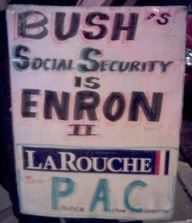
After crossing the street from Central Park, I knew I'd found the building. I was immediately accosted (no exaggeration, they were practically right in my face from the start) by people asking if I wanted to "help save Social Security." You have to see their signs to believe they're real:


(If the pictures didn't show before, they should now. If not, please try clearing your browser cache and then refresh this page.)

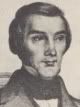
The first picture is ok, but I apologize for the blur in the second. All I had was my camera phone (a mere 1.2 megapixels), but you can at least see the gist of the signs. The second one shows Bush in an old-fashioned outfit that I didn't recognize offhand, so I asked, "King George?" The person replied, "Napoleon."

These people are from the Lyndon LaRouche Political Action Committee, which claims to be "not authorized by any candidate or candidate's committee." Obviously, though, they're Democrats. Go to Political Moneyline and check out the LaRouche PAC's expenditures: they're like a Mini-Me Soros who spent (wasted) untold sums last year against Bush's campaign, and they've even spent money for anti-Tom DeLay bumper stickers? Actually, they're worse than Democrats. Certainly not all Democrats are statists, but every one of these LaRouchers was definitely a statist.

My bull**** detector went off once I saw this on the back of a "brochure" (if you can call it that): "MOBILIZE AMERICA to defend Social Security -- defend America's Constitutional commitment to the General Welfare." What rubbish! It reminds me of a political science professor I once had. For a Ph.D. in history, she surely knew damned little about Constitutional law. She actually had the ignorance to claim, right there in class, "The Constitution gives Congress the power to tax and spend to promote the general welfare."

You know what I find ironic? These LaRouchers compare Bush to Napoleon and Pinochet, and George Schultz to Hitler and fascists. Yet LaRouche has a LaRouche Youth Movement. It's right there on the website; that's their name for it. Now who's more like Hitler? Call me a "digital brown shirt" for liking Bush, but what about these indoctrinated youth? Few of them probably know nothing substantial about any of the issues, except for the lines that parents, teachers and mentors have taught them to parrot.

For those unfamiliar with Friedrich Hayek, do yourself a favor and pick up a copy of The Road to Serfdom. I mean that literally, as it's one of the most wonderful books ever written. Pay particular attention to chapter 10, "Why the Worst Get on Top": Hayek explained how dictators come to power by manipulating the gullible, especially the young. Now take a look at the very name of the LaRouche Youth Movement. I rest my case.

All you need to know about LaRouche's politics you can glean from this speech, where he spouted horse**** like, "Roosevelt saved the United States from becoming fascist. The United States would have become fascist in the middle of the 1930s, but for Franklin Roosevelt's election, and the actions he took, beginning the day he entered office in March of 1933." That is unequivocally a lie or pure ignorance of history and politics. Roosevelt was a statist who succeeded another statist. It doesn't matter if you call it fascism, where you think you own private property but the state effectively owns it by exercising full control, and socialism, where the state admits it owns it all. Statism is statism.

Then LaRouche bragged about what he claims is an upcoming global crisis, "And I had to stop it. I had to be the equivalent of Franklin Roosevelt. Because there was nobody else in a leading position in the United States, or otherwise, who was qualified to do what I had to do." Gee, what modesty! What was that again, what Hayek wrote about individuals having only imperfect knowledge, that total knowledge is dispersed throughout society? In other words, no one person knows it all. Until now! Now we have a self-prophesied, self-annointed political Messiah in Lyndon LaRouche! Forgive me if I spit in disgust at that thought.

Oh, and LaRouche also said in the same speech, "Therefore, I was ruthless, as ruthless as required, and as ruthless toward myself, as toward others around me, and toward the Democratic Party and its leadership, and other relevant institutions..." I don't recall that Hayek specifically said in The Road to Serfdom that a dictator must have megalomania, which LaRouche certainly has. Hayek did say, though, that dictators must have a comparative advantage in ruthlessness, among other things.

All right, enough about the wackos and their fearless leader. I found the debate itself was overall...unconstructive. It reminds me of a Star Trek line, "We could talk all night and not convince each other." Social Security is just one of those issues. Tanner, Krugman and Marshall were all excellent and put forth great arguments, except that Krugman more than once used bad analogies. It was the same rhetoric we've heard all along, though. For example, I sent Donald Luskin a link the other day that I stumbled across. This article is from the November-December 1996 Mother Jones magazine, and though Krugman hadn't yet come on the scene, the article had Michael Tanner and Cato, the Economic Policy Institute, AARP, Chile as an example of privatization, and all the same rhetoric we hear today. In that article, Michael Tanner warned that there's really no trust fund, others said the trust fund will grow to nearly $3 trillion by 2018, and the EPI warned that investing fees are more expensive for low-income workers.

I sigh because over these last eight years, very little about the Social Security debate is really new information. We still know the "trust fund" will have to be dipped into starting in 2018, but Cato is still repeating the warning that the "trust fund" was invested in Treasury bonds, so they'll have to be redeemed either by higher taxes or unchanged taxes with spending cuts. We had eight years to start doing something, and our leaders blew it. I'll cut Bush a little slack, because he's had a lot of foreign policy to keep him busy. But what was Clinton's excuse in the late 1990s, when the U.S. economy was sizzling? He should have taken real leadership, even if it was to continue Social Security as it is. But he didn't, partly because he was too "occupied" in the Oval Office, if you know what I mean.

Back to the debate itself. The crowd at NYSEC, for the most part, was a bunch of liberals who, judging by when they cheered and applauded, wanted to preserve Social Security's status quo. I saw a lot of elderly, no doubt senior citizens who believe Democrats' lie that Social Security privatization means a cut in current retirees' benefits. There were also a lot of young people, and I had this feeling they were all so well indoctrinated in liberal statism, that they were there to hear why Social Security should remain as it is. The segment of society I didn't see many of: people in their 30s, 40s and 50s, i.e. the ones with the most to gain by Social Security privatization, and the most to lose when the "trust fund" must be redeemed by higher taxes.

The moderator, being from NYSEC, was completely liberal and not very good at all. Some, like me, had reservations about Bob Schieffer moderating that Bush-Kerry debate; in the end, I thought he did excellently. For crying out loud, though, this "Vered Mallon" was just pathetic. It was bad enough that her introduction did little more than extol the virtues of this liberal NYSEC organization: they want a "kinder, just world," "civil rights" and "women's reproductive rights." She said, "We are a community of faith -- our faith is in people," and added that they want to "pursue justice for everyone." Her bias was so evident that you couldn't have done worse asking Dan Rather to moderate during the 2004 presidential election debates. She gave credit to Democracy Now, The Nation and Democrats.com for supporting the debate. She even called them "vital organizations" -- what more evidence does one need of her and NYSEC's bias?

She mentioned that next month they're doing some event about Wal-Mart, no doubt bashing it. Geez. But I knew I was really in for it when she introduced Michael Tanner as from "Cato, a conservative think tank." I scribbled that in my notebook so furiously that the tip of my pen almost sliced through the page (I love the Uni-ball Signo RTs with the ultra-fine .38 mm tip). I was pleasantly relieved when Tanner got up to do his introduction, declaring that Cato is libertarian, not conservative.

Each of the three panelists was allowed five minutes for an introduction and summary of their positions. Krugman had an inscrutable look as the moderator babbled on, and his expression didn't change as Tanner got up for his intro. Krugman kept writing something and gave only a couple of claps of polite applause, which was really rude.

It's getting late, so may my readers forgive me that I need to call it a night. Tomorrow I'll talk about what was said in the debate. What I'll conclude with tonight is the completely bogus Abraham Lincoln quote that Mallon referred to, and several times.

She claimed that Abraham Lincoln said, "Government should do for people what they cannot do for themselves," and that "Public good transcends private interest."

I'm no Lincoln scholar, but I like to think I know my history more than the average person. I cannot find any source for either of these alleged Lincoln quotes, and until someone points me to one, I dismiss Mallon as fabricating a LIE or just citing an urban legend. Google the first, and you find a lot of leftist websites saying, "I believe, as Lincoln did, that..." Nothing, however, points to where Lincoln ever said such thing. I think I'll e-mail Thomas DiLorenzo. If anyone on the planet would know the veracity of those quotes, he would.

The closest thing I can think of: Adam Smith in Wealth of Nations did say certain public works must be the responsibility of the government, but only because their size means no single person can afford them. With things like Social Security, why can't an individual person save for his or her own retirement? I was pleased that Michael Tanner made this point in the debate, but he should have gone further:

Why must the central government make others' retirement contingent on your current payroll taxes, and later make your retirement contingent on the next generation's payroll taxes?

Labels: , , ,