Tuesday, August 26, 2008

More liberal lies about energy

This idiot speaking before Hillary said that the U.S. uses 25% of the world's oil but has only 3% of the reserves.

First, that's proven reserves. Reserves are in fact not going down, but constantly going up despite global consumption. That's because because we keep discovering new reserves that exceed what we take out. The world consumes about 87 million barrels of oil per day, so Brazil's new reserves of 33 billion barrels could alone supply the world's needs for just over a year. And what about all the other deposits we know about and will likely continue to discover?

Second, the moron is confusing consumption with total supply, just like there's a difference between income and savings. The former is a rate at which the latter increases or decreases. If a wife is using 25% of the family's income but personally contributed only 3% of the assets, that's not necessarily a problem. What if the family spends $100,000 a year but has billions in wealth? If the U.S. uses 20 million barrels of oil per day. That means a newfound deposit of 20 billion barrels will by itself supply the U.S. for 1000 days.

Now the idiot is talking about Obama's plan to invest $150 billion over the next 10 years in "green technology," how it will create 5 million new jobs. Don Luskin debunked this in June:
Let's see... $150 billion over ten years is $15 billion a year. Let's see... 5 million jobs. That's $3,000 a year per job. Let's see... that's a wage rate of about $1.40 an hour. If those are "good" jobs, I'll take a bad one if you don't mind.

Does this mean Obama favors repealing the minimum wage?
All you need to do is put things in perspective, to think for a minute that a billion is a thousand millions, and liberals' lies become so transparent.

Good lord, the fucker is so obese, he can't even fully button his shirt collar. Reminds me of Peter Jackson at the Oscars a few years ago. Surely they make enough to afford a decent shirt with a collar that fits?

Labels: , , ,

Wednesday, May 28, 2008

My memento of the Bear Stearns collapse

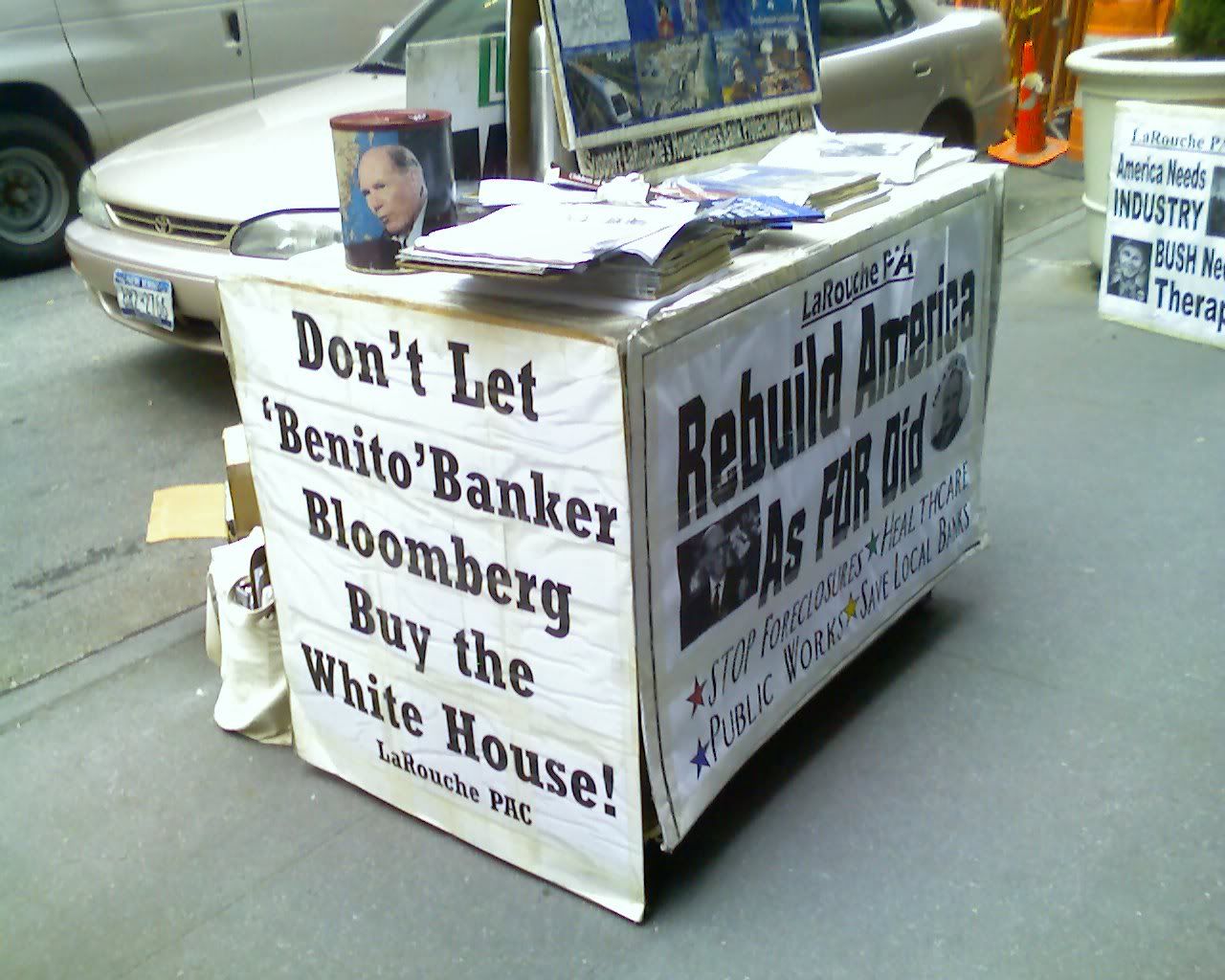
On my way from work to Grand Central, I often walk by Bear Stearns' headquarters. On the evening of last March 18th, the LaRouchers were out in force. I've kept forgetting for a long time to post this picture; click it to enlarge. All I had was my Motorola RAZR, but the picture still turned out very well.


I've previously blogged here and here about encountering LaRouchers. The one thing they did get right is opposing the bailout. But look at their insanity on these completely unrelated signs! Sadly, it isn't just ex-con Lyndon LaRouche and his followers who believe that government must "rebuild" U.S. industries. Plenty of Republicans and Democrats also believe that the government must "do something" to "revitalize" or "stimulate" the economy. They don't even differ much on which industry or industries should get "help."

But LaRouche is about the biggest nutjob of them all. He wants to revert the United States to early 20th century, if not 19th century technology. Railroads? Steel? Water power? It goes without saying, as Bastiat would remind us, that with every dollar the government takes from us to spend on industries we don't support as consumers, the rest of us in the private sector have a dollar less to spend on modern industries we do like: computers, media, airlines, etc. When we have the freedom to save and spend as we see fit, the natural outcome is that the most desired and/or most efficient goods and services will survive.

Labels: , , , ,

Friday, May 19, 2006

Congressional morons that keep the price of oil high

I've talked before about Congressional Democrats perennially successful attempts to block drilling in the barren ANWR, and Democrats' purely partisan calls for energy independence (which would only make oil more expensive), and Democrat-supporting environmentalists whose lobbying has prevented the construction of any new domestic oil refineries in the last 30 years. But don't get me wrong: some Republicans are just as much to blame.
House Votes to Keep Offshore Oil Drilling Ban

WASHINGTON — The House of Representatives is not lifting a quarter-century congressional ban on offshore oil drilling in coastal waters outside the western Gulf of Mexico amid arguments that new supplies are needed to lower energy prices.

A proposal to end the long-standing moratorium as it applies only to pumping natural gas was expected to be voted on later Thursday as lawmakers moved toward late-night approval of a $25.9 billion Interior Department spending bill.

The proposal to allow oil drilling in waters off both coasts and in the eastern Gulf of Mexico — areas off limits to energy companies since 1981 — was rejected by a 279-141 vote. It had been offered by Rep. Ted Poe, a Texas Republican, who called the drilling ban "an outdated policy" when the country needs to reduce its dependence on energy imports.

Separately, the House passed by a 252-165 vote a measure that would bar oil companies who fail to renegotiate contacts that allow for federal royalty relief no matter how much oil costs in the marketplace from future oil or gas leases.

The measure was aimed at correcting a mistake made by the Interior Department in the 1990s that failed to put an oil price cutoff for royalty relief. The mistake could cost the Interior Department as much as $7 billion in lost royalty revenues. While the measure does not order these contracts renegotiated, it would put pressure on companies to do so, its supporters said.

"Energy companies have been taking oil and gas from the American people for free and then selling it back to them at record prices," said Rep. Maurice Hinchey, a Democrat who sponsored the amendment.


Supporters of the drilling ban, renewed by Congress each year since 1981, scrambled to try to restore the natural gas drilling ban which had been stripped from the Interior spending bill in committee.

Republican Rep. John Peterson argued that developing the offshore gas resources would pose none of the environmental risks — mainly the prospects of a spill — associated with oil drilling. Supporters of the ban argued that natural gas and oil drilling were too closely linked.

Lifting the moratorium for the first time in 25 years would allow energy development within three miles of shore along coastal areas "where tens of millions of our citizens have made it clear that they don't want any more drilling," said Rep. Lois Capps of California, which has extensive offshore deposits but strict bans on exploitation.

Capps planned to offer an amendment to continue the natural gas drilling prohibition.

Florida lawmakers — both Democrats and Republicans — said energy development off the state would threaten a multibillion dollar tourist industry. Florida depends on tourism "and we're going to protect it," vowed Rep. Alcee Hastings, a Florida Democrat.

Opponents of the drilling prohibition argued that access to offshore oil — and especially natural gas — would drive down energy prices and help reduce the country's dependence on foreign sources of energy.

"We have lost millions of jobs already because of high energy costs, and we're going to lose millions more," said Peterson, who has tried unsuccessfully for two years to lift the offshore moratorium as it applies to developing natural gas.

Soaring natural gas prices, which have quadrupled since 1999, have forced companies — especially in the chemical and fertilizer industries — to consider moving overseas where fuel prices are much cheaper, he said.

Peterson's measure would lift the congressional ban which prohibits the Interior Department from offering gas leases in waters along both coasts and in the eastern Gulf of Mexico. It would not affect a presidential ban on drilling, issued by executive order, that is in effect until 2012.

Drilling proponents also faced an uphill struggle to get the moratorium lifted in the Senate, where senators from coastal states probably could block any such action.

President George W. Bush has said he has no plans to remove the drilling ban.

But Capps said if Congress lifts its moratorium and declares that coastal waters should be opened to drilling, she fears the president "is going to revoke his moratoria" as well.

The offshore drilling issue has divided Congress largely along geographic lines.

Lawmakers from coastal states —both Republicans and Democrats — worried that drilling offshore could threaten their tourist and fishing industries and bring risks of environmental damage.

"People don't go to visit the coasts of Florida or the coast of California to watch oil wells," said Rep. Sam Farr, another California Democrat.
Don't you just love Congressional politics? Nothing is ever passed anymore as a separate bill. And the most pernicious measures inserted into massive bills tend to be simple, yet so effective in damning the American people.

Whether in ANWR or off-shore fields, merely allowing drilling will help drive down oil prices immediately. Capps needs to take a microeconomics class or two. Prices are not just a reflection of the present, but of expectations of future supplies too. When buyers on the global petroleum market are uncertain of Iranian and Nigerian output, and when they expect China and India's appetite for oil to grow, they're willing to pay more. When they know that the supply, especially domestic supply under stable U.S. control, will be higher for years to come, they won't be as willing to pay. As I've explained before, we won't see $40 per barrel crude right away, but buyers will have greater confidence in reliable supplies.

Back into the limelight steps Maurice Hinchey, the conspiracy theory nutcase who claimed on Sean Hannity's radio show that Karl Rove leaked the "Bush memos" to CBS. (After a year and some months, he has yet to offer one shred of proof.) In accusing the oil companies of making too much profit, Hinchey ignores the reality that our friend Josh Hendrickson pointed out last month: other industries normally have far higher profit margins. And I ask, who was crying for the oil companies during the 1990s when oil and gasoline prices were quite cheap?

Hinchey's crime is even worse: is he really as stupid as he sounds, that he laments the federal government losing $7 billion in royalties, when the oil companies would invariably pass that cost on to consumers? He also omits the fact that states and the federal government collect far more in gasoline taxes than oil companies make in profit. I wish I could remember now who recently noted that with all the taxes collected over the years, the federal government could buy every American today a brand-new Prius. How's that for putting things in perspective? And don't forget the double-taxation, because governments also get a cut of oil companies' profits.

Certain lawmakers are so concerned about tourism, but higher oil prices (at the pump and also the rippling effect) cost Americans far more than the tourism industry would gain. "Protect" is the proper word, all right, because Hastings and Farr are engaging in nothing short of protectionism. "To hell with you, and to hell with the idea that I should have to compete. I'm going to use the power of government to benefit my livelihood and make you bear the cost."

Did they ever consider who can still visit Florida or coastal California when high gasoline prices force families to cut back on leisure? What of families taking vacations closer to home, because it now costs considerably more to drive somewhere, or because airline tickets have gone up from higher fuel costs? And what of the working poor, who Democrats supposedly champion? Instead of actually doing something to bring down the price of gasoline, all the Democrats are doing is protecting the vistas, which are enjoyed more by the well-to-do. Just who are liberals really fighting for?

And three miles is really quite a distance. To put something else in perspective, I work about a mile north of the Empire State Building. At triple that distance, even the largest oil rig will hardly mar the sea's horizon. I personally would prefer the oil rigs out there, knowing that someone's helping to keep my fuel costs down (and strictly for his own self-interest).

Humberto Fontova recently noted in Human Events that there tends to be more aquatic life, especially fish, around the artificial reefs of oil rigs. His excellent piece addresses the issue of oil rigs' environmental impact. "The environmental dangers of oil exploration and extraction rank right up with the marvels of Cuba's healthcare as modern man's most zealously cherished fables." In 50 years, we've never had a major spill from rigs, only tankers, and "More birds get fried by landing on power lines and smashed to pulp against picture windows in one week than perished from three decades of oil spills." It's well worth reading the whole thing.

Labels: , , , ,

Wednesday, April 26, 2006

What to do about the price of gasoline?

Leave it to one of the greats to tell us like it is. Larry Kudlow wrote on Tuesday that President Bush undid a few things by which government is making oil and gasoline more expensive. He added:
One action President Bush should have taken (and could still take) is to end the 54-cent-a-gallon tariff on imported ethanol (which basically means Brazilian ethanol.) Why the U.S. government should protect the already heavily subsidized ethanol industry at the expense of American consumers is hard to fathom.

Energy Secretary Sam Bodman actually defended the tariff earlier this month saying it was necessary so that foreign producers "can have no advantage over American companies." Holy smokes, this is the energy version of steel tariffs and it's just as bad an idea.

But all this talk of price gouging is nothing more than the usual political pabulum.
Update: one thing Larry didn't mention is that President Bush directed the EPA to wave "clean air" rules, by which the EPA requires certain states to use only specific blends of gasoline. Believe it or not, there are 42 different blends (maybe even more now!), so if gasoline supplies run low in a state that is heavily restricted by the EPA, it often can't just buy gasoline from an adjacent state. Sometimes it must come from two or more states away, which makes the gasoline unnecessarily expensive. Bush said "Every little bit helps" regarding the effect on gasoline prices, and even this good start had a little downward pressure.

However, Bush called for increasing tax breaks for hybrids cars, which I have exposed as "The bad way to cut taxes." As I explained, cutting taxes must be uniform, not just for specific industries or products. Otherwise, like in the case of hybrids or anything else we can get "tax credits" for, it's merely favoritism -- a subsidy. By nature, a subsidy is how the government skews the market in favor of special interests.

Larry had previously assailed the ridiculous ethanol subsidies here, concluding, "The administration is being hoisted on its own ethanol petard." And he is correct. The blame for gasoline prices is not just from the price of oil, but the pile of crap known as the 2005 energy bill. In a couple of decades, economists might just look back on the energy bill and its effects like we today look back on the 1970s wage and price controls: "Who were the schmucks that didn't think about ethanol's scarcity, or even that its price would go up from demand, yet mandated a sudden spike in its use?"

But in our midst are interventionists in the guise of free-marketers, who have a form of laissez-faire but deny the power thereof. As I explained several ways in that link, there is no, NO justification whatsoever for ethanol subsidies. Any subsidy takes money from some to give to others, and though the latter can then sell their goods for less, at best it's all the same for the consumer. If an item would normally sell for $2, but a $1 subsidy allows it to sell for $1, then the taxpayer still pays $2 total, for who else pays the subsidy? Then it gets worse, because an equivalent item that might sell for $1.50 will never come to market. The uncompetitive sellers stay in business, at the expense of the consumer and his lost 50 cents.

Now, I also oppose subsidies for oil companies. I'm the first to support the elimination of all subsidies for everyone, believing that that is the level playing field on which they compete for the consumer's business. But to be fair, "Big Oil" hardly receives the boost that ethanol producers and corn growers are. The energy bill boosted their subsidies, and the mandate to phase out MTBE was the hidden windfall for them. When I tried to tell rufus a dozen times that ethanol will rise in price as it becomes more popular, he didn't believe me, but I turned out to be right.

Sadly, President Bush, though I believe he knows better, has bowed to politics and has come out against price gouging, though such a thing is completely mythical. If he didn't, Democrats would score too many points with voters. Republicans have to display some populism, lest anger over gas prices (fueled by mainstream media) give them the same fate as George H.W. Bush. As this Detroit News op-ed says so well, "One thing you can always count on, as soon as the price of a gallon of gasoline nears $3, Democrats will start demagoguing." Link courtesy of our friend Josh Hendrickson. Josh has also noted the interesting correlation between gas prices and Bush's approval ratings, and that if the Republicans finally get smart, they'll bring up ANWR. Drilling in ANWR would immediately cause crude oil prices to drop (because current prices also reflect future supply), but Democrats consistently block all legislation. Especially now, I cannot fathom why Republicans don't drive this point home.

At the present time, our only option is for the lesser of two evils. I, for one, would rather have Republicans half-heartedly screwing up the economy than Democrats completely wrecking things with "windfall profits" taxes. That reminds me: when will Democrats start calling for "windfall profits" taxes on ethanol producers, who are now earning larger and larger margins? Or do they not want to risk that the American people will finally realize that it's absurd for government to support business, and that it's this absurdity that makes things more expensive than they ought to be? Unlike liberals' use of "ought," my use there means "if the blasted government didn't stick its nose in, whether it's trying to 'help' or simply redistribute money to supporters."

People want government to "do something" about gasoline prices, when in fact the federal government shoulders a good part of the blame. People also wanted government to "do something" about the Great Depression, too, though the Federal Reserve triggered it, and the federal government prolonged it. Why look for solutions from the people who created the problem in the first place?

Labels: , , ,

Tuesday, February 21, 2006

Saving us from foreign oil "dependence"?

In his latest follow-up to a State of the Union Address that extolled the fallacial virtues of big government, President Bush struck again:
Bush: U.S. on Verge of Energy Breakthrough

MILWAUKEE Feb 20, 2006 (AP)— Saying the nation is on the verge of technological breakthroughs that would "startle" most Americans, President Bush on Monday outlined his energy proposals to help wean the country off foreign oil.

Less than half the crude oil used by refineries is produced in the United States, while 60 percent comes from foreign nations, Bush said during the first stop on a two-day trip to talk about energy.

Some of these foreign suppliers have "unstable" governments that have fundamental differences with America, he said.

"It creates a national security issue and we're held hostage for energy by foreign nations that may not like us," Bush said.

Bush is focusing on energy at a time when Americans are paying high power bills to heat their homes this winter and have only recently seen a decrease in gasoline prices.

One of Bush's proposals would expand research into smaller, longer-lasting batteries for electric-gas hybrid cars, including plug-ins. He highlighted that initiative with a visit Monday to the battery center at Milwaukee-based auto-parts supplier Johnson Controls Inc.

During his trip, Bush is also focusing on a proposal to increase investment in development of clean electric power sources, and proposals to speed the development of biofuels such as "cellulosic" ethanol made from wood chips or sawgrass.

Energy conservation groups and environmentalists say they're pleased that the president, a former oil man in Texas, is stressing alternative sources of energy, but they contend his proposals don't go far enough. They say the administration must consider greater fuel-efficiency standards for cars, and some economists believe it's best to increase the gas tax to force consumers to change their driving habits.

During his visit to Johnson Controls' new hybrid battery laboratory, Bush checked out two Ford Escapes one with a nickel-metal-hybrid battery, the kind that powers most hybrid-electric vehicles, and one with a lithium-ion battery, which Johnson Controls believes are the wave of the future. The lithium-ion battery was about half the size of the older-model battery. In 2004, Johnson Controls received a government contract to develop the lithium-ion batteries.

On Tuesday, Bush plans to visit the Energy Department's National Renewable Energy Laboratory in Golden, Colo., to talk about speeding the development of biofuels.

The lab, with a looming $28 million budget shortfall, had announced it was cutting its staff by 32 people, including eight researchers. But in advance of Bush's visit, Energy Secretary Samuel Bodman over the weekend directed the transfer of $5 million to the private contractor that runs the lab, so the jobs can be saved.
And it gets worse from there. The article was supposed to have been written this Monday, but from something it said, I would have thought it was from November or so. It mentioned Americans have only recently seen a decrease in gasoline prices. Strange, because in my area (and gasoline down the road is quite expensive compared to elsewhere), pump prices started decreasing significantly about four months ago.

Isn't it so easy to "invest" in new ventures when it's not your money, especially when the money comes from people who have no control over how it's invested, and when it's all but impossible for them to hold you accountable for mismanagement and outright fraud? Isn't it so easy to "save jobs" when it's not your money? Isn't it equally stupid when it's just for the sake of jobs, a basic Keynesian principle? When it's not your money, though, you need not give a damn whether the company can operate profitably, or whether its scientific goals are at all feasible. Since the money government spends is never its own, it's no problem for government to award another lucrative contract, or give another tax break, so a company can develop a new battery that, subtracting whatgovernment poured in, actually loses money on net.

The best and only way the federal government (and any level of government) should promote a "breakthrough" in new energy sources is to not promote any source whatsoever. Governments at all levels must stop their interference in market processes, and let the competitors battle it out. Cease all subsidies, like those given to ethanol manufacturers. Cease special tax breaks for oil industries, too. Cease the subsidies for alternative fuel sources like wind and solar energy, which are extremely inefficient. Cease the unfair hindrances on nuclear energy. People use the phrase "level playing field" all the time, and many don't realize a true "level playing field" is when government neither assists nor hinders anyone.

That some of our Middle East oil-buying dollars go to terrorists is a very valid concern about free trade. I'll get to that later, but right now let me say that President Bush has to emphasize it because the Democrats have been. Neither side is doing it out of genuine concern, though. The Democrats certainly didn't care about "energy independence" until recently, but they've created the myth because they don't have much else to make an issue of. Bush has no choice but to follow suit, and sadly, a serious economic matter gets reduced into more partisanship.

Congress is deeply concerned about dependency on Middle East oil. So deeply that, in a vote this last December, it again rejected allowing drilling in ANWR (most of the blame we can put on Democrats), let alone other rich oil fields in Alaska. More than any subsidies or tax breaks, more than any promotion of "democracy" abroad, drilling in ANWR would have the greatest effect on reducing our "dependence on foreign oil." It would also immediately reduce oil prices on the global market. Effects on price would occur once appropriate legislation passed (or even rumors it would pass), before any drilling commenced, because prices do not just reflect current supply, but future expectations of supply.

Critics say it's only enough oil to supply the U.S. for two years, but that is a lot. Imagine that you and your family suddenly found a two-year supply of food in your back yard, and that you are your grocer's biggest customer. Wouldn't he suddenly be very conciliatory if before he demanded high prices? Perhaps he has a lot of savings to carry him through two years, until you consume all of your finite supply. But what if you look a little more and find an even greater supply, or you find a way to make the food yourself for a cheaper cost than your grocer's prices? Worse, what if in that time, you find a grocer who will sell for really cheap prices? (Here I refer to tar-sand oil deposits in Alberta, Canada, which are a promising source once the technology gets going.)

I recently had a discussion with a close friend about Middle East oil and Sino-U.S. trade. Is it wise that we send so much money to potential enemies in actual warfare? No, but we trade with Saudi Arabia, Iran and China because the benefits outweigh the costs. Benefits and costs aren't always monetary, remember. So by measuring trade flows, we can actually approximate how much Americans, collectively, are willing to save by accepting the risk that Middle East terrorists eventually will harm us and our interests, using some of the dollars we paid for Middle East oil. The same goes for China using some of our money to modernize and expand its military, with the single goal of conquering Taiwan.

Admittedly it is not an absolute that free trade promotes peaceful relations. After all, we certainly cannot trust Iran, at least not with its current leadership. Peaceful relations can still be very cold, after all, and free trade isn't a guarantee of permanent peace, but it does maintain peace in the present. The trade will continue until one side decides, or both sides decide, that it prefers the destruction of war, and the risk of losing, instead of peaceful trade.

If Iran really wanted nuclear weapons, couldn't it just buy technology from renegade Soviets? Perhaps, but I would think not. It's far more noticeable than Iran's nuclear projects, which they claim are covert, but we know about them, and the Iranians know that we know, and we know that the Iranians know that we know... Besides, once Western intelligence learned of Iran's acquisition of a nuclear weapon, it would play into the United States' hands: such a discovery would invite UN Security Council action (severe sanctions). Moreover, Israel would undoubtedly begin military strikes against all possible nuclear sites in Iran. Madman Mahmoud, therefore, will continue playing the stall game.

I would suspect India is doing everything to ensure that none of its nuclear technology, at least that which could be used to develop weapons, reaches Iranian hands. It's benefiting far more from peaceful trade with the United States than it could ever get by selling nuclear technology to Iran. Similarly, for all the anti-West violence, Pakistan as a nation likes warm relations with the United States. China and North Korea are a different matter, especially North Korea, because Kim Jong-il, aka He of the Supposedly Infallible Memory, is a madman.

If we right now cut off all trade with Iran, that may force its hand before we can deal with it. Iran might then seek out the nearest available nuclear warheads and lob a few toward Israel, and its missiles could potentially carry warheads to southern Italy. I do believe we will eventually have to assault Iran with our military might, which will be much easier until Iran has a working nuclear weapon. Right now Mahmoud & Co. think they have time to develop nuclear weapons on their own.

China is also stalling. I think its leaders look far into the future and are willing to exercise the requisite patience. As I wrote last March in my "How libertarian are you?" entry:
Someone best described as a neo-con once told me that China is merely a paper tiger and nothing to worry about. Perhaps so. Vietnam, however, taught our enemies that we can be beaten if they make it too costly for us to win. I worry that China will become a serious threat in a couple of decades, as it continues to strengthen its military and modernize its society. At some point, China may be able to capture Taiwan because they'll make the blood price too high, and if anti-war sentiment sufficiently ferments over the years.
It's important to remember that not every dollar in China's trade surplus is a dollar it can spend. China needs some of those dollars to buy petroleum, and because it must import many different types of raw materials, it doesn't have much of an overall trade surplus compared to that with the United States. Also, it returns many of the dollars to the U.S. Treasury and receives U.S. Treasury bonds, which are not just an investment, but collateral for China's insolvent banking system.

There's still a lot of money that China can allocate for its military expansion, though, but even in a couple of decades, it could not hope to approach, let alone defeat, the United States. But again, those fellows in Beijing aren't looking to win: they just want to make the fight over Taiwan so decreasingly worthwhile that we'll give up.

Meanwhile, we continue to trade with China. Free trade means that neither side is more dependent on the trade than the other is: free trade is symbiosis, not parasitism. China's communist leaders have embraced some market reforms as the key to prosperity, with the clear goal of modernizing China into a formidable superpower. Are they really selling us a rope to hang ourselves with, a twist on what Lenin mockingly said of capitalists? Or are they embracing a snowball (the free market) they formed themselves and will never hope to stop?

I don't think free trade, and the market reforms it encourages, are the answer to ending tyranny in China. I think that, like in the United States, it will take an armed revolt by the people. My own ideas on how to accomplish that, however, cannot be publicly shared.

Labels: , ,

Wednesday, February 01, 2006

Caught between Scylla and Charybdis

(Oops! I changed the time but forgot to change it to PM, and I didn't change the date either. Writing about the SOTU at 2 p.m. on Tuesday? Call me psychic.)

Transcript: President Bush's 2006 State of the Union Address

Transcript: Gov. Tom Kaine delivering the Democratic response

President Bush said some good things tonight in his State of the Union speech, but some bad things too. And as I fully expected, the Democratic response, instead of challenging President Bush on the actual Constitutional limits on the federal government, relied on partisan politics and new myths like "energy independence" and that the federal government should "serve us."

As I'm writing this up from my quickly typed notes, Fox News showed a clip that I didn't notice before. John Kerry turned to his left and said something to Dianne Feinstein. The side of his face was toward the camera, but Feinstein was facing it, and it wasn't hard to read her lips. She replied, "I know." Maybe he said something like, "That should be I up there!"

The President began well with a good indirect jab at the Democrats, criticizing the partisanship in Washington. The Democrats' behavior throughout Justice Alito's confirmation hearings was so disgusting that even Robert Byrd said, "The people of West Viriginia in no uncertain terms were, frankly, appalled by the Alito hearings." Byrd could have been stronger and said he was pointing fingers at unnamed members, but what would you expect from a partisan Democrat? Byrd could have a very tough campaign this time, so he needs to sound less extreme and more centrist. He's probably taking lessons from Hillary.

"We will choose to build our prosperity by leading the world economy or shut ourselves off from trade and opportunity. In a complex and challenging time, the road of isolationism and protectionism may seem broad and inviting, yet it ends in danger and decline." Take that, John Kerry. Wide and straight is the road of protectionist economics, and it leads only to impoverished economies.

"There is no peace in retreat, and there is no honor in retreat.... But our enemies and our friends can be certain: The United States will not retreat from the world, and we will never surrender to evil." As one who supported invading Iraq to topple Saddam and turn the most willing Iraqi people into friends, I'm naturally biased, but I rather liked that. Contrast Bush's refusal to surrender with the anti-war left who want to cut and run, come what may to Iraqis, and not because they have a sincere desire, but because it's to take the opposite position.

I was watching the speech on Fox News, which then cut to Charlie Rangel. He looked like he didn't particularly give a damn. Cut to John Kerry, whose countenance screamed, "Damn it, I should have been giving the speech tonight!"

"In less than three years, the nation has gone from dictatorship, to liberation, to sovereignty, to a constitution, to national elections." As I wrote last March, even the United States, after declaring independence in 1776 and formally gaining it in 1783, had much civil unrest (to the extent that George Washington thought a civil war was imminent) and an ineffective federal government until 1788. With our help, Iraqis have accomplished so much and so fast that it borders on miraculous.

"Fellow citizens, we are in this fight to win, and we are winning. The road of victory is the road that will take our troops home. As we make progress on the ground and Iraqi forces increasingly take the lead, we should be able to further decrease our troop levels. But those decisions will be made by our military commanders, not by politicians in Washington, D.C." Very good: peace through victory.

"...there is a difference between responsible criticism that aims for success and defeatism that refuses to acknowledge anything but failure. Hindsight alone is not wisdom. And second-guessing is not a strategy." Another good jab at the anti-war Democrats. God knows we've made tactical errors in Iraq, but that is the nature of war. My father reminded me more than once how we bombed our own troops in Italy during World War II. It's one thing to examine mistakes and try to improve our military -- it's another to say that because we made mistakes and will inevitably make mistakes, we should never go to war and simply surrender.

"...the leaders of Hamas must recognize Israel, disarm, reject terrorism and work for lasting peace." I fear that's just a pipe dream. Hamas is all about working toward the destruction of Israel, using terrorism against innocent civilians.

"Liberty is the right and hope of all humanity." A bit of a platitude, but good to inject.

"...Iran, a nation now held hostage by a small clerical elite that is isolating and repressing its people. The regime in that country sponsors terrorists in the Palestinian territories and in Lebanon, and that must come to an end." With all the focus on Iran's attempt to develop nuclear weapons, I'm glad Bush reminded us that Iran's very government has long since been a major sponsor of global terrorism.

"I urge members of Congress to serve the interests of America by showing the compassion of America." I sighed here, because this compassion is the false notion of government charity, which of course is paid for by other people.

"So to prevent another attack -- based on authority given to me by the Constitution and by statute -- I have authorized a terrorist surveillance program to aggressively pursue the international communications of suspected Al Qaida operatives and affiliates to and from America." I more than sighed here, because not only does the Constitution of the United States not give such powers to the executive branch, the Fourth Amendment requires warrants. In these days of instant digital communications, obtaining a warrant within minutes should not be difficult.

Gathering intelligence on terrorists is certainly essential. I and other libertarians (currently derided by many conservatives as "civil liberties Chicken Littles") do not oppose the intelligence gathering, but the methods. As someone recently asked me rhetorically, why won't the administration submit requests to FISA? Are there so many terrorist-connected calls coming out of America that it would overwhelm the system? Is the administration is trying to save taxpayer dollars by cutting down on paper usage? Or are they not wiretapping who they say they are, so no court (even FISA) would actually grant such warrants? I'll also add, in all fairness, the possibility of an overzealous and misguided attempt to protect Americans.

The camera cut to Hillary Clinton, the queen of state-worshippers, who was smiling insincerely and slightly shaking her head.

"Our own generation is in a long war against a determined enemy, a war that will be fought by presidents of both parties who will need steady bipartisan support from the Congress. And tonight I ask for yours. Together, let us protect our country, support the men and women who defend us, and lead this world toward freedom." The camera cut to Hillary again, who was no longer smiling and clapping just halfheartedly.

"In the last two-and-a-half years, America has created 4.6 million new jobs -- more than Japan and the European Union combined." That was a sobering statistic illustrating Japan's travails (and not from a lack of effort) and the EU's stagnation (which is from a lack of real effort in reforming their tax policies and welfare states).

"In a dynamic world economy, we are seeing new competitors like China and India. And this creates uncertainty, which makes it easier to feed people's fears. So we're seeing some old temptations return. Protectionists want to escape competition, pretending that we can keep our high standard of living while walling off our economy." I very much liked this. Bush can talk like a real free-trader when he wants, but he's disappointed me a few times with things like steel tariffs.

"We hear claims that immigrants are somehow bad for the economy, even though this economy could not function without them." Though our welfare state attracts many immigrants who want a free ride, that is all too true. Many illegal immigrants really do do the jobs that Americans won't, and they're people who simply want to come to this country peacefully and work hard.

"All these are forms of economic retreat, and they lead in the same direction: toward a stagnant and second-rate economy." The road goes in only two directions, and the other way is toward prosperity.

Bush touted his tax cuts, as he should have. "In the last five years, the tax relief you passed has left $880 billion in the hands of American workers, investors, small businesses and families. And they have used it to help produce more than four years of uninterrupted economic growth." That's $880 billion spent by people on what they judged was necessary and efficient, not politicians' latest projects.

I still maintain that the timing of Bush's tax cuts was a stroke of luck, otherwise our very mild recession (unemployment not even at 7%, when "normal" unemployment in a stagnant but "happy" economy like France's is 10%!) would have been much worse. Bush added, "I urge the Congress to act responsibly and make the tax cuts permanent."

I would like to add that I urge Congress and the President "to act responsibly" and cut federal spending -- by a lot. When Bush spoke of "another $14 billion next year," I could only laugh bitterly and say, "Big deal!" That drop in the bucket will make no difference in the deficit, let alone halving it by 2009.

Once Bush mentioned the word "earmarks," McCain vigorously applauded. Bush then called upon Congress to give him the line-item veto, which Clinton briefly had. I fear that, even with a Republican Congress, President Bush expressed the same hopeless desire that his father did.

Bush then turned to massive growth in "entitlements" (how I hate that term, because it implies obligation on government's part). By 2030, nearly 60% of the federal budget will be on Social Security, Medicare and Medicaid. To put it in perspective, our current entitlement spending is about $1 trillion out of a $2.5 trillion federal budget, and at 60% it would be an even more staggering $1.5 trillion. If you follow that link, one error I'd like to note in the newspaper article is that the $2.2 trillion figure is budgeted federal spending, but actual federal spending in 2005 was $2.47 trillion.

"Congress did not act last year on my proposal to save Social Security, yet the rising cost of entitlements is a problem that is not going away. And with every year we fail to act, the situation gets worse." Good, very good. Emphasize that the longer we delay, the more wealth we lose and the more painful we make reform.

Then Bush said, "So tonight I ask you to join me in creating a commission to examine the full impact of baby boom retirements on Social Security, Medicare and Medicaid." Oh, for the love of heaven, we already know the full impact! Numerous thinktanks of all political persuasions have all done projections and arrived at more or less the same figures about how many elderly will be retiring and how many workers will be supporting them. Where they differ is how to deal with it.

"One out of every five factory jobs in America is related to global trade, and we want people everywhere to buy American." It's a good statistic to show the regular American how free trade may send some of our jobs overseas, but we create new jobs to make things for our new trading partners.

But it really scares me Bush talks about "a level playing field." Is that a sly reference to China's alleged currency manipulation, which GM and Ford have recently used as an excuse for their failures?

Bush then got to the meat of his "compassionate conservatism": "Keeping America competitive requires affordable health care," and "Government has the responsibility to provide health care for the poor and the elderly." I again was reminded that he might sound Reagan-like in promoting tax cuts, but Bush is still a big government conservative.

"We will make wider use of health information technology to help control costs and reduce dangerous medical errors." If private companies could already use the technology to control costs, though, they already would have. Companies would jump at the chance because they could continue to charge the same prices, increasing their profits...at least until one company charged less to get more customers, and others followed suit.

He promoted "health savings accounts" as he did during the 2004 campaign, and that they should be "portable." But such accounts wouldn't be necessary if we didn't tax savings -- if we had a more sensible tax system that didn't discourage savings (which fuel investment), people could simply save that money without the need for more government regulations.

Medical liability reform is a must, but I have no confidence in this being passed anytime soon. It's been proposed for years, and nobody does anything significant.

What is significant is Bush's attempt to brag that, "Since 2001, we have spent nearly $10 billion to develop cleaner, cheaper and more reliable alternative energy sources." In other words, we've spent $10 billion so that we can use more expensive forms of energy, like wind, solar and water. If these were more efficient and cheaper than fossil fuels, then we'd already have been using them. The President sadly does not understand this aspect of the free market, because he continued in proposing his "Advanced Energy Initiative -- a 22 percent increase in clean-energy research at the Department of Energy to push for breakthroughs in two vital areas."

How much more of our money can the federal government spend so that we can use more expensive, less efficient ethanol? How much must we spend so we can use hybrid, electic and hydrogen-fueled automobiles, which, as our friend TKC pointed out, don't really save money overall?

Federal subsidies for ethanol are something I've criticized several times. When President Bush proposed federal funding for "additional research in cutting-edge methods of producing ethanol, not just from corn but from wood chips and stalks or switch grass," to "make this new kind of ethanol practical and competitive within six years," I wanted to tear my hair out.

What he said next sounds like a good idea, "to replace more than 75 percent of our oil imports from the Middle East by 2025," but as I pointed out here, it's not a bad thing to import something for cheaper than you can make it yourself. We could ban all imports of Middle East oil, but at what price? "By applying the talent and technology of America, this country can dramatically improve our environment, move beyond a petroleum-based economy and make our dependence on Middle Eastern oil a thing of the past." Again, at what price? When we've made oil so expensive with bad supply-limiting policies that we stifle our economy?

Next, the proposal of the "American Competitiveness Initiative," i.e. another big government program to skew the labor markets. "I propose to double the federal commitment to the most critical basic research programs in the physical sciences over the next 10 years." In other words, double the spending, but what exactly are the "most critical" programs? Who will determine them, business investors who carefully weigh what they're pouring their money into, or government bureaucrats who dole out other people's money while under the influence of industry lobbyists?

The "research and development tax credit" is a good start toward real tax reform, because it sounds general enough. Specific tax incentives are bad policy, simply because they skew markets by favoring one industry (or company) over another. What I want to see is a full repeal of all taxes on businesses, because they do not pay taxes. I explained toward the end of this entry that businesses merely pass taxes onto consumers, which requires overhead, so it's actually better to have individuals bear the full tax burden.

"We made a good start in the early grades with the No Child Left Behind Act, which is raising standards and lifting test scores across our country." Even conservatives like Michelle Malkin are more than dismayed at the huge mess and boondoggle of NCLB. With all those billions wasted, and schools in fact rarely left better off, how can we trust the federal government, as Bush called for tonight, "to train 70,000 high school teachers to lead advanced placement courses in math and science, bring 30,000 math and science professionals to teach in classrooms, and give early help to students who struggle with math so they have a better chance at good, high-wage jobs"? As I discussed here, schools cannot attract professionals who can make much more in the private sector, and many school districts are like NYC's, unable to pay those salaries because they're too busy paying so many bad teachers.

"I ask Congress to reform and reauthorize the Ryan White Act and provide new funding to states so we end the waiting lists for AIDS medicines in America." This is fundamentally redistribution of wealth, and it is self-defeating. Giving more money to states will encourage greater supply of the medicines, it is true, but it will divert pharmaceutical companies' efforts from other ventures that they'd have undertaken. They will make less medicine for influenza, less insulin, etc., so this is another example of government skewing the free market's determination of what is most important to people.

"Each of us has made a pledge to be worthy of public responsibility, and that is a pledge we must never forget, never dismiss and never betray." Actually, I thought he and Congress made pledges "to preserve and protect the Constitution of the United States."

And now for the Democratic response:

I was immediately suspicious when Tom Kaine began by mentioning his missionary experience. It's just like liberals to blur the important distinction between individual charity and government powers. Indeed, he wasted no time: "Our faith and values teach us that there's no higher calling than serving others. Our federal government should serve the American people."

Could there be any bigger poppycock in the world than liberals' belief in the nanny state?

"As Americans, we do great things when we work together." Perhaps he should ask, oh, Ted Kennedy, Chuck Schumer and most of the Democrats on the Senate Judiciary Committe, who disgraced themselves at Justice Alito's confirmation hearings.

"When there is a natural disaster, you expect a well managed response." A nice generality, but the federal government has no Constitutional authority to do what it has for Louisiana and Missippippi in Katrina's aftermath.

"...you have a right to expect government to be fiscally responsible, pay the bills and live within its means. Tonight we heard the president again call to make his tax policies permanent, despite his administration's failure to manage our staggering national debt...huge surpluses to huge deficits..." Again I ask, where was the Democrats' "fiscal austerity" were in the 1980s when they were refusing to go along with Reagan and cut non-military spending, when Democrats controlled Congress and produced several budget deficits higher than today (as a percentage of the economy)? Moreover, not only were Clinton's two "surplus" years achieved in teamwork with a Republican Congress, the surpluses were not that large as a percentage of the budget or the economy.

In fact, federal debt has increased but is not as bad many think. Forget the absolute numbers and look at Steve Conover's January calculations. U.S. federal debt as a percentage of GDP is quite favorable compared to other nations, especially those in our range but whose economies are performing dismally. I'll post more on this another time, but federal debt is actually quite manageable right now. How many people do you know have a high debt ratio, but also get consistent pay raises of nearly 4% a year, pay between just 4% and 5% interest on their loans, and can borrow all the money they want because there are so many who are offering to lend money?

Kaine's nonsense about the United States' "credit rating" reflects either his ignorance or his partisanship: a country's credit rating is reflected in the interest rates it pays on its government bonds. The still-low interest rates on Treasury bonds are why paying interest on the national debt no longer consumes a quarter of the federal budget, unlike in the early 1990s. Foreigners have become so eager to save their money by buying our bonds, and they earned the dollars by selling goods and services to us.

"Congressional Democrats have a plan to educate 100,000 new engineers, scientists and mathematicians in the next four years." Ah, Bush proposed 30,000, so the Dems will more than triple that to prove that they're still the premier party of big government!

"The White House has made efforts to cut Medicaid funds for our most vulnerable citizens. Our seniors were promised that the new federal Medicare drug plan would make it easier and cheaper to obtain their medication." The Medicare prescription drug plan was bad, but Democrats don't see why it really is. To them, it's bad because they were beaten to it by a Republican President and Republican-controlled Congress. In reality, it's bad because the drug plan, and in fact Medicare/Medicaid, are not part of the federal government's constitutional powers.

"In Virginia, we've worked to provide health insurance coverage for nearly 140,000 children who weren't covered four years ago." But the age-old question: at what cost? Who's paying for it, and what are the taxed people not buying (meaning jobs are destroyed all over, little by little) because they are paying for others' health care?

"...Republicans and Democrats alike have come together to fight the administration's efforts to slash Medicaid and push more costs onto the states." And that is why both parties can be so wrong. The federal government under the real U.S. Constitution, not Robert Byrd's revised edition that allows spending on whatever they damn well please, is one of specific, limited powers. The Tenth Amendment clearly states that everything else is reserved to the states or to the people.

Kaine drudged up the old "inaccurate information" accusation, a nicer way than some Democrats' claim that the President deliberately misled the American people, when Democrats (among whom were Bill Clinton, Al Gore, John Kerry and Ted Kennedy) since the late 1990s warned that Saddam was still pursuing WMD programs and couldn't be trusted. I look at the War on Terror this way: the Taliban are gone, a regime that harbored al Qaeda. Saddam has been toppled, a dictator who permitted al Qaeda and other terrorists to operate training camps in Iraq. Saddam also harbored Abu Nidal and gave money to Palestinian suicide bombers' families. Instead of two countries whose governments call for our destruction, Afghanistan and Iraq's governments are now friendly to the U.S., with about 50 million people now able to determine their own destiny. That sounds like pretty good success to me within four years.

What will be curious in the next while is the verifying of an Iraqi general's claims that Saddam sent chemical weapons to Syria on stripped-down civilian planes.

"Working together, we have to give our troops the tools they need to win the war on terror." Is that why John Kerry voted for the $87 billion before he voted against it?

"Last summer, I joined Democrats in Washington and in other states and called on oil companies to share in our sacrifice and return some of their record-breaking excess profits." The Democrats ignore the fact that if oil prices hadn't gone so high, oil companies and oil-producing nations wouldn't be working so furiously to develop new oil fields so that we don't run out of oil. For more on the Democrats' myth of energy independence, click here. For the reason that Hillary and other Dems' desire to tax oil companies to hell will backfire by causing even higher prices for consumers, click here.

Beware: the Democrats' plan for energy independence will only make everything more expensive for us all by reducing our access to less expensive fossil fuels, by increasing our use of expensive alternative fuels.

"But at the same time, we have to ensure that our homeland defense efforts begin with consistent federal action to protect our borders." After how many years, Democrats are starting to talk like Republicans on immigration.

"The administration is falling behind in other critical areas: preserving the environment, keeping our workplaces safe, protecting family farms, keeping jobs in America." The environment is doing quite well. Because of technological advancement that allows us to do more with less land, as well as conservation spurred by the free market, we don't need to cut down as many trees, and we thus have more forest today than at any time since the 1940s. How are workplaces not safe, other than post offices that seem to produce a lot of lunatics? "Family farms" tend to be old-fashioned and inefficient, and they should be allowed to go under or be bought out. And "keeping jobs in America" is the tired old Kerry line from the debates, which is ignorant economics.

When Kaine talked about "rights endowed by our creator," is he talking about what liberals claim as rights? The right to health care, i.e. getting medical care at others' coerced expense? The right to work, i.e. the right to force a business to continue your employment no matter how unfit you are? What liberals' "rights" come down to is using the government to help yourself to others' pockets.

If Kaine and other Democrats really do want to "replace the division that's been gripping our nation's capital," then absolutely "we need a change." But in no way, after watching their shameless antics since President Bush nominated Miguel Estrada, are "Democrats are leading that reform effort" like Kaine claimed. If Democrats are serious about eliminating the partisanship, then their leadership can start by obtaining Congressional resignations from, in no special order, Harry Reid, Nancy Pelosi, Hillary Clinton, Ted Kennedy, John Kerry, Barbara Boxer, Dianne Feinstein, Dick Durbin and Byron Dorgan (I include Dorgan for his belief in taxing oil company profits above $40 a barrel).

"...working to restore honesty and openness to our government, working to replace a culture of partisanship and cronyism with an ethic of service and results."

Before telling others to take the specks out of their eyes, Democrats would do well to remember names like Henry Cisneros, Ron Brown, Susan McDougal and Marc Rich.

Labels: , , , , , , , , , , ,

Thursday, October 13, 2005

Tilting at windmills

Perhaps "economically illiterate" is too harsh, but the President should know better than to believe a political leader can bring about reduced fuel consumption by an "order."

No, not George W. Bush, though he's done the same. I'm referring to Gloria Arroyo, President of the Philippines, who received her Ph.D. in economics from Georgetown (where she was a classmate of Bill Clinton). And if I may mention it again, when they were young my mother played mahjong with Arroyo (née Macapagal, daughter of the beloved Diosdado Macapagal).
Giant windmills energize northern Philippines

When enormous windmills began appearing on a desolate stretch of the northern Philippines coast, locals were overjoyed rather than alarmed.

The steel contraptions, standing 23 storeys high, were unlike anything impoverished families from Bangui Bay had ever seen. But they were enthusiastic nevertheless.

The 15 "giant electric fans" were bringing electricity to their homes for the first time.

"It was a joy to watch them being built," said 72 year-old Rosita Ridun, whose family earns less than two dollars a day collecting pebbles on Bangui beach for sale to construction companies.

"My grandchildren described them as giant electric fans."

Standing in an arc in wind-lashed scrubland, the windmills, which started supplying electricity to 40 per cent of Ilocos Norte province in May, are the first source of clean energy introduced in the Phillipines, a nation with 84 million people reliant on oil and gas.

Costing more than 48 million dollars, the windmills, built by a private company with interest-free loans from the Danish government, can harness winds the strength of Hurricane Katrina which devastated the US Gulf Coast last month.

And as crude oil prices spikes above 70 dollars, interest in the windmills is growing. President Gloria Arroyo has ordered a reduction in fuel consumption and an investigation into possible alternative energy sources.

Consequently, government and state-owned power company officials are requesting the head of the Bangui Bay project, a Danish engineer, try and help them replicate these windmills throughout the country.

"Everybody wants to be a wind developer now," said engineer Niels Jacobsen, president and chief executive of the Northwind Power Development Corp.

Jacobsen started work on the 24.75-megawatt project in 1999 after meeting Ilocos Norte provincial governor Ferdinand Marcos Junior, who was intent on fixing the patchy and low-voltage power supply to his region which lies on the northern tip of the country's electricity grid.

Marcos was well aware of the potential of wind because his father and former president, also Ferdinand Marcos, ordered a study into alternative energy in the 1970s amid the first global oil crisis.

The project itself was a logistical and engineering feat.

Each of the three rotor blades and its base, called a nacelle, weighs 104 tonnes with a diameter wider than the wingspan of an Airbus.

Three piers were built to land these structures and the tapered towers of steel measuring 4.2 meters thick (4.6 yards) at their base, which were shipped direct to Bangui Bay from Europe.

Piles were driven 12 meters (13.12 yards) into the leased land to support a 17-meter (18.6-yard) diameter base plate made up of 300 cubic meters (10,593 cubic inches) of concrete on which each tower stands.

A substation and 57 kilometers (35.3 miles) of transmission lines were also built to deliver the electricity to the province's local power cooperative. The cooperative buys this electricty at a discounted rate rather than sourcing more expensive electricity from a state-owned company.

But it's not just the cooperative and locals who have benefited from the windmills. Northwind earnt carbon credits from the project - and will sell 1.5 million dollars worth of them over 10 years to the World Bank which manages a carbon credit fund as part of the Kyoto protocol to reduce greenhouse gases.

"We only sold a portion because, upon the advice of the World Bank, those carbon credits that we are still entitled to may be sold at a higher price later," said Ferdinand Dumlao, Northwind board chairman and treasurer.

Dumlao said the project cost translated to two million dollars per megawatt of power generated, which is more than double the start-up cost of a normal power plant running on coal, oil, or other conventional fuel.

Without the interest-free loans from the Danish International Development Agency (Danida), the project would have been unviable.

Danida provided 30 million dollars in loans, payable over 10 years, and more than 10 million dollars in grants, with the rest of the project cost coming from shareholders' equity, including loans provided by the windmill and other equipment manufacturers.

"It's not really going to make anyone rich," said governor Marcos, adding that Northwind investors would need between 20 and 25 years to earn money.

"Frankly, if there's money to be made the province would have involved itself."


However Marcos does think the windmills will have other spinoffs, such as perhaps becoming a permanent drawcard for tourists.

"Ilocos Norte is not really the spot where you would expect to see a high-tech operation like the windmill, so the people can hardly believe it. I can barely believe it myself," Marcos said.

"You even have tourists visiting the site which is great. It would make people more conscious about the availability of alternative power sources."
I reproduced the entire article because it'll eventually disappear from Yahoo's servers, and because I found all details important.

Arroyo disappoints me. Perhaps it's the quality of economics taught at Georgetown, but her education should have told her that "ordering" reduced fuel consumption doesn't work. As Capital Freedom so succinctly put it, all the advertisements and government policies won't make people conserve gas. Prices will. When I asked last August what government should do about the high price of oil, the simple answer was: nothing. The power of markets will balance supply and demand, as they always have throughout history, and government intervention promises only the shortages of the 1970s.

It's a shame that the Philippines, already a very poor country, is trying to assert unnecessary independence from imported oil. The article briefly admits but ignores the economic foolishness of the windmills: based on output, their startup costs are twice as much as a conventional power plant. But they've found some Dutch suckers "investors" who are acting more like philanthropists. There's nothing wrong with them using their money so that poor Filipinos can have electricity for the first time in their lives; it in fact is a noble thing. But the Dutch shouldn't kid themselves: they're effectively engaging in charity.

Considering it's the Philippines, I'd expect it will take 15 to 20 years to repay the loan instead of the planned decade. Significant investment returns may never materialize. Yes, I'm pessimistic about the economic and political future of my mother's home country. There's still a great deal of corruption and graft, and no matter who's in power, the government is always trying to control the economy in one way or another. (I'll elaborate some other time.)

Even the World Bank is getting involved, artificially skewing markets from their optimal state: the "carbon credits" are a false incentive with no economic basis. A great part of the World Bank's money comes from American taxpayers, but somehow I don't feel pleased about having been coerced into subsidizing needlessly expensive "clean" electricity for these Filipinos. Poor people don't have luxuries like "environmentally friendly" energy sources, and the poorer they are, the more their only concern is having enough resources to survive. They could produce more energy with the same amount of money (or the same amount with less money) by burning fossil fuels, and that's of higher importance to their everyday lives than a clean atmosphere. As (if) Filipinos grow wealthier, then they can afford to incorporate higher-order value judgments into their economic decisions: a cleaner environment, refusing to do business with a company whose policies they disagree with, etc.

I'm not aware where Ferdinand Marcos, Jr., was educated, but he had it exactly right: if these windmills had been profitable, the private sector would have already built them. That's why I opposed the West Side Stadium proposed for Manhattan, and the same principle applies to other government "investment." Beware the politican who wants to spend tax dollars on "job creation," "promoting clean energy" and other benevolent-sounding goals.

Labels: ,

Monday, October 10, 2005

The Democrats' new myth of "energy dependence"

The Democrats' radio addresses of October 1st and October 8th demonstrated that they'll never be above hypocrisy until they shake off their state-worshipping leadership. When the push for "energy independence" was in full swing during the 1980s, Democratics hardly made the hue and cry like today. Now they embrace it for the same reason they do "fiscal responsibility": political opportunism. Woe to the voters who believe the likes of (in no particular order) Nancy Pelosi, Harry Reid, Dick Durbin, Ted Kennedy, Chuck Schumer, Barbara Boxer, Diane Feinstein, and yes, Hillary Clinton too (but she's running for President and, like her husband, is portraying herself as moderate).

Before discussing the energy issues, I want to emphasize the differences between supply-side Reaganomics and Democrats' approach to reducing federal budget deficits. Democrats want to hike taxes to continue massive federal spending, exemplified by John Kerry's fallacious campaign proposals to treat the top 1% like Santa Claus (but excluding him and his wife, who throw their money into tax-free investments and tax shelters to avoid the higher taxes they call for). And recently, Barbara Boxer all but admitted, in a form e-mail to Eric Cowperthwaite, that she doesn't want to cut pork and instead wants to raise taxes on the "wealthy." The plan to "tax the rich more to balance the budget" plan may sound "fiscally responsible," but it will stagnate the economy as the rich cut back on producing, which I've explained indeed trickles down and destroys jobs for everyone. Reagan, in stark contrast, advocated cutting taxes and cutting spending even more to promote economic growth and balance the federal budget. Unfortunately the Democrat-controlled Congresses, just like today, never wanted to cut back on spending. More unfortunately, George W. Bush and the Republican Congresses have really blown it with their own spending binges, but that's something to talk about another day.

Senator Maria Cantwell, D-WA, gave the October 1st address:
High fuel costs are costing people their jobs, their pensions and their businesses.

Because of rising energy prices, farmers are having a tough time breaking even, and school districts are facing the choice of hiring teachers or paying for higher fuel costs.

These are the terrible consequences of our over-dependence on fossil fuel. The natural disasters of Katrina and Rita have showed us first hand how truly vulnerable we are.

America can do better. It's time to get serious about our energy security. In the short-term, we must protect consumers from price gouging. And, in the long-term, we must stop our over-dependence on foreign oil and make our country more secure.

These two challenges demand that we act with both urgency and compassion.

Ninety-percent of Americans believe price gouging is occurring at the pumps. Unfortunately, there are those in the nation's Capitol who do not believe consumers need further protection.

Twenty-eight states currently have laws on the books to prevent price gouging, and we should pass something at the federal level as well.

Senate Democrats believe we should pass new legislation to stop price manipulation.


I'm glad the President called this week for conservation, but conservation must be more than a convenient slogan. Recently, the administration has rejected conservation attempts like more accurate fuel mileage for cars and bi-partisan proposals for reducing our dependence on foreign oil by a million barrels a day.

If we want to make America more secure, we must rely less on foreign oil and fossil fuel. We need leadership and a long-term vision. That's why Democrats want to make America more energy independent by 2020.

We want an energy plan that bets on American ingenuity and investment rather than gambling on the future good will of the Saudi Royal Family and the OPEC cartel.

We know we can do better. Americans always rise to the challenge. A recent study said America can reduce half of our oil use by investing in light weight materials and alternative fuels.

If we succeed, America will be economically stronger and more secure internationally....


Energy independence is one of the greatest challenges of our generation. The American people are counting on us and we should provide the leadership.
And yesterday, Congresswoman Rosa DeLauro, D-CT, said much the same thing:
This uncertainty tells us that until America reduces its dependence on oil — particularly foreign oil — volatile oil and gas prices will continue putting families' economic security and our national security at risk.

Americans have shown they are ready for new thinking when it comes to solving the energy crisis. Unfortunately, it appears that Republicans in Washington do not share that commitment. The President's energy bill enacted into law earlier this year was an $85 billion giveaway to big oil and gas companies. And legislation passed by the Republican-led House of Representatives this week provides billions more in tax breaks to the oil refining industry, rolling back environmental laws unrelated to the nation's energy problems, but doing nothing to lower gas prices.

Indeed, Americans deserve to know why oil company profits continue to skyrocket as families and small businesses suffer from high gas prices. Just last month, Exxon Mobil announced that its profits reached $110 million per day — up 60 percent from this time last year. Yet the Administration remains unresponsive to the impending home heating crisis. Fewer than one in five families who qualify for the Low-Income Home Energy Assistance Program are getting help. This, as one study finds some seniors are choosing between heat and buying prescription drugs.

This as almost 12,000 families with a loved one serving in Iraq or Afghanistan are unable to heat their homes. There is something fundamentally wrong with families having to use their stoves and ovens to heat their homes as their spouses, sons and daughters are fighting for their country abroad.

Democrats believe this is a moment for leadership — time for a new direction. America can do better.

Our values tell us that government has a moral obligation to protect families and businesses, making sure that our most vulnerable citizens are cared for. With the Bush Administration's failure to act in response to more than 7,000 complaints of price gouging at the pump, Congress should pass tough criminal penalties for oil company executives who engage in price gouging. America's leaders did not stand for price gouging during World War II — nor should ours today.

But we owe working Americans more than short-term solutions that put a Band-Aid over our mounting energy problems. Rather than rolling back our clean air and water laws and drilling in pristine places like the Arctic Refuge, Democrats believe we should renew our commitment to creating tax credits for hybrid vehicles, increasing fuel efficiency standards for cars, and investing in ethanol, biofuel, hydrogen fuel cell technology. These new strategies can harness the power of American ingenuity and our farm economy to solve our energy problems, grow our national economy and liberate America from its dependence on Middle East oil.

Democrats believe that the time has come to seize this moment and develop a bold energy policy that invests in new technology and prepares us for the challenges of the 21st century. We need to declare our energy independence. We believe as America unites to rebuild New Orleans, so too must our leaders summon the courage to address our country's energy needs. Making our families and the nation more secure is a matter of urgency — a matter of values.
My, my, my...where shall we start with this mess of Democrats' half-truths, lies and utter economic ignorance? There's more to be shot down here than in a typical Krugman op-ed, so I apologize in advance if I didn't address a particular point (but like with my singing, I do requests).

The one true thing they said is that President Bush signed an energy bill full of pork, but he is not completely to blame. He approved a package that members of Congress laid out, including Democrats. Will Senator Cantwell and Rep. DeLauro continue to be hypocrites, or will they admit their own parts in the 2005 Energy Bill Giveaway? I don't suppose either of them made any speeches, on or off the House and Senate floors, assailing the energy bill's waste? I also wonder how many of their pet projects made it into the transportation bill, which is infamous for spending on something in every Congressional district.

I've previously addressed the nonsensical accusations of price gouging (with a follow-up here), and I also noted Jim Tisch's wonderful debunking of that fallacy. The main problem is people's false perception of business: oil companies, like any other, do not hoard their money. For one, they constantly invest a large part of their profits in finding new sources of oil, because believe it or not, they can't let oil get too expensive lest it drive people toward competing fuels. Also, any profits going to their workers, from janitors to middle managers to CEOs, wind up spent in the economy. It's merely a shift in spending; nothing is lost. There's nothing being hoarded by these mythical greedy executives, because because the money does indeed trickle down as wealthy people spend it on goods and services that lower-income people provide.

Socialists like to crack a rather stupid joke about averages: Bill Gates walks into a bar, and someone says, "Hey, our average income just went up!" Even if it weren't so economically ignorant, it still wouldn't be funny. What that joke forgets is that in a real economy, Bill is spending and saving his money. He's not keeping it all to himself, nor is he trading only a small portion with only one or two people. In a real economy, he'd be spending money, which sustains jobs for other people. When he saves the rest in bank accounts, government and corporate bonds, stocks, property, and other assets, he's also sustaining jobs for others. In short, there's not a damn thing to fear from someone being rich. If anything, as Jon Henke of Q&O recently put it: "we don't have inequality in income—we have inequality in output. Some of us haven't been producing our share."

People should be no more concerned about oil companies' higher profits than if automakers had sudden windfalls because people cut back on meat purchases and suddenly bought more cars. It's not the end of the world, only that one industry is more competitive than another. Now, you most definitely should worry if you had to cut back on one expenditure because a government policy made another expenditure more expensive, but that's not happening with oil. The price increases are a normal result of free market forces, but history promises disaster if we attempt price controls.

Senator Cantwell would have learned from an introductory microeconomics course that any attempts from autarky are on the road away from prosperity. The problem with her notion of being "economically stronger" by reducing oil imports is that it isn't true in the least. She apparently has never heard of the principles of comparative advantage and free trade, which for over 200 years have been economic fact. Importing, even from OPEC nations, is far from being the victim in a parasitic relationship. It's symbiosis, because why did we purchase foreign products if we didn't benefit more than making them ourselves?

The simple reason that people buy from others is because it's overall cheaper than the buyers doing it themselves. Oil is no exception. The Democrats want independence from OPEC, but they are the short-sighted ones, not realizing (or ignoring for the sake of partisan politics?) how reducing our oil imports will wreck Americans' standard of living more than any so-called "price gouging" by oil companies. We buy oil from other nations not because we can't produce it on our own, but because it's more expensive to rely more on our own oil.

Average gasoline prices at the pump have not hit $4 or $5 per gallon, contrary to the fearmongers' doomsaying. But there's a guaranteed way to make $5 per gallon gasoline come true: we only need to follow the Democrats' plan to make the U.S. "independent" from foreign oil. We buy half of our oil from other nations because it's cheaper than what we could produce ourselves. That's not to say we shouldn't continue to explore and drill more off the Texas and Louisiana coasts and other places, but when we need oil today, it's cheaper to buy half of our needed oil from others, and there's nothing wrong with that. When we stop using foreign oil, even if we found ways to boost our domestic production to meet demand, prices would still spike. If that oil were in fact cheaper than buying from the Middle East, we'd have already been pumping it. So we can have "independence," but at what price?

I recently came across this AP article that talks about a possible 1 trillion barrels of oil in the western U.S. -- locked away in shale. It's not a feasible source of oil with today's technology, but it may be in the future. But it may not, so why do we tolerate politicians throwing our hard-earned tax dollars into subsidizing these ventures? It should be left up to businessmen, who invest only their own money and their partners' money, and only after calculating risks -- and they must calculate carefully, since after all, it's their money. They don't have the luxury that Robert Byrd and Ted Stevens do: the power to coerce money from taxpayers and throw it into their pet projects.

There's a second, often forgotten way that we'll hurt our own economy by placing restrictions on imported oil. Nations that export oil to the U.S., including OPEC, use the dollars earned to buy goods and services from Americans. The rest is invested in American assets, like U.S. Treasury bonds and corporate bonds; some is used to buy housing in the United States. So if we told Saudi Arabia, for example, that we'd now import $1 billion less, that's $1 billion less that they would spend on U.S. goods, services and assets. That means Americans would be thrown out of work, which will ripple through the U.S. economy, Saudi Arabia's, and the world's. As those people are thrown out of work, people who sell to them (in any country) will lose income too -- a death spiral which, as I've said before, decreases at each stage, but it doesn't stop until everyone's impoverished by protectionism. This is hardly theoretical: it's precisely what the Hawley-Smoot Tariff did. (Whoops, I called it "Hawley-Smooth" and have corrected that typo.)

Democrats are hypocrites for claiming concern about the effect of higher gas prices on Americans, because they still oppose drilling in ANWR that would help ease gasoline prices. Their environmentalists lobbied the EPA to require 42 different gasoline blends in the name of "clean air," such that when a region runs low on gasoline, it must often import its specific blend from two, three or more states away. Democrats pushed for the environmental regulations and restrictions that hinder the construction of new oil refiners and make it more expensive for existing refineries, which would ease gasoline prices the most. What Democrats apparently want are price controls that will assuredly lead to shortages just like in the 1970s.

Democrats want to "invest" money in alternative fuels, which amounts to spending $2 per unit on new technology so you can save $1 per unit. In 2004, without needing the outrageous pork-laden energy bill, the federal government was giving $3.3 billion annually to ethanol producers, who produced only 3.41 billion gallons of ethanol. Thus the true price of ethanol is 88 cents per gallon higher than it actually appears, because ethanol producers cleverly use subsidies to make their product artificially competitive. It's a very old trick that's been around for so long that Bastiat cautioned against the illusion. You would notice paying 88 cents more at the pump, but not when your taxes are invisibly and painlessly taken via withholding.

Even so, alternative fuels like ethanol and biodiesel are not dominant simply because they're more expensive than using oil. In fact, new studies indicate that ethanol isn't even worth the energy used to produce it. These alternative fuels require petroleum to make, and they produce less energy per volume (meaning lower fuel economy), so you're not breaking even in the end. Hybrid cars may use less gasoline, but they retail for thousands more; most Americans would take at least four years to break even. And if the federal government gives you a "tax incentive" (i.e. a subsidy) to buy a hybrid car, who doesn't realize that it comes at the expense of higher taxes elsewhere? All this should make sense to any thinking person, which explains why the Democrats' leaders will never understand it.

This article from the Christian Science Monitor touts how well Brazil is doing with "flex" cars that run on both gasoline and ethanol, which is possible because so much of Brazil's economy is devoted to sugar production, enough that it offsets the cost of the petroleum required to produce ethanol. But what has happened to price of sugar? Not surprisingly, it's gone up, and sugar on the world market has recently hit its highest price in seven years. This is what I tried to tell someone last June, after he left comments insisting that the federal government had to push us toward (corn-derived) ethanol. Corn would become very expensive, because the U.S. doesn't have enough of an agricultural base; there's nothing wrong with that, simply a fact that our economy is more technology-based than agrarian-based. Ethanol's price would therefore shoot through the roof once government mandated it as a mainstream fuel. Why, then, should we bother when we instead have the alternative of affordable petroleum?

But wouldn't subsidies, these so-called "investments," for alternative fuel industries support jobs and boost the economy, like the Democrats claim? I need not elaborate on this, nor should I attempt to, because Bastiat already did, long, long ago. His "Candlemakers' Petition" is the ultimate argument against protectionism and the involved subsidies, using protectionists' own arguments to prove their absurdity.

Another absurd argument that the Democrats made in their radio addresses is that it's a bad thing for people to use stoves and ovens to heat their homes. People do that because it's cheaper, since, as I already noted, oil has unavoidably become more expensive because of a supply crunch. When did it become wrong for people to seek a cheaper alternative, especially when it conserves a resource that has become more scarce? I thought these Democrats wanted people to conserve oil.

But that's the thing: these Democrats don't want people to conserve because of economic forces or personal choice. They want people to conserve because that's what paternalist government has decided for them. Sadly, even President Bush and other Republicans have fallen for the same idea that government can legislate conservation, and that government should "protect people" from oil companies' "predatory pricing."

What of the Democrats' assertion that trade breeds dependency? Well, aren't you dependent on your local supermarket, department store and other businesses? Would you really be better off if you grew your own produce, raised your own animals for food, and sewed your own clothes, so that you won't have to depend on others' goodwill? Not in the least. We trade with each other because of comparative advantage: we buy from someone because it was cheaper than the total cost of our time.

I invariably buy breakfast and lunch during the work week, because it's not worth my time to fix my own meals and bring them from home. Am I not, then, dependent on the delis, restaurants and food carts that I patronize? What if I had a problem with a particular business and refused to go back, or if they "blacklisted" me from coming back? (That reminds me, the Seinfeld-famous "Soup Nazi" on 55th St. isn't too far from my job.) Not to worry! If I lost one option, there are many other places I could go. Even if the neighborhood had only one restaurant, an entrepreneur would eventually start up a competing business, recognizing that there were people looking for an alternative. And trust me, in midtown Manhattan between Rockefeller Center and Central Park, there's a lot of business.

For the same reason, we need not fear this mythical "dependency" on trade with China. As I said toward the end of my entry The face of the enemy, China would shoot itself in the foot were it to stop exporting to the U.S., because it has too many competitors in low-grade industries like textiles, cheap plastics and inexpensive consumer electronics. For the same reason U.S. sanctions did not work on Iraq (because the French, Russians and Chinese continued to do business with Saddam, especially illegally), China could hardly wage an effective economic war against the U.S. by cutting off trade. There are too many other nations who could take its place, like Indonesia and Vietnam for textiles, They would likely sell the goods and services at a higher price (if they could then they'd have already competed with China), but probably not so high that it would wreck the U.S. economy. Meanwhile China would suffer greatly from the loss of income.

So just who's dependent on whom? The reality is that neither side is more dependent than the other: as I said, trade is symbiosis. That's another wondrous thing about free trade, whether between nations or individuals. Cato constantly reminds us that trade fosters peace, and that is true. The same principle of cooperation that governs our individual, everyday transactions also governs trade on the national level. It also encourages each party to have its own internal peace. It's in a nation's best interest to maintain its own rule of law and encourage its own economic growth, just like it's in my best interest to maintain a stable personal life so that I can continue working. If my own life is so chaotic that I'm undependable, who would want to do business with me?

All in all, I'd rather the Democrats stop this claptrap about "energy independence" and talk about real independence: freedom from Big Brother government, freedom from stifling taxes that discourage work, and freedom to make decisions for myself. Now that's leadership I would welcome.

Labels: , , ,