Tuesday, April 11, 2006

Those who fear Wal-Mart and call for "separation of commerce and bank"

When I first heard that Wal-Mart might go into banking, I was quite intrigued. Imagine the great physical convenience for the millions of Americans who shop at Wal-Mart. Also, with its giant financial infrastructure already established, Wal-Mart could probably offer very competitive rates and services. On top of loans and investments, Wal-Mart could use deposits for its own internal purposes: building new stores, expanding existing ones, and increasing supply lines, things that might yield better returns than investing deposits in more traditional ways. No wonder banks complained from the start that Wal-Mart shouldn't be allowed -- they were, without a doubt, scared!

But, Marshall Manson reminded me earlier in a regular e-mail that Wal-Mart isn't actually going into commercial banking. What it wants to do is establish its own industrial bank to reduce its costs of processing credit and debit card transactions. Since Wal-Mart is almost notorious for aggressive price competitiveness, we can bank (pun intended) on it turning the savings into even lower prices. This is far more beneficial to the poor than forcing Wal-Mart to pay higher wages and offer health care benefits, which only causes Wal-Mart to raise prices, hire fewer people, and not even build a new store somewhere.

Marshall wrote:
Wal-Mart is not interested in opening bank branches now or in the future. You will not see a Wal-Mart Bank in a Wal-Mart Store.

What you will see is more than 1,150 independent community bank branches in Wal-Mart stores. And we have agreements for another 250 branches....

Wal-Mart's largest competitor, Target, operates its own industrial bank, as do General Motors, GE, Toyota and many others. Indeed, more than 60 industrial banks, owned by diversified firms and commercial entities like Wal-Mart, are operating today in the United States.
So we won't see Wal-Banks (yet), but bank branches opening in Wal-Marts is still a terrific thing. Wal-Mart always seems to be a step ahead in redefining the phrase "one-stop shopping." Many people already need drive to just one place for hardware, shampoo, DVDs, music, electronics, one-hour film developing and even a Subway lunch. Now they can do their banking without having to drive elsewhere and search for a parking spot. Who doesn't like the extra free time because one no longer has to make several stops? And if it's not that great an idea, and/or if the banks have poor service, people won't go for it.

The FDIC hearings began today on whether Wal-Mart should be permitted to open its own Industrial Loan Corporation. The question isn't why, but why should it prevented? Is Wal-Mart harming anyone through force or fraud? I really can't see how. If people do not like Wal-Mart's business practices, whether the wages it pays or that it might have its own bank, they are free to take their business elsewhere. Conversely, if Wal-Mart can improve its own business model and get more of my business, so long as I harm no one else, what concern is it to anyone else?

Marshall pointed me to a Seattle Times article that I found ridiculously one-sided. At the very start, it accused Wal-Mart of "ever looking for ways to expand its already huge empire," and that "such a step could hurt local banks much like the mom-and-pop stores were during Wal-Mart's rapid expansion." There's a superficial explanation of what Wal-Mart wants to do, but lengthy details of the various complaints against Wal-Mart (which turn out to be banks' protectionism). Yet nowhere in the article, that I can see, does it mention that Wal-Mart having its own industrial bank would save its customers money.

"Concerns are twofold. One is the mixing of banking and commerce — parts of the economy that have traditionally been separate." Since when was there an economic maxim or absolute principle dictating that "banking" and "commerce" must be separate? What property of a retail company makes it inherently untrustworthy as a bank? "Traditionally" has long since gone past the wayside, anyway, and let's be mindful that "tradition" can be a stupid excuse when we're clinging to an erroneous idea. Similar to the anti-Wal-Marters' irrational call for "separation of commerce and bank," the Glass-Steagall Act in 1933 forbade a firm from doing both commercial and investment banking. Such banks were an easy scapegoat for the Great Depression, but the myth of mutual exclusivity was destroyed in 1999 when Bill Clinton signed the Gramm-Leach-Bliley Act. Firms like JP Morgan Chase have been doing just fine engaging in both investment and commercial banking, yet for several decades, banks "traditionally" didn't do both.

Side note: the banking problem of the Depression wasn't that banks accepted deposits while also underwriting securities. The main problem wasn't what banks were doing, but that the Fed inflated the money supply during the 1920s, creating an artificial boom, then suddenly pulled the rug from under the banks with a massive tightening at decade's end (cutting the money supply by a third!). The resulting artificial depression forced people to withdraw their savings, and these "runs" on the banks forced many into bankruptcy. For my other entries on the Great Depression and why government made it last longer than it should have, see here, here and here. Just don't be like the ignoramus I refuted here, a leftist who thinks the free market caused the Depression.

The Seattle Times article stated, "The other is concern that a Wal-Mart bank could swallow local banks with its national presence and deep pockets, outcompeting even large institutions such as Bank of America, Chase and Wachovia." So are other banks, even the giants, so uncompetitive that they'd be like the old, inefficient "mom & pop" stores that Wal-Mart drove out of business? I can't say that I'll shed a tear for them. If Wal-Mart can provide the same service or better service with greater efficiency, why is that a bad thing? Why is government so insistent on propping up the uncompetitive dinosaur businesses, which merely makes goods and services more expensive than they should be for consumers?

"Federal Reserve officials also have weighed in to urge Congress to close a legal loophole that allows nonfinancial companies such as Wal-Mart to open industrial loan corporations." Even if Wal-Mart wanted to go into commercial banking, why should it not be allowed? Are consumers not free to choose to bank at a Wal-Bank or not to bank there? But the central planners, in their eternal arrogance, think they know better than we do how to run our own lives. Why should the Federal Reserve, FDIC or Congress have any powers over the peaceful, voluntary commerce that I choose to do with Wal-Mart?

Worse than the do-gooder central planners are the anti-Wal-Mart crowd. Their position is so weak that, as always, they can't compete, and their protests are so ineffective (100 million Americans each week still think Wal-Mart is good enough to shop at), so they abuse the power of government. This time they're allied with major banks who oppose Wal-Mart having its own industrial bank. Naturally, because the banks like that current government regulations force Wal-Mart to give them business. Otherwise, the banks would lose not just Wal-Mart's business, but business from other major companies that would follow Wal-Mart's example and set up their own ILCs. In other words, Wal-Mart's freedom to improve its business model is a threat to banks' monopoly -- and remember that true monopolies originate and are sustained only through government. In this case, through the Federal Reserve and FDIC.

I've blogged before on how the Fed's monetary powers are an invisible way to confiscate ordinary people's wealth. The FDIC sounds like a good idea, but let's not hold our breath waiting for a free lunch. In fact, the FDIC does nothing but promote a moral hazard: banks can make riskier loans and investments because they know that deposits are insured. Though banks pay "premiums" to the FDIC, like with any business, all costs are ultimately borne by the customer. Shouldn't it tell us something that even Franklin Delano Roosevelt initially opposed deposit insurance?

Saturday, March 22, 2008

Will Krugman ever get anything right?

Paul Krugman, who predicts economic Armageddon after another in the hope he'll eventually be right, did a curious thing in his new op-ed "Partying Like It's 1929": he didn't blame George W. Bush or Republicans, contrary to his norm. But as is his norm, he demonstrated a lack of awareness of real economics and history.
If Ben Bernanke manages to save the financial system from collapse, he will — rightly — be praised for his heroic efforts.

But what we should be asking is: How did we get here?

Why does the financial system need salvation?
The opening is mild enough, if you put aside that Bernanke is hustling along the inflation and deserves no accolades for anything.
Why do mild-mannered economists have to become superheroes?
Those of us who understand Krugman know that here he's not just talking about Bernanke, but about himself too.
The answer, at a fundamental level, is that we’re paying the price for willful amnesia. We chose to forget what happened in the 1930s — and having refused to learn from history, we’re repeating it.
This is true to some extent, but only because Krugman is making generalities. It's not completely true, semantically, because most people today, especially lenders, never understood the problems of the 1930s and hence could never have chosen to forget it.
Contrary to popular belief, the stock market crash of 1929 wasn’t the defining moment of the Great Depression. What turned an ordinary recession into a civilization-threatening slump was the wave of bank runs that swept across America in 1930 and 1931.
As an academic, "one would think" Krugman would know enough to be more precise in his phrasing. (I put "one would think" in quotes because it's a common rhetorical trick Krugman uses, to imply an absolute with which no one can disagree.) Just what does Krugman mean by "defining moment"? It's a ridiculous cliché, and most often used to reference time periods too long to properly be called a "moment." Krugman really wants to reduce two years to a "moment"? Well, when he fudges numbers to prove his agenda, why should we be surprised when he fudges language too?

But let's play Krugman's game, both with his imprecise use of "defining moment" and his assumption that it was "the wave of bank runs." The American economy had already slipped into a recession about in August 1929, but it wasn't quite apparent to the regular American. At the end of October 1929, however, most Americans knew something was wrong. Is Krugman really suggesting that news about the crash, and neighbors jumping out windows, also didn't "define" for Americans (or however he's using "defining moment") that the economy was in trouble, that it was the bank runs that didn't occur for several more months?

Or is Krugman merely trying to correlate modern events with past events, fudging historical details just like he does with numbers and words?
This banking crisis of the 1930s showed that unregulated, unsupervised financial markets can all too easily suffer catastrophic failure.
If Krugman isn't blaming Bush and/or the GOP, it's a safe bet he's at least blaming the free market. Thankfully we had Milton Friedman to tell us that it was the Federal Reserve that directly caused the Great Depression by sparking and fanning the initial financial crisis. The economy was already under strain in the late 1920s; the last thing it needed was a deflationary shock. This isn't natural, mild deflation that my friend Josh Hendrickson has talking about, but a massive slashing of the money supply, far greater than anything possible under the free market during the same period of time, that confuses borrowers and lenders alike, preventing them from making the right decisions.

There was a mild, lesser-known recession in 1927 to which the Fed responded, but in 1928, the Fed already began tightening monetary policy. It "raised the discount rate from 3.5% to 5%. Because nominal prices were falling, the latter translated into a real discount rate of 6%, which is quite high in a year following a recession." Now, some erroneously claim that the Fed was even trying to expand the money supply. That argument ignores that when the Fed "made major purchases of U.S. securities, and cut interest rates from 6 to 4 percent," that still didn't undo that the Fed had previously sold three-quarters of its Treasury holdings, and that interest rates were higher than when the Fed started! So let's not emphasize the bank failures themselves, which are merely a symptom. The cause was the monetary policy that affects all banking operations.

The Fed didn't reveal to the public precisely what it was doing, so its monetary machinations confused buyers and sellers in any market. People knew something was wrong, but everyday people can't readily perceive that there are fewer dollars going around. What people at the time did know was that big layoffs were taking place, and those who couldn't find new jobs in time had to, naturally, tap into their savings. Their expectation was that they can withdraw a dollar at a dollar's value. It's true that banks lend out most of their savings at any given time, but it was more than millions of Americans trying to pull their money out at once. The sum of their claims exceeded what was now there: eventually the Fed's actions reduced the money supply by nearly a third.

If the money supply is cut, most prices can adjust as sellers become aware. Deflation increases a currency's purchasing power, so prices will go down. Wage earners can be paid less, and in fact must be, because sellers must cut prices. This, though, is a problem for borrowers and lenders. Deflation means that as people earn less, they'll find it harder to repay existing loans -- not inherently bad if it's natural, but the deflation of the Great Depression was artificial, not to mention much larger than anything naturally occurring. Today, we just can't conceive the havoc of having to repay loans with a money base only two-thirds of what it was.

You may wonder why I've been talking about this for four paragraphs, to counter just one line, but it's to demonstrate that by a simple examination of history, Krugman is flatly wrong to blame the "free market" for the banking problems.
As the decades passed, however, that lesson was forgotten — and now we’re relearning it, the hard way.
Krugman is correct here, but again, only because he's speaking so generally.
To grasp the problem, you need to understand what banks do.
If there's one thing we've learned from Krugman over the years, it's that we should be skeptical of what he says, especially when he assumes this smug "professor" tone.
Banks exist because they help reconcile the conflicting desires of savers and borrowers. Savers want freedom — access to their money on short notice. Borrowers want commitment: they don’t want to risk facing sudden demands for repayment.
Krugman's explanation is unnecessarily complex. Banks are simply "brokers," middlemen who create a marketplace where buyers and sellers can come together. The sellers are those who wish to lend, and buyers are those who wish to borrow.

Krugman's explanation is also partly wrong. It's based on the liberal myth of "zero-sum" (that if someone gains, someone by definition must lose). The desires of borrowers and lenders are actually no more "conflicting" than a deli's desire to earn money conflicts with my desire to buy lunch. Borrowers wish to borrow money at a certain premium, and lenders wish to get a return on money they cannot touch.

He's furthermore wrong in his explanation of what savers and borrowers want. Savers don't necessarily "want freedom — access to their money on short notice." Savings are often tied up and cannot readily be liquidated at face value, which savers accept when they invest in instruments of a clearly specified duration (CDs, bonds, notes, etc.). Conversely, borrowers do "want commitment" in a way, but when Krugman says "they don’t want to risk facing sudden demands for repayment," it's meaningless because it's obvious. Loans are made on terms, whether mortgages, auto loans, credit card and other revolving loans, even margin calls. What borrowers do want is assurance that they won't have to pay back more than what the contract says, or pay it back earlier than specified.

After spending three short paragraphs explaining bank runs (which is correct because he kept it simple), Krugman praises intervention:
That, in brief, is what happened in 1930-1931, making the Great Depression the disaster it was. So Congress tried to make sure it would never happen again by creating a system of regulations and guarantees that provided a safety net for the financial system.
Indeed! The Federal Deposit Insurance Corporation, coupled with Fed action (to "inject liquidity" however and as it deemed necessary), successfully prevented bank runs. It did not, however, eliminate the fundamental problem of banks making bad loans. The very existence of the FDIC, coupled with the promise of central bank action, created a moral hazard. Banks were hardly discouraged from making riskier loans than if they had to eat the losses, and moreover, the implicit promise of a bailout encouraged them to make riskier if not corrupt loans -- whether the S&L bailouts two decades ago, or the subprime situation now.

Ultimately, "safety net" means that the responsible American is made to pay for the sins of the irresponsible, which is in line with Krugman's collectivism.
And we all lived happily for a while — but not for ever after.

Wall Street chafed at regulations that limited risk, but also limited potential profits. And little by little it wriggled free — partly by persuading politicians to relax the rules, but mainly by creating a “shadow banking system” that relied on complex financial arrangements to bypass regulations designed to ensure that banking was safe.

For example, in the old system, savers had federally insured deposits in tightly regulated savings banks, and banks used that money to make home loans. Over time, however, this was partly replaced by a system in which savers put their money in funds that bought asset-backed commercial paper from special investment vehicles that bought collateralized debt obligations created from securitized mortgages — with nary a regulator in sight.
Do you see? Like above, Krugman isn't talking about preventing problems, only lamenting that they weren't FDIC-insured, which is the same to wish that "If only the federal government were responsible for bailing these people out."

The Federal Deposit Insurance Reform Act of 2005 and its followup Federal Deposit Insurance Reform Conforming Amendments Act of 2005 set a top limit of the Deposit Insurance Fund at 1.5% of all insured deposits. That means anything over 1.5% is shifted to the American taxpayer. That prompted Congressman Ron Paul to warn about the Reform Act in 2005 from a practical perspective as well as constitutional: "In the event of a severe banking crisis, Congress likely will transfer funds from general revenues into the Deposit Insurance Fund, which would make all taxpayers liable for the mistakes of a few."

As we've seen, though, the federal government didn't need the Act or anything similar to bail out the S&Ls in the late 1980s and early 1990s. Today, Krugman wants it to happen again with those who invested in mortgage-based securities, or at least laments it can't happen by the FDIC? Why should the rest of us pay for the foolishness of others? Anyone who shifted investments to CDOs did so deliberately, and with the knowledge they could lose value. Just like stocks, corporate bonds, etc., CDOs simply aren't covered by the FDIC, and investors knew that every time they looked at a prospectus. If they didn't bother to look at a prospectus, well, that's their fault.
As the years went by, the shadow banking system took over more and more of the banking business, because the unregulated players in this system seemed to offer better deals than conventional banks. Meanwhile, those who worried about the fact that this brave new world of finance lacked a safety net were dismissed as hopelessly old-fashioned.
Until now, I thought even Krugman knew that if you wanted to earn maximum returns, you had to accept maximum risk. Why should collateralized securities be considered "safe" and thus subject to a taxpayer-provided bailout?
In fact, however, we were partying like it was 1929 — and now it’s 1930.

The financial crisis currently under way is basically an updated version of the wave of bank runs that swept the nation three generations ago. People aren’t pulling cash out of banks to put it in their mattresses — but they’re doing the modern equivalent, pulling their money out of the shadow banking system and putting it into Treasury bills. And the result, now as then, is a vicious circle of financial contraction.
After talking about the evils of this "shadow banking system," why isn't Krugman happy that people are getting out of it? After all, he shouldn't be calling it a crisis, but a correction.

In fact, Krugman should be delighted that this gives the federal government more money to spend, and that those evil capitalist bankers have less capital available. The rest of us know that the way the federal government spends, our money is far more at risk of being wasted by Washington than being lost in CDO investments.
Mr. Bernanke and his colleagues at the Fed are doing all they can to end that vicious circle. We can only hope that they succeed. Otherwise, the next few years will be very unpleasant — not another Great Depression, hopefully, but surely the worst slump we’ve seen in decades.

Even if Mr. Bernanke pulls it off, however, this is no way to run an economy. It’s time to relearn the lessons of the 1930s, and get the financial system back under control.
Ron Paul also said when opposing the Reform Act, "Immediately after a problem in the banking industry comes to light, the media and Congress inevitably blame it on regulators who were 'asleep at the switch.' Yet most politicians continue to believe that giving more power to the very regulators whose incompetence (or worse) either caused or contributed to the problem somehow will prevent future crises!"

Similarly, Krugman expects the Federal Reserve and the federal government, the very engineers of the current financial crisis, to "fix things"? It was the Federal Reserve that caused the Great Depression, the stagflation of the 1970s, the 1990-91 recession (look at the rates from the late 1980s through 1990 and tell me what 8% and 9% FFRs will do for economic growth), the 2001 recession, and now the subprime mess. I had the pleasure of meeting Bruce Bartlett a couple of weeks ago, and one thing we talked about was our central bank. As he so well put it, "The Fed always overdoes it." It tightens too much, or loosens too much. I'll add that it creates bubbles and pops them.

Then there's the federal government. Besides the moral hazard of bailouts, it pushed mortgage lenders to lend more money to minorities. Stan Leibowitz wrote an excellent history of how ACORN complained in the 1980s that low-income minorities weren't getting as many loans. The fact that banks rejected loans on the basis of ability to repay, not race, didn't deter Congress and the Clinton Justice Department from using legislative and executive blackmail to force lenders to make less unsound loans. It turned out, not surprisingly to those of us who understand market forces, that banks didn't want to make the loans because of the high risk they wouldn't be repaid. Yet the liberal media turned this into headlines like, "Minorities hit hard by rising costs of subprime loans."

And Krugman really believes that more regulation, more oversight, will prevent crises in the future? Well, I suppose that when you're delusional enough to blame the "free market" for what it didn't do, you're delusional enough to believe the Fed and government will "rescue" us from the financial monster they created.

Labels: , , , ,

Sunday, April 23, 2006

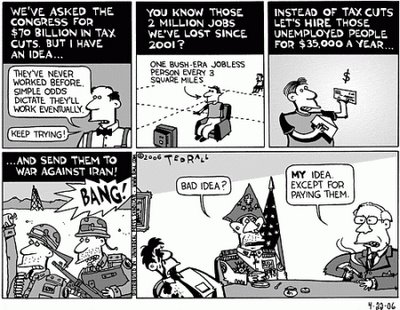
How many lies can Ted Rall make in one cartoon?

Or is he really that much of an idiot to believe his own tripe? Here's his "cartoon" from Saturday. And I use "cartoon" loosely, because as many before me have observed, his drawings have all the sophistication of an elementary school student's scribbles. (Remember, Rall is the one who accused Art Spiegelman of lacking talent.)


Let's deal with it one frame at a time. Here's the truth about tax cuts. As Jack Kemp pointed out in 2003, Kennedy cut taxes. (I'm not the first to note that today he'd be shunned by his own party.) The result: economic boom and increased tax revenues. Reagan massively cut tax rates, especially on the very top incomes upon which most people's jobs depend. The result: the end of stagflation, increased federal tax revenues, and the prosperity of the 1980s (often wrongfully maligned as an era of "greed"). And before them, Calvin Coolidge and Congress in 1925 lowered the top tax rate to 25%. The result: continued economic prosperity through the rest of the 1920s, until the Federal Reserve pulled the carpet out from under Americans (cutting the money supply by a third, triggering the Great Depression).

Compare this with what Franklin Delano Roosevelt did to create a new low in the Great Depression. As I wrote in April 2005:
Keynesian-apologist bunk like this blames the Depression's sudden worsening on a cut in federal spending. The claim is that FDR wanted a balanced budget. The raw data shows that FDR's "balanced budget" had an 8% spending drop in 1937 compared to 1936 to 1937, and a 10% drop in 1938 compared to 1937 (17% overall). However, "tax receipts" surged 37% in 1937 compared to 1936, and then 25% in 1938 compared to 1937 -- an overall increase of 72%. Yes, the federal government cut spending, but it was simultaneously raising taxes -- raising taxes a lot. The top tax rate soared to 79% in 1936, after being raised to 63% in 1932. Massive spending cuts by themselves would have sufficed, but not with simultaneous tax hikes. The higher taxes and constrictive regulations simply discouraged businesses and their owners from doing anything profitable with money. Business owners could expand their businesses, but the after-tax income wouldn't be worth the increasing marginal cost. Would-be investors could save money, but who would borrow it? Government making it unprofitable to create wealth is why the Depression worsened, not because FDR wanted a balanced budget.
Supply-siders like me point out that a balanced budget isn't everything. In fact, it's worse than government borrowing when it means tax hikes (which discourage economic activity) to finance continued high levels of spending.

Regarding the second panel, keep in mind that I'm just a regular Joe. I have no access to economic data to which any of you and Ted Rall are restricted. So when I look at BLS employment statistics, available to anyone in the world, and see that non-farm employment now is over 2 million greater than in January 2001, I can only think of one word to describe Rall's willful ignorance of plain facts: bullshit! I seem to be using that word a lot lately. Lately I've been really tired (not really overworked, but I have so much to do), and maybe liberals' idiocy is starting to get me.

By the way, Rall can't do simple mathematics, either. The United States has a surface area of 3,718,711 square miles (both land and water). So even were his stupidity true, it would be one "Bush era jobless person" every 1.86 miles.

At least his math was correct in the subsequent panels, but his perception of reality, as usual, was off. If the U.S. military recruited two million more people at annual pay of $35,000 each, the total cost would far exceed $70 billion. That's because the U.S. military has extremely high equipment costs per person. Compare the Pentagon's request of $440 billion for 2006, and the 1.4 million active duty personnel (with another 1.3 million or so reservists) in the U.S. armed forces. Keep this in mind the next time someone says that military personnel don't get paid enough. Not to denigrate military service, but when operating costs are extremely high, and your customers (American taxpayers in this case) are willing to pay only so much, you therefore cannot pay your employees very much. And it's possible because there is actually quite a labor pool of people who are willing to serve in the armed forces for not a lot of money (i.e. their employment value at the margin, as Don Boudreaux explained).

I suppose, though, that Rall would finance it with more tax cuts on the rich. Perhaps more tax hikes like FDR's, which plunged the U.S. deeper into the Depression? More tax hikes like Clinton's, which did nothing for the American economy, though Paul Krugman claims they "ushered in an economic boom"?

This is the economic argument. I'm not even getting into the moral argument: it's your money, so why should others have the authority (not "right" or "freedom") to take and spend it as they wish? "Theftinomics" is a word Rall made up to describe government economic policies that are based on theft and fraud. That's a perfect term, actually, for Rall's socialism (euphemistically called "progressive liberalism" by mainstream media). If someone makes $1 million without coercing anyone, without committing a crime, then why are any of us entitled to a penny of it? Yet governments at all levels insist on their cut, so they can redistribute it to everyone else.

It's said that a broken clock is still correct twice a day. Does it matter when a broken clock like Rall is correct but only for the wrong reasons?

Labels: , , , ,

Tuesday, September 06, 2005

What the British are teaching their children about the U.S.

A couple of weeks ago, Capital Freedom observed how terribly written modern history books tend to be: there's much of information, but ultimately no substance. I came across this education-oriented website in my Internet travels, and while it isn't a textbook, it still contains outrightly false claims, much like a bad textbook steeped in historical revisionism. For example:
The Wall Street Crash in October 1929, created the worst depression in American history. President Herbert Hoover was slow to provide federal relief to farmers and stubbornly refused to give help to the unemployed in urban areas. Hoover vetoed a bill that would have created a federal unemployment agency and also opposed a plan to create a public works programme.
The Crash of 1929 did not "create" the Great Depression. It is often considered to mark the perceived beginning of the Depression, but it was actually just another precipitate of the circumstances that really caused the Depression. Briefly, the Depression stemmed partially from agricultural overproduction (self-induced deflation), but principally from the Federal Reserve suddenly tightening the money supply after encouraging years of unsustainable growth via loose monetary policy. The Hawley-Smoot Tariff of 1930, and other nations' retaliatory tariffs, exacerbated the Depression by destroying international trade. Hoover and FDR's massive federal spending also worsened the situation, which I will detail later.

It is completely wrong to claim that Hoover didn't commence public works projects to help stimulate employment: FDR's "New Deal" was simply a successor to Hoover's policies. While Hoover may not have instituted programs to help farmers like Roosevelt did, Hoover focused on industrial employment. He was hardly slow to commence federal interventionism into the "unemployment situation."

I've never spent the hours required to compile an exhaustive list of Hoover's support of public works, but the owner of this site did, and he lays it out so well. It documents Hoover's many instances just from late 1929 through mid-1932 of advocating and planning public works programs. He did veto two bills that were intended for "unemployment relief," not because he opposed them in principle, but because the federal budget couldn't afford such spending. It is patently false to portray Hoover as any different than FDR when it comes to the proto-Keynesian absurdity of establishing government programs to "increase employment": one was as bad as the other. Last March, I was highly critical of Bob Herbert for his insinuation that Hoover was a sort of "limited-government conservative" who nevertheless distrusted capitalists.
As governor of New York, Roosevelt made strenuous attempts to help those without work. He set up the New York State Emergency Relief Commission and appointed the respected Harry Hopkins to run the agency. Another popular figure with a good record for helping the disadvantaged, Frances Perkins, was recruited to the team as state industrial commissioner. With the help of Hopkins and Perkins, Roosevelt introduced help for the unemployed and those too old to work.
Roosevelt did indeed help people find work, and the two biggest beneficiaries are named right there: Harry Hopkins (who became one of the New Deal's chief architects) and Frances Perkins (who served as Roosevelt's Secretary of Labor and was instrumental in Social Security's creation). What more comfortable job is there than a bureaucrat's?

What dismays me most about that site is how, in discussing Roosevelt's New Deal, it promotes John Maynard Keynes' greatest fallacy: "To dig holes in the ground, paid for out of savings, will increase, not only employment, but the real national dividend of useful goods and services."

Bastiat in "What Is Seen and What Is Not Seen" famously exposed the "broken window" as an economic fallacy (which we're still seeing today in natural disasters' aftermath). Less well known is that, in the same essay published over 80 years before Keynes' General Theory, Bastiat refuted the notion that government spending can increase employment. Yet many Republicans still believe as much as Democrats, which I discussed in my entry When conservatives become socialists. Whether it is 19th century French government taxing a farmer to fund state dinners in Paris, or New York City and New York state taxing their citizens to spend possibly $1 billion to help construct a football stadium, the ultimate effect is still the same. The farmer now has no money to drain his field, and modern taxpayers have less money to spend on what they want. There is no increase in total spending, only a transfer -- at best.

We saw this very situation in Hoover and FDR's tax hikes to finance public works: businessmen had less money to invest and hire, since the federal government taxed it away and spent it on public works that largely produced nothing. Back in April I recounted the disastrous tax hikes to finance the New Deal; the first was actually in 1932, under Hoover. Obscenely high marginal tax rates stifled the already weak U.S. economy as businessmen gave up trying to create something with their money. Who will work at something profitable when government will take most of it? So when Brad DeLong claims the federal government had to step in during the Depression because there was no business investment, he's confusing cause and effect like his mentor Paul Krugman (scroll down a bit for the update with my comments). There was no business investment because the federal government had stepped in.

Tuesday, January 10, 2006

What hath the free market wrought?

(Don't miss my preceding entry, The rule of law, "overpriced," market clearing, and information in markets, which gives good background to this entry.) Reader Michael Bolig had sent me someone's false accusations against the free market. Actually I'd already seen them here, having noticed a little traffic coming from that site. Michael had posted the link to my entry last night, where part of my discussion was the superiority of the free market over central planning. Here's a line-by-line response:

The market is capable of generating an enormous amount of wealth, no doubt.

As opposed to the state-driven slavery and poverty of central planning? I'll take the free market any day.

But here are some things an unfettered, free market CANNOT or HAS NOT done:

* The market did not anticipate or resolve the use of child labor in this country and elsewhere. It created it.

This is complete ignorance of cause and effect, both in history and economics. Child labor existed has existed since the dawn of man for one reason: societies were so poor and could produce so little that parents needed their children to work. Modern history books omit that before factories and other manifestations of urbanization, children performed back-breaking labor on the family farms. In a recent e-mail to Don Boudreaux of Cafe Hayek (I originally said "told," but he's a much smarter man than I am, so I can't really "tell" him anything), of course no one wants children to work. If we had the power to create an ideal world, we would have no adults work, either. I will refrain from saying children should work or should be prohibited from working. Instead, I will recognize that some societies need their children to work. Do you want to eliminate child labor in the Third World? Then you will condemn families to starvation, or at least increased poverty, because the parents alone cannot earn enough income. Shall we then try to pay them higher, "fair" wages? That nonsensical approach ignores the reality of finite money. Because their buyers (including we Americans when we import) can purchase only so much, doubled wages mean that only half will remain employed. Tripled wages mean that only a third will remain employed. This is why the minimum wage does not work, because some will receive more money while others are left unemployed. There is no escaping the reality of finite money. In my mother's home country of the Philippines, one need not travel too far outside Makati (Manila's business and entertainment district, equivalent to Manhattan) to see cardboard cities, and the harsh reality that a lot of children must work so the families don't starve. It wasn't too long ago that American families faced the same thing. My father was only 11 when the Depression hit. Though he didn't have to work in a factory, at least that would have paid more than the often futile attempt to sell apples on Schenectady streetcorners.
* The market did not anticipate or resolve the demand for slavery. It demanded free labor and created it.
Clearly this person doesn't understand what the free market is. The free market prohibits the use of force, which is what slavery needs to exist. The free market requires individual freedom, property rights and purely voluntary transactions, so it in fact is completely opposed to slavery. As a matter of history, it has almost always been government that either began or supported slavery. In the West it was Spanish imperialism, because the conquistadores had no regard for indigenous people's rights. Since they were military agents of their country, it was government that began the practice of slavery. Then the British continued the practice, encouraged by their government's issuance of various charters and other incentives to do business in the American colonies. After the colonies gained independence, the U.S. federal government specifically blessed slavery, even long after it was abolished by every other Western nation, which all did so without bloodshed. Prof. Thomas DiLorenzo in his book The Real Lincoln pointed out that South American nations, which I describe as forged in the fire of Spanish slavery, still abolished slavery peacefully. Only the United States has had to fight a war to abolish what was federally blessed slavery, and why? Because government had given its blessing, making slavery such an established institution that the free market could not destroy it. Update: let me clarify, in case some of you might be wondering. I definitely know that the Civil War was not fought specifically to "free the slaves," but my phrasing is because the abolition of slavery was a result of the North's victory. If you're familiar with The Real Lincoln, you'd know one of DiLorenzo's themes is peaceful secession: the question was not just if states have the right to permit slavery within their borders, but whether they can leave the Union at will. And long before I read his book, "states' rights" was quite emphasized in the Utah public schools I attended. Yes, that's right: allowing the free market to work would have destroyed slavery. DiLorenzo explained the simple economics: slaves just aren't very good workers. Supposedly you only have to clothe them a little, feed them a little, and house them in the worst of conditions. However, you won't get a lot out of them. You'll incur greater costs hiring a free worker, but you'll get far more from him: it's spending a little more to get a lot more production. You won't have to waste time beating slaves or chasing after runaways. A private worker who doesn't work hard enough or doesn't show up at all, on the other hand, can be fired. Let's not forget that the slaves were typically sold by fellow Africans who had captured them. But they were not taken prisoner specifically to sell, but because they were captured in war. Again, that's not the nature of the free market.
* The market did not anticipate or resolve the polution and burning of Boston Bay or the creation of thousands of superfund sites. It created them.
No doubt this person also believes that guns kill people. Actually, people kill people, and it is people who create the pollution. Before Superfund sites, before our modern industry that gave us wonderful technology to improve our standard of living, we faced far greater pollution threats from our own sewage. Recall how Drew Barrymore was ecstatic at being able to "poop in the woods" or some such tripe, which continues today in places like India, where rivers are used for sewage, drinking water, bathing, and disposal of human ashes. Only a century ago, instead of worrying about pollution from automobile exhaust, we worried about diseases from horse dung. Nobody cleaned it up, so it typically stayed in the street, where it would dry into dust and be carried away by the wind. Humans have always had to worry about pollution, even in the most "natural" conditions that we idealistically liken to Eden. The Superfund sites themselves are very dangerous, but it's like the old joke: a man tells a doctor that it hurts when he does a certain action, so the doctor replies, "Then don't do that!" Very few people live near such dangerous sites, and because of the wonderful wealth that the free market created in the U.S., those affected were able to find other places to live.
* The market did not anticipate or resolve acid rain or the hole in the ozone layer. It created them.
As the years have shown, acid rain is far from the Armageddon that environmentalists predicted. Which is better, slightly more acidic rain that in reality affects relatively few people, or a lack of industry that results in a low standard of living, and thus highly polluted rivers because of a lack of sanitation? You can't have it both ways. That man has created the hole in the ozone layer is one of the great environmental myths. Just like global warming, it's been around long before heavy industrial activity. Hint: solar radiation, which, in conjunction with natural occurrences like volcanoes (Pinatubo is near my family's hometown), also causes more global warming than human activity.
* The market did not anticipate or resolve the Great Depression. It created it.
Completely untrue and just plain wrong. As Milton Friedman demonstrated decades ago, the Federal Reserve, whose very function is contrary to the free market, triggered the Great Depression by reducing the money supply (sometimes said to have been by a full third), after the Fed had spent much of the 1920s inflating the money supply to create an artificial boom. Then J.P. Morgan and other cohorts attempted to sustain the unsustainable by trying to save the stock market. Stocks should have been allowed to plummet so that they would reflect their true value, but the bankers refused to let the free market work. For further reading on what really happened before and during the Depression, see here, here, here and here.
* The market did not anticipate or create the 40-hour work week, the two-day weekend, safe working conditions, and employer-provided health care, pensions, or defined-benefit plans. It fought them.
Absurdities. The modern work week is the product of a society's wealth, not government. Government can mandate that, health care, pensions and all the safe working conditions it wants, but without technological advancement, it can issue regulations until every bureaucrat is blue in the face. And how do we achieve technological advancement? Not just the free market, but pure capitalismZ. Shorter work weeks, better working conditions, and benefits like health care, are in fact products of competition. So again, this person is completely wrong: the free market will produce benefits. Companies will offer greater incentives to attract the best people, so that they can maximize output, which allows them to offer even more to retain the best employees.
What resolved all of the terrible sins of an unfettered, free market? Government partnership with business and labor and the mixed economy they (we) created. Period.
What utter elephant dung! It has always been big government and its chartered "business allies" (which are not the free market) that tyrannize and enslave people, maintained a feudal system for centuries against free market principles, and make people unemployable with myriads of regulations.
Folks like Bolig either forget or choose to ignore the inherent pitfalls of extremism. His economic policies are just that, and they run counter to the economic practices that here to date have made our nation so strong.
I hate to break the news to this person, but it's the "unfettered free market" that is the sole reason for American prosperity, not government. But if he'd really like to extol the virtues of government, why doesn't he mention the homes that people are forbidden to build, just because of some small "endangered" animal that isn't even native to the area? What about the traffic congestion created by government, which forbids the construction of new roads? My friend Charlie told me that the "wetlands" controversy still continues in Utah after God knows how many years. This 120-mile highway would do wonders for people who must commute along I-15. But opponents criticize the plan as "cutting a terrible swath through world renowned wetlands and fertile farmlands, contributing to automobile-dependency and sprawl." World renowned? How many people outside Utah would consider the wetlands that, and how many people outside Utah even know there are any wetlands at all? In the six years since I left Utah, I myself had forgotten. And, Charlie reminded me, the wetlands were created by man; after all, Utah was principally a desert. How about the fertile farmlands? There's plenty elsewhere in the U.S., so much that we're the world's greatest food exporter. What the people of Utah need is more space to drive, not grow crops.
I wonder what names Bolig will resort to calling me now?
Worshipper of the state, as Bastiat put it, would be quite apt.
Any possible proceeds (and that's a big if) from ANWR won't come online for a good ten years. That doesn't help is this winter. It also doesn't help our air and water ten years from now.
Completely wrong. First, let's all be clear on the fact that the proposed drilling site is a very small part of ANWR. This area happens to be so barren that it's properly compared to the moon, and with no vegetation there, no animals live there. There are animals elsewhere in ANWR, just not where we're going to drill. To claim that wildlife will be affected is akin to opposing repavement of Central Park Drive because it will affect the wildlife at the Bronx Zoo. Second, the current price of anything is always a reflection of current and future supply. If people think future inventory will be limited, they will buy more today to stockpile. That's why the price of petroleum and gasoline rise the moment there's a hint of a supply shock. (Read this for more on how higher prices force people to conserve, and simultaneously encourage people to supply more). We don't even have to start drilling in ANWR: global crude prices will start falling once Congress merely approves the drilling. Prices won't come down by $20 per barrel, but they will drop because people will know we have a reliable future supply. To those who oppose drilling in ANWR but call Middle East oil "a threat to national security": you would put a few expendable reindeer above national security? I myself don't consider imported oil an inherently bad thing. I explained in this entry why "energy independence" is not a strictly desirable thing. If you're worried about Muslim nations getting more money to finance terrorists, fine, but in and of itself, there is nothing wrong with importing anything. Why make something yourself when you can buy it for a cheaper price? If we're truly worried about sending money to Saudi Arabia that gets diverted to terrorists, then ANWR's supply (about two full years for the U.S.) can replace about eight years' worth of imported Saudi Arabian oil. The Saudis, especially with how the royalty spend money like water, would likely be willing to negotiate certain reforms long before that time is up.
I agree - I think tax breaks for anything is poor public policy and contributes to making our tax code incredibly arduous and untenable. If we decided we need something collectively, then we should raise the revenue up front and pay for it. If we (government) cannot afford it, we shouldn't buy it. The market rewards debt-free players. Clinton showed us that in the late 90s.
I explained a while ago why specific tax breaks ("incentives") are the wrong way to cut taxes. The economic growth in the 1990s had nothing to do with Clinton's "economic policies." It was the time of a great economic boom, spurred by leaps in productivity -- all factors far beyond Clinton's influence, let alone. The only two things Clinton did for the American economy were NAFTA and agreeing to the Republicans' 1997 tax cuts, which did help, but they enhanced the boom, not created it. Clinton's "economic policy" of balanced budgets is another economic myth: the federal budget was never balanced until the very late 1990s (and even then it needed Social Security revenues to mask its deficit), when our economic growth was unsustainable and we were headed for recession. The market rewards those who act prudently, including borrowing. Look at the American economy in the 1980s: huge budget deficits, but the low tax rates encouraged people to invest, and that grew the economy faster than the need to borrow. If you can borrow $1000 and turn it into $2000, are you going to refuse just because you must pay back a total of $1500? Why turn down $500?
And not only does it penalize a government in debt (us taxpayers are paying billions of dollars in interest now, folks, courtesy of Republican leadership), but it penalizes the everyman by way of increases in interest rates. The more money government borrows, the more expensive it is for everyone else to borrow it. Supply and demand applies to the dollar as well.
Part of the reason I am a supply-sider is that I believe it is permissible for a government to borrow for prudent things. As I explained here, government borrowing does not carry the disincentive of raising taxes. We may "burden" our children with repaying the money at interest, but our policies in the present time will grow the economy such that they can easily afford the debt service payments. Is it such a bad tradeoff that your children will pay back $5000 a year in principal and interest, when you've increased their salary from $50,000 a year to $70,000? The last two statements betray a lack of understanding of real-world economics. "Rubinomics," the notion that government borrowing "crowds out" private borrowers, does not exist in an open economy with any creditworthiness. Foreigners, mainly China, Japan and South Korea, are more than willing to sell us inexpensive goods, then lend us a good portion of what was once our money. It's not only U.S. creditworthiness, but because so many foreigners are competing with each other to buy U.S. Treasury bonds, that we're not really paying a lot of interest for the amounts borrowed. Take a look at current yields, and they're astonishing in the face of repeated Fed interest rate hikes.
What's worse - Democrats who pay their bills, or Republicans who borrow and spend?
By far, Democrats who insist on tax hikes to cover their profligate spending, which only stifles an economy while providing goods and services with wasteful efficiency. When a nation has the ability to borrow from people who are crawling all over each other to lend to you, it's stupidity not to take free money. However, I have assailed conservatives many times for unnecessary, unconstitutional spending.

Monday, August 21, 2006

Analysis of the socialist mindset

Previous:
The intellectual bankruptcy of the left, part IV
Rumors of Wal-Mart's demise are greatly exaggerated

My analysis:

I'm continually amazed that middle class, educated, young people who, on the face of it, are among the most privileged on the planet develop such jealousy of others' wealth.

Was there some personal tragedy in their lives that colored their outlook? Or had they truly been brought up in an intellectually bankrupt environment and thus just repeat the prejudices instilled in them by their elders? Or do they have a personality which requires a pat "Let the government fix it!" answer to complex social issues and thus latch onto the first authority figure that they come across that provides this?

These days many have chosen Franklin Delano Roosevelt as the model for social and economic organization. Others have chosen Keynes to provide their moral framework, while others have picked Krugman to provide the foreign policy framework.

Clearly it is a result of having passed through the school system, which is a period where critical thinking is never taught. Whatever the reason, the results are predictable and tiresome. Thoughtless arguments, catch phrases in place of opinions, ad hominem attacks and stereotyping.

This is too bad, because these people are in charge of society, and their superficial understanding of how the world should work doesn't inspire hope that intelligent solutions will be forthcoming to society's continual problems.

"Tax the rich" is borne of nothing more than jealousy; it is pointless and thoughtless. Rather than blathering on like this, take some time and learn about the real world. Read some history and see how the themes of today have recurred many times in the past and that the only times the people (that means you, me and everyone else) came out ahead was when government was quashed.

Try the books of Friedrich Hayek, Ludwig von Mises, Milton Friedman and Ayn Rand for a start.


I have to admit something: every last italicized word was utterly vacuous tripe. So, it's a good thing that all I did was take what our socialist visitor posted the other day and replace a few words. If you look closely, you'll see that I also corrected verb conjugations and added a few necessary punctuation marks. In his meretricious claim to seek honest discussion, he demonstrated a less-than-complete command of the English language.

It's a testament to the intellectual bankruptcy of the left that their arguments are so generic, so vapid, that you need only change a few words to change their position completely. Remember Bill Clinton's cameo in "Contact"? That only demonstrated that the president can say anything, and it's so fundamentally meaningless that you can take a piece and apply it to whatever you want.

What single word in any of Bobby's arguments at all refuted what I had said? I'm still waiting for his proof that Wall Street is abandoning Wal-Mart, let alone his ridiculous notion that "traders and hedge funds" are the ones who control stock markets' direction. And like most other socialists, when persistently rebutted with actual fact, he said he's "done" with my blog after his rhetoric proved inadequate. Boo hoo, he's taking his marbles and going home. Hear that? That is the sound of the door hitting him on the way out.

"Resist the devil, and he will flee from you." Rejoin socialists' claims with sound logic, and they will flee. My warmest thanks to Billy, Mike and Shamus: when the day comes, I look forward to standing with you.

Why do socialists believe the way they do? It's an irrelevant question: for whatever reason, they've come to depend on and extol government as the solution. It comes down to the expression that "When all you have is a hammer, everything looks like a nail." Government is the socialists' hammer: they cannot conceive of any solutions to society other a new government policy or program. Ironically, they claim believers in the free market, like me, give simplistic solutions, when as Don Boudreaux explained, "To recommend the market, in fact, is to recommend letting millions of creative people, each with different perspectives and different bits of knowledge and insights, each voluntarily contribute his own ideas and efforts toward dealing with the problem."

I critique the efficacy of government because if we, imperfect as individuals, cannot make the proper and best decisions for ourselves, then how can government be any more competent, discerning and successful, since it is comprised of us? There's nothing magical about going into public service that suddenly makes a person always seek the best for "the public good" (a concept I don't believe exists at all). James Buchanan and Gordon Tullock's contributions to public choice theory were especially important for revealing politicians and bureaucrats as self-interested when it comes to public policy as they were in the private sector.

I don't believe in Wal-Mart, or any business. I do believe in capitalism, which is predicated on the free market. The free market is simply where people are be free to reach their own agreements with each other, where no one has the right to force either party against their will. Liberals, though, believe that people are too stupid to make their own decisions, insisting that we need a government to "coordinate" our efforts, determine what is "fair," and keep us "safe." Again, though, government is comprised of people who are still imperfect beings.

Why should I defer my own decisions to another imperfect person who cannot possibly be more aware of my personal circumstances than I? Why should I trust someone who, as history proves time and time again, is hardly going to look out for me any more than he'll look out for himself and special interest groups? "Oh," the socialists counter, "but he is less imperfect than you. Elections are about determining who are the best among us, so that they may guide our collective efforts." Is that so? One look at Ted Kennedy makes me wonder just how imperfect every Massachusetts voter must be, and I don't know too many Utahns from my 14 years there who'd be much worse than Orrin Hatch.

As Bastiat, my patron saint, declared in The Law, "God has given to men all that is necessary for them to accomplish their destinies." The same God who gave us the unalienable rights to life, liberty and property also gave us sufficient faculties to recognize and use them at our own discretion. Bastiat declared at the end of The Law that "liberty is an acknowledgment of faith in God and His works," therefore you are denying God's wisdom if you give up your liberty so that others may govern your life. I, for one, would rather make my own mistakes instead of someone making potentially worse mistakes for me. And if I harm no one but myself, then like Christ's reply when Peter asked if John really wasn't going to die, "What is that to thee?"

But socialists like Bobby, as bastiat explained, want to play God with society: they form an idea of how things ought to be, then set about reforming society. They justify their intentions by pointing to the past and claiming their "liberal" policies have bettered society. Nothing could be further from the truth. Some time ago, I asked and answered the question, "What hath the free market wrought?" Well, what has it? Nothing that liberals accuse of it, i.e. child labor, slavery, pollution, the Great Depression. I will be charitable and excuse any liberal for ignorantly believing that the free market at all influenced the first three. However, I will forever say that any liberal is a damned fool if he believes the free market had anything to do with the Great Depression.

Just as the free market is not guilty of these accusations, "progressive" government policies are hardly responsible for any disappearances of child labor (which occurs only when societies prosper beyond a point where they starve if children don't help), the emergence of the 40-hour work week (again the natural result of a prosperous society that no longer must toil from sunrise to sunset), and things like insurance (partly because of how firms compete for employees, and partly because of government tax policies that make it cheaper to offer $5000 worth of insurance than another $5000 in pay). Liberals, though, are confused by the logical fallacy called cum hoc ergo propter hoc: they assume that because these things occured during the expansion of "progressive" government, these things occurred during that expansion. In fact, like the government-borne economic woes in South America that Paul Krugman foolishly blamed on the free market, these things occurred despite anything government did.

What about my job in corporate compliance? Am I not receiving pretty good pay only because government has reined in big business, requiring them to be responsible to their clients? Actually, think of how compliance analysts like me, or accountants, or lawyers, would have better jobs if the firm didn't have to employ so many of us in capacities that generate no revenue. My job would probably still exist in the same way, I think, since my firm prides itself on having the toughest ethics standards (far beyond what the SEC requires). Regardless, the firm's managers (and their subordinates) are more than capable of determining on their own, without a government body telling them, whether or not they need me. They can make determinations based not so much on what the owners (shareholders) say, but what our clients say. Or do, if they bring new business to us, or take their business elsewhere.

Similarly, I need no government to create a job for me, to determine what my "fair" wage is, to determine what is the most optimally nutritious food for me to eat, or anything else that involves me and just me. Do you?
Look at the entire world. Which countries contain the most peaceful, the most moral, and the happiest people? Those people are found in the countries where the law least interferes with private affairs; where government is least felt; where the individual has the greatest scope, and free opinion the greatest influence; where administrative powers are fewest and simplest; where taxes are lightest and most nearly equal, and popular discontent the least excited and the least justifiable; where individuals and groups most actively assume their responsibilities, and, consequently, where the morals of admittedly imperfect human beings are constantly improving; where trade, assemblies, and associations are the least restricted; where labor, capital, and populations suffer the fewest forced displacements; where mankind most nearly follows its own natural inclinations; where the inventions of men are most nearly in harmony with the laws of God; in short, the happiest, most moral, and most peaceful people are those who most nearly follow this principle: Although mankind is not perfect, still, all hope rests upon the free and voluntary actions of persons within the limits of right; law or force is to be used for nothing except the administration of universal justice.
What Bastiat wrote still holds true 156 years later, yet despite the decades of evidence of tyranny and fallen empires, many still cling to the idea that government can create prosperity by interference.

Labels: , , ,

Monday, August 13, 2007

The latest reason to disregard the AP's "economic" news

"U.S. Homeowner Woes Felt Around World" laments the headline. With phrases like "The latest crisis in financial markets," "fears that Americans are failing to keep up with their mortgage payments" and "a glut of foreclosed homes," you'd think it was the end of the world. After all, we have sources like the prescient "Gabriella Savarini, a 69-year-old shopkeeper in Rome"! Never mind that she's telling us the obvious ("problems on the stock exchange have consequences for the economy of America and of the world"), the fact that the Associated Press quotes her means we must regard her opinion as gospel, right?

Let's go through some of the ludicrous doomsaying in the article:
"The sharp falls in global stock markets obviously affect consumer wealth, which again could dampen spending," said Howard Archer, chief British and European economist at Global Insight.
How can a top economist at any reputable company be so confused about saving and spending? If this is an example of their usual "insight," then Archer and his employer had better stick to providing raw data, instead of analyzing it (let alone making predictions!). The "sharp falls" will have minimal effect on the portfolios of those who meant to save their stock investments. On the other hand, the drops will, as we'll see below, (properly) penalize those who think they can time the market with short-term investments.
The most immediate effect for the half of all American households who own mutual funds and other individual investors worldwide is a decline in the value of their investments, which may or may not be short-lived.
This will require a trifle lengthy debunking, as I'll have to get into numbers. Thankfully, people like Paul Krugman and the AP's "economic writers" (particularly the perma-bear hacks Martin Crutsinger and Jeanine Aversa) are a great indicator of the economy. When they're predicting gloom while there's a Republican in the White House, things are actually going great.

Stock markets across the world have been dipping lately, but as far as the American exchanges, let's look at the facts. As I noted back on April 5th,
Year-to-date, the DJIA has gained only 0.8%. But if you had bought a Dow Jones Industrial Average index fund on February 28th, the day after it closed at 12216.2402, then your purchase as of April 5th's close would have already gained 2.8% (the DJIA closed at 12560.8301). If you had bought on March 6th, the day after the market "tumbled" to 12050.4102, then your purchase as of April 5th's close would have gained 4.2%.
As I explained in that post, I refer to "the day after" because when you buy a index fund, the Net Asset Value is calculated from the underlying securities' prices from the day before. So on February 28th, you're buying at prices determined at the close of February 27 (the day of the first big dip).

The Dow Jones Industrial Average was at 12216.2402 on the close of February 27th, and at 13239.54 on the close of this last Friday, August 10th. So if you had bought into a simple DJIA index fund on February 28th, then excluding fees and taxes, you'd now be up almost 8.4%. If you had bought into the index fund on March 6th, the day after the DJIA closed at 12050.4102, you'd now be up almost 9.9%. (For simplification purposes, when I talk about funds' gains, I'm not counting dividends you may receive.)

Let's look at the S&P 500: 1399.04 at the close of February 27th, 1374.12 at the close of March 5th, 1453.64 at the close of August 10th. So the gain since February 27th is still 3.9%, and the gain since March 5th is 5.8%. For the NASDAQ, the numbers are 2407.8601 at the close of February 27th, 2340.6799 at the close of March 5th, and 2544.8899 at the close of August 10th. The gain since February 27th is 5.7%, and the gain since March 5th is 8.7%.

So what's the lesson, that the DJIA is better? Not necessarily. The first secret to successful investing is to diversify: index funds in each of the three (plus others like the Russell 2000) are a desirable, and even then, they are only a portion of a successful portfolio. Buy into some tech funds, but don't ignore other vehicles like emerging market funds, health care mutual funds, and energy SPDRs.

But, naysayers may argue, what about those who buy at the top of a bull market? After all, the DJIA closed at 14000.4102 on July 19th, the same day that the S&P 500 closed at 1553.08 and the NASDAQ closed at 2720.04. The losses since then, respectively, have been 5.4%, 6.4% and 6.4%. Well, the second secret is that no matter how well or poorly the markets are doing, think long-term. Wait a few years and see how the averages do, considering U.S. stock markets have a consistent historical upward trend. Individual investors should never expect to get consistent short-term gains, but they can have every confidence in the long-term gains of properly diversified holdings.
The distress in the markets makes it harder and more expensive for businesses and consumers to get loans and cash, Archer said. If companies cannot get loans, they cannot expand and may have to cut expenses, typically through layoffs.
This is a common logical fallacy: make a questionable statement, and make it seem valid by immediately making a generalized statement that is only generally true. In this case, the current "distress" in the markets does not necessarily make it harder for "businesses and consumers to get loans and cash," whether any particular entity or on average. Such a blanket statement is simply not true, for the very reason that if you are competitive, then by definition, you'll get a loan at competitive rates. So it's more accurate to say, "The current dip in the markets, which some economists and financial analysts explain is a natural correction from recent highs, could further tighten the easy credit of the last several years. If so, it will be harder for less competitive businesses and consumers to ride the coattails of the successful when seeking to borrow."
America faced a crisis similar to the current mortgage fiasco when hundreds of savings and loan companies went belly-up in the 1980s. Back then, the fallout did not spread dramatically to foreign shores because the U.S. government stepped in to bail out the banks and repay depositors.
So is the reporter shilling for Hillary Clinton or John Edwards, that he implies the federal government will need to bail out all these defaulting mortgages? Is he even serious in making the comparison to the S&L scandal? The two situations are completely different. The S&L crisis was borne of government, first because the federal government insured S&L loans (creating the moral hazard of encouraging S&Ls to make bad loans, knowing they couldn't lose if the loans weren't repaid), and second because of certain government officials' participation in the fraud that exacerbated the collapse. What's happening today with mortgages is typically that stupid people get in over their heads by borrowing money they latter cannot afford to repay, allowing smart investors to buy foreclosed properties. Finally, the doomsaying about "foreign shores" didn't apply then or now: foreigners weren't heavily invested in S&Ls compared to other things, and the same applies today. Foreigners love our stocks more than investing in S&Ls or buying mortgage-backed securities, and they especially love U.S. Treasury securities and our real estate.
A steep sell-off in global markets on Thursday and Friday was triggered by distress signals from France's biggest bank, BNP Paribas, which had to freeze billions of dollars in assets in three mutual funds because of the falling value of securities linked to high-risk mortgages taken out by U.S. borrowers.
Incorrect. They were hedge funds that dealt with asset-backed securities, which are different from a mutual fund. Hedge funds are all about investing in very high-risk securities, and with the fact that they require heavy initial investments (US $100K is not uncommon), would-be investors know what they're getting into.

In any case, BNP Paribas only temporarily suspended redemption of three funds, whose aggregate value is about $2 billion (compare that to the, what, $10 trillion today in mutual funds?). Now, the mainstream news would you have think the worst, that BNP was having troubles like American Home Mortgage (which recently collapsed into bankruptcy because it cannot repay loans). But the reality is that BNP didn't have any loan troubles, but that with the latest market volatility, it simply had trouble valuing the funds' underlying securities. Doesn't it make sense that if you don't know how much something is worth, you can't trade it?
Global interdependency isn't a recent phenomenon: The Wall Street stock market crash of 1929 and the Great Depression affected the entire world, and helped create the conditions for the rise of fascism in Europe.
Stock markets were only one portion of the Depression, and in fact, the events of October 1929 was merely a symptom, not a cause. (Click here for my blog entries involving it, they're all worth a read.) Simply, the Depression was triggered by the Federal Reserve suddenly cutting the money supply by a third in the late 1920s, then exacerbated by the Hawley-Smoot Tariff (protectionism that hurt all nations that tried to retaliate against each other), and further by tax hikes that strangled any attempts to invest in business growth (as compared to "public works" that wasted money hiring people to dig holes and fill them back up, or build bridges nobody needed at that cost).
But with faster communications and real-time trading, market jitters in New York race around the world almost instantly today.
And this is undesirable? Information should spread as quickly as possible, because markets work most efficiently that way.
More Americans are failing to keep up with their home mortgage payments, and there are concerns that this could ripple around the globe because much of the debt from mortgages has been packaged into securities sold to pension funds, banks and other investors who were hungry for high returns on investments.
This would be a problem if most or at least significantly more Americans were having trouble, but that's not true.
The same mortgage securities in the U.S. that are crumbling in value are a part of bigger holdings that banks from Japan to Germany bought into because of low U.S. interest rates and a good returns.
They're part of overall portfolios, but not a major component at all. Remember that word "diversified"?
Meanwhile, the ability of banks to convert assets to cash quickly was in doubt because some were unable to track how much money they poured into now worthless securities backed by sub-prime U.S. mortgages, or loans made to high credit-risk individuals.
The attempt is to lump all sub-prime mortgages together, and make it seem like they're all in trouble. They're not. But, the liberal media always needs to create some sort of economic Armageddon, at least when a Republican is in the White House.

The rest of the article is historically accurate, but with the same Chicken Little tone. UBS lost $125 million, and Bear Stearns closed two funds that had been worth $20 billion. Yet the companies are still solvent, aren't they? We shouldn't be surprised that they are. Financial giants and their high-risk investors are prepared for such losses: hedge funds' inherently high risks keep them from being no more than a small portion of, you guessed it, a properly diversified portfolio.

Toward the end, it's explained how central banks are intervening, as they've occasionally done in the past, increasing the supply of loanable funds by injecting money into financial markets. Actually, this is the last thing we want: if credit is too easy to come by, why do we want it to continue?

Sleep well tonight: unless you put your 401K into a single individual stock, and barring the Democrats screwing up our economy, things will be fine.

Labels:

Tuesday, January 24, 2006

Forgetting the most important people: the owners

This news article tries to tug at readers' heartstrings but forgets certain truths about business:
Ford Workers Upset About Plant Closures

HAPEVILLE, Ga. - Mark Gilmore moved with his teenage son from Ohio to Georgia 18 months ago in a quest for more stable work at the Ford Motor Co. assembly plant outside Atlanta. Now, he's regretting the decision after the automaker announced Monday it is shuttering the plant along with 13 other facilities in a major cost-cutting move.

"It's a shame when you can give your whole life to something and then it crumbles right in front of you," said Gilmore, 34.

Other employees at Ford plants in North America slated for closure reacted with emotions ranging from anger to disappointment to surprise. The company said 25,000 to 30,000 jobs will be lost.

"Their hopes and dreams and aspirations and secure future are gone for now," said Ken Dearing, president of the local union that represents Ford workers at the Hazlewood, Mo., plant outside St. Louis, which also will be idled....

In Michigan, James Crawford said he is too young to retire and might not have enough seniority to get hired at another plant, even though he has worked at Ford for 18 years.

"This really hits me hard," said the 39-year-old car painter, who listened to the announcement on the radio in a white Ford Probe parked across the street from the Wixom plant. "It looks like I'm starting over."

Crawford's sentiment echoes the uncertainty that is just beginning for most of the workers.

Those old enough will retire, but are worried about the security of their pensions.

Younger workers are hoping to land jobs at other plants, but they're not optimistic. Ford said it will make efforts to place some workers at other facilities....

Hapeville Mayor Alan Hallman called the news "a setback for the state" and the community of 6,200 just south of Atlanta. Tax revenue from the plant accounts for 9 percent of the small city's budget.

"We've got hundreds of man-hours and thousands of dollars invested in various plans to keep them here. The fact that they've elected to idle the plant is very disappointing," Hallman said....

Georgia officials had worked with Ford for four years to study ways to keep the historic Hapeville plant in production, but "market forces beyond the control of government have caused it to succumb," Gov. Sonny Perdue said Monday.

Perdue said Ford had considered retooling the plant for assembly of a new model of vehicles. "Unfortunately, global market conditions have forced Ford not to pursue that option," he said.
I've been laid off before, so I know what it's like to scramble for a new job, but never with 25,000 or 30,000 others. However, there's so much emphasis on workers, and no one remembers the owners -- in this case, company shareholders. Are Ford's owners in the business to lose money? No rational person would argue that they are, but people think that if they believe it's "unfair" for Ford to lay off employees.

A company loses money by keeping more employees than it needs, especially when business is poor and mandates layoffs. So when the workers criticize a company for layoffs, they're effectively asking owners to be philanthropists, not businessmen. When municipalities ask companies to keep unprofitable plants and factories open, they're asking the owners to throw away money. It really does not matter how much the company has poured in; if it can't salvage its investment, it has no choice but to shut it down. Local governments frequently offer tax incentives and the like to lure businesses, which are simply the use of taxpayers' money to encourage businesses by making their operations artificially cheaper. What if the business still cannot remain solvent? Well, that's a good incentive to let the free market work the next time around, and let a business come because it sees a genuinely profitable opportunity.

Am I the only one who questions how a 34-year-old man can say he gave his "whole life" to a company? If he started working at 18, then he hasn't even worked there for half of his years. Even if we consider strictly his adult life, 14 or 15 years is not long compared to a normal American life span. He's still quite young, and if he has any reasonable skills and good references, he should be able to find another job. Even the 39-year-old painter is still young. Perhaps they can move to Indiana, where Toyota is hiring. It's not the easiest thing to move across the country, but as I've said before, "Okies" did so during the Great Depression. I myself moved 2000 miles (from Utah to New York) for a better college and better employment opportunities.

Life does not always turn out the way we plan, and in our modern economy, one shouldn't expect to stay within the same career, let alone the same company. One of my friends was 42 when he entered the retail brokerage side of the industry. He had his own light construction company, and when it didn't survive, he found a job as a financial advisor. But turnover happens even at the upper echelons. Top investment bankers switch firms often enough, lured by better packages, that Citigroup now requires its investment bankers to give 50 days' notice or else forfeit their bonuses.

It's a great risk for a municipality to depend so much on one company for employment and tax revenue, just like an investor risks a great deal by focusing on one specific venture. I wrote a bit on Sunday about Flint, Michigan, which is being hit hard by GM's disappearing act, and also Schenectady, my father's hometown. Like many others, my father found a good job at the GE plant, but when GE's presence declined, so did the city. When trying to lure a business that will be an important part of the local economy, a government must ask itself, "Will this company always be here?" If not, then it's perhaps not so wise to hand out tax incentives (and occasionally use eminent domain) and act as if the sun will always be shining.

If you want to eliminate the possibility of an employer laying you off, there's no substitute for working for yourself. Similarly, there's no substitute for saving for your retirement yourself, instead of relying on a company's continued good revenue. By not trading with others, you limit your maximum earnings potential -- the price of reducing risk.

Wednesday, August 23, 2006

How to talk to socialists

Previous:
Analysis of the socialist mindset
The intellectual bankruptcy of the left, part IV
Rumors of Wal-Mart's demise are greatly exaggerated

Well, our socialist visitor is back, though he said he was never coming back -- just like all those Hollywood liberals said they were leaving the U.S. if Bush were re-elected, but didn't.

He said:
External circumstances led me to look at your site again.
I see you have misrepresented all my points, set up a straw man, called me a socialist and then satisfied yourself that you have won the argument.
Translation: someone told him he was getting his ass flamed, and being a glutton for punishment, he just couldn't resist how bad.

My oh my, Bobby is a fine one to accuse others of misrepresentation and using straw men. It was his favorite anti-Wal-Mart blog that made a personal attack on me all that time ago, and it's Bobby who misrepresents himself by denying his socialism.

On a personal note, I never feel a need to "satisf[y] [my]self that [I] have won the argument" -- I let my words stand on their own merit. I will add, however, that it's not hard to defeat socialists, particularly ones like Bobby who repeat the same propaganda and can never refute your points.
I've never said anything about socialism, by which most people mean state ownership of the means of production. Government regulation of industry is not socialism. Collecting taxes is not socialism. Representative government is not socialism.
But Bobby doesn't want to stop at collecting taxes. He wants a government to make decisions for people. That's socialism: government having massive economic control. In its final, pure form, socialism is full state control over the means of production (I wonder if he had to look that up when I called him a socialist), but socialists are more than content to "creep" toward the goal.

Representative government can very well be socialism. When government taxes Peter to give to Paul, that's the redistribution of wealth. In other words, socialism. Moreover, democracy itself is completely undesirable, as the Founding Fathers often warned about. They called it "mobocracy" for a damned good reason: there's no protection for the individual rights to life, liberty and property. Woe unto you should you be one of the 49 in a population of 100, when the other 51 vote to take away your property. And if you're in the top 1% of income earners, the other 99% won't hesitate to seize a chunk of your wealth.

But wait a minute: "Government regulation of industry is not socialism"? I realize that most political science taught today is complete crap, but how damned stupid must someone be to think that regulation is not socialism? Marx discussed such socialism in his Communist Manifesto, actually criticizing it for not going far enough. But he still didn't deny that those who supported the regulation of industry, as part of achieving "egalitarian" social reformation, are socialists.
While you pray to your god Bastiat, it is worth noting that he is a marginal figure in the world of economics. In addition none of the ideas that you extol, such as the "free market" and laissez faire treatement of business has ever been put in place anywhere in the world.
Clearly Bobby has no idea what he's talking about, particularly since I most certainly don't pray to Bastiat, but I guess he thinks "economics" is the baloney that Krugman and DeLong throw out. Krugman doesn't have much support these days, anyway, as Don Luskin recently noted, and this is a guy who supposedly will win the Nobel Prize someday.

Economics isn't about trade flows, inflation and employment statistics. Real economics is fundamentally the science of human choice and its consequences, and Bastiat's astute insights are so legendary that I do not need to defend him as a great pioneer. The difference between Bastiat and Krugman is that had the Nobel Prize been around in Bastiat's time, he'd have won it repeatedly, but it would be like when Phil Collins won his Oscar: their brilliant accomplishments transcended any need for a mere award. So many of Bastiat's principles seem evident today, but do we think condescendingly of pre-medieval Arab mathematicians because their algebra is old hat to us? As Don Luskin once told me when we met for drinks, even Krugman wouldn't dare contradict the "broken window" fallacy.

Now, Bobby thinks that laissez-faire has never been put in place anywhere in the world. What parallel Earth does he live on? Whatever it is, it must be the most impoverished piece of cosmic rock ever imaginable. Even Bastiat in 1850 noted that the most prosperous societies are those where government stayed the most out of commerce. Look at the United States. Look at France and Germany. The U.S. prospers despite all the hindrances and obstacles government creates. France and Germany can't prosper no matter what the governments do.

As I've pointed out, we have had four supply-sider presidents: Calvin Coolidge, John F. Kennedy, Ronald Reagan and George W. Bush. Coolidge was especially known for a belief that government should not interfere with business, save when it commits force or fraud. That's not laissez-faire? Reagan made Goldwater's 1964 platform a reality and started us down the road of government deregulation (until Democrats and then Republicans brought us back up). Reagan wasn't following laissez-faire? Bush is only somewhat laissez-faire

How about laissez-faire with international trade? Hawley-Smoot Tariff of 1930, world trade collapses, and the Great Depression spreads globally. Free trade agreements (better than nothing) starting in the last part of the 20th century, and everybody prospers (especially poor countries who now can earn money from wealthier countries).

And what has Ireland been doing, but following laissez-faire policies? And what has it reaped, besides immense prosperity that places it at the head of Europe?
If your hope is that such a society can be achieved then you have proved my point about being hopeless utopians.
I never claimed to want a Utopia. I just want people to be free to make their own decisions, and let them determine their own destinies. You, on the other hand, are promoting more Utopian ideals by extolling the fallacial virtues of government deciding what's "best" for the people.

You don't appear to be a very well-educated person, because if you were, you'd know that "utopia" is the least appropriate word to apply to free marketers' belief of how the world should be.
PS. Just for the record I've probably made more money in the stock market that your entire clique combined, so I'm hardly a socialist.
What a laughable boast. I'd put money down and call for his 1099s, but I'd first bet he doesn't even know what those are. When I regularly played Ultima Online, I routinely met other players who claimed to be 6'2", 220 pounds in real life, bench-press 350, blah blah.

Talk is cheap. Staying true to your principles is not. Ask Nathan Hale in the afterlife: sometimes staying true to your principles is extremely expensive.

There's no reason socialists can't profit off a capitalist system, anyway. Socialists can be just as hypocritical as anyone, using tools that they themselves claim to loathe. Look at George Soros, who doesn't dare advocate actual socialism, but he promotes "interventionism," which is still socialism. Soros doesn't believe people can be left completely free to their peaceful, voluntary transactions, because too much "self-interest" causes problems. Yet it's his own self-interest that allowed him to earn billions. That's just like socialists: they'll use whatever they can to get to the front, and once they do, then they start talking about redistribution.
By the way you failed to respond to my questions about why you are so angry and have such a need to deny reality. Sorry, you failed to address any of my issues.
Socialists just don't understand that people don't like being stolen from. They just don't understand that people tend to have a sense of property, but the socialist few among us who want to feed off others' labor. The socialists know they can't achieve full-blown socialism, so instead they creep: Teddy Roosevelt's "progressivism," FDR's "New Deal" politics (including trying to stuff the Supreme Court), Lyndon Johnson's "Great Society" and "War on Poverty" (which made society less great and more impoverished), GWB's "No Child Left Behind" and prescription drug bill, and 21st century Democrats' push for universal health care. Very few Americans would have supported universal health care 50 years ago, because they still had some sense of pulling your own weight. However, socialists condition each generation by telling 1000 truths and 1 lie, then 999 truths and 2 lies...

And isn't it amazing when you take socialists' stupidity apart, sentence by sentence, and they ignore that, fail to answer a single thing you said, then claim "you failed to address any of my issues"?

Note to Bobby: "issues" is a malapropos word. Try something better suited like "points" or even "assertions." Do yourself a favor and try to stop sounding eloquent; your command of the language isn't that hot. Maybe you're using Roget's, but next time, I recommend a decent copy, not a fake from the dollar store.

Labels: , ,