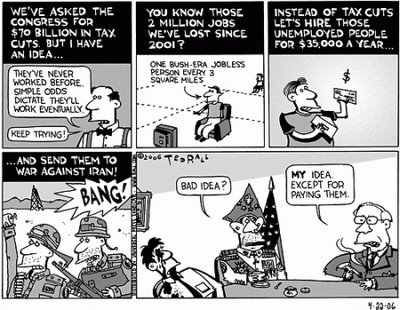
Thursday, February 11, 2010

"Olympic Village: Athletes Impressed, Taxpayers Angry"

That title alone is all you need to read to understand the nature of the state, but here are the particulars:
Paid for, thank you very much, by the taxpayers of Vancouver. More than any other project in recent Olympic history, the $1 billion residential complex represents the risks that urban governments face when trying to host one of the world's biggest parties. The city planned to invest about $47 million in the project back in 2006. However, cost overruns and the recession forced Vancouver to step in and bail out the private developers who were charged with financing the project. The city avoided the humiliation of welcoming the world with a half-built Olympic Village, but at a great price: in early 2009, new Vancouver mayor Gregor Robertson declared that taxpayers were "on the hook" for the $1 billion project. "What ended up happening was that the city became a bank for private-sector development," says Mark Cutler, director of Olympic Village Development for the Vancouver Organizing Committee, the body that is operating the complex during the Games. (See what becomes of Olympic stadiums.)
"Bank"? A real bank doesn't want to lend if it thinks it won't get repaid. However, taxpayers as a "bank" fits with the denouement of the movie "The Night Stalker": toward the end, Kolchak finds a victim that the vampire was keeping alive. "His own private blood bank."

Pay very close attention: this is how the state invariably works. It doesn't want to kill you, at least not until you can be replaced. Remember what St. Frédéric taught us: "The state is the great fictitious entity by which everyone seeks to live at the expense of everyone else."

When Salt Lake City began a second Olympics bid in the late 1980s, the contemptible Norm Bangerter, Utah's governor at the time, had no problem turning state taxpayers into human collateral. It was then that I learned that modern Olympics bids mean that developers get an implicit guarantee from politicians that taxpayers will pick up the tab for "cost overruns." What I didn't understand then is that when the state makes you pay for something against your will, you are most certainly human collateral: it isn't just your property being taken (or being promised by someone else to yet someone else), it's your very life being stolen, because you will never get back those moments you spent to acquire that property.

Those who don't understand that morality, or refuse to see it, should still be able to see the practical question: what possible motive do the organizers, developers and other Olympic affiliates have, then, to keep costs under control?

Robert Barney, director of the International Centre for Olympic Studies at the University of Western Ontario, has flatly said, "There has never been an Olympic Games that has made a profit...including federal allotments, municipal allotments, provincial or state allotments, it's always been that a debt has to be paid somewhere." His co-director, Kevin Walmsley, has said, "The Olympic Games are not a profit generator and never have been. What is always consistent is, there are always cost overruns." The facts prove them correct. Forget the lies that politicians, Olympics officials and developers feed us. Their accounting methods in the private sector would land people in jail for fraud.

I commented last October over at Alarming News:
Olympics are corporate welfare. Any infrastructure won't be built based on what actually people want and need, but on politics. If it's done in a free market, then businesses and "organizers" would be putting up their own money, and nobody would be forced into it. The reality, though, is that taxpayers are always implicitly put on the hook for any "cost overruns." They'll share in the debt, but not the profits.

Poor Rio. I hate to say "Better it happen to them than us," but how else can you put it?

Jamie, I've known enough to oppose Olympics since I was 12 years old, when I lived in Salt Lake City during the start of its ill-fated quest. No modern Olympics has ever made a profit, once all costs are taken into account. Check here:

MONTREAL, 1976: Debt: >1 billion (globe and mail; abcnews.com)
LAKE PLACID, 1980: Debt: $11 million
CALGARY, 1988: Debt: $910 million
BARCELONA, 1992: Debt: US$1.4 billion
SYDNEY, 2000: Games billed as self-financing by politicians were a $2.3-billion loss (Auditor General New South Wales Report on Sydney (2000) Olympics)
EXPO
The same link notes that:
Officially, Atlanta made US$10 million, but that excludes the US$1 billion taxpayers spent on infrastructure.

Utah tax revenues post-Olympics have fallen so far short of predictions that the state is facing a US$155 million shortfall, has slashed spending, dipped into emergency funding, and may have to order more employee layoffs. http://deseretnews.com/dn/view/0,1249,400008943,00.html
It's a very simple point of logic: if hosting an Olympics is such a great moneymaker for developers and city businesses alike, then why are taxpayers needed to guarantee it?

Bastiat wouldn't need to know anything else about our modern world to tell us the simple answer. He would reply, "Developers already know from past Olympics that they can't do it without taxpayers, whether to guarantee the debt or to pay for infrastructure. Do you not see it also?" The developers are just a modern form of protectionist, whom Bastiat described as petitioning to the government, "Thus, since everyone else uses the law for his own profit, we also would like to use the law for our own profit. We demand from the law the right to relief, which is the poor man's plunder."

Labels: , , , ,

Tuesday, March 10, 2009

The silliness and waste of the modern "Tea Party" protests

Fifteen days ago, in the midst of many Americans talking about mailing tea bags and beatifying Rick Santelli, my friend Billy Beck wrote:
"The tea-bag protest is a fabulous thing,..."

It's rubbish. I guarantee you: everybody talking about this is going to make sure the monster is fed next April 15th and they cannot wait to get in line and vote again.
And he is correct. As if to prove it, Bryan Pick at QandO wrote about Brad Warbiany's idea to minimize automatic withholding, in an effort to "starve the beast."

Brad has been a friend for several years, but certain things must be said here. I left a comment in reply to Bryan that is also for Brad and anyone else who thinks this "protest" will work -- who thinks this "protest" is anything like the Boston Tea Party.
Bryan, don't take too much offense here, but I'll ask bluntly: are you, or are you not, still going to "catch up" by April 15th on what the feds say you "owe"?

If you are, then your "protest" amounts to nothing. Just what do you think you'll accomplish by "postponing" anything? Lack of tax revenue has never stopped the federal government from its real spending. The several so-called "shutdowns" were about budget disagreements on how much to tax and how much to borrow, not an actual lack of revenue.

Regardless of which party controls what branch, the Fed will simply create more money and buy as many U.S. Treasury securities as needed for the feds to keep spending. This means we all will pay via inflation, on top of taxpayers still catching up at the end. So your efforts amount to little children trying to hold their breath at the dinner table. (Not to say the feds are our rightful parents or guardians, but my point is about the efficacy of your method.) You can "protest" until your faces turn blue, but you'll still be all paid up by April 15th.

What difference does it make if your Uncle Sam molests you at 11 p.m. or 4 a.m.? He's patient. He knows you'll eventually submit, and he knows that every applicable November, your siblings will always agree with your parents that Uncle Sam can keep coming over with the specific intent of molesting you (if you follow the analogy, I'm saying Americans just keep voting for the representatives and their bureaucrats who will keep taxing us and spending our money).

Grimshaw is correct. If you want a real protest, then millions indeed must start withholding. This requires a wee bit more resistance than most people are willing to put forth, but that's what it's going to take to change the system.

"We must all hang together, or assuredly we shall all hang separately." The few, like Wesley Snipes and Richard Hatch, are easily taken out.
I also made a quick followup:
Let me put it this way, saying nothing more.

Was the Boston Tea Party at all about postponing buying the tea? How did it get the attention desired?

Labels: , ,

Wednesday, February 04, 2009

A tax cut is government "giving" money?

Here's a snapshot of Yahoo's headlines from two nights ago, which I didn't have a chance to write about at the time:


But if you clicked on the stimulus story, here's the headline (McClatchy, not the AP, but just as liberally biased). The story is still up, for now.

"Unclear if stimulus tax breaks will save jobs, spark spending"

God knows the mainstream media can't allow the least positive headline about letting people keep their own property. The article is balanced enough, I suppose, in presenting the two arguments for and against tax cuts as an economic stimulus. But that's not the point: the point is that the taxes are simply theft of people's property. That quoted asshat Roberton Williams, of the ultra-liberal Tax Policy Center, opposes tax cuts because "If people want to save, giving them money will not force them to spend it."

Giving them money? Considering it was their property to begin with, taken by force with the ultimate threat of death if they resisted the robbery, it's as much "giving" money to taxpayers as a mugger robbing someone blind but "giving" him $20 for cab fare home. I wrote about this nearly four years ago, in the early days of this blog, talking about idiots who think "rich" people should pay higher taxes because "they can afford to give more back to the government."

Similar is the attitude of another asshat, Congressman George Miller of California, who thinks a tax break for 401Ks is a subsidy. A subsidy is money that the government takes from someone else and gives to you. The government "graciously allowing" a worker to save money without paying income taxes on it is not a subsidy because it's the worker's own property.

Labels: , , , , ,

Monday, May 26, 2008

Despite being so rich, Warren Buffett is still ignorant of real economics

Buffett is clearly wealthier than I am, and I'll readily concede a "smarter" investor -- whatever "smarter" means. But he might want to use some of his billions and take some real economics courses. Walter Williams, Don Boudreaux, Russ Roberts at George Mason University, or Burt Folsom at Hillsdale College, could set him straight on free trade. And soon Buffett can take the class "History of [Economic] Thought" at Trinity University, which will be taught by Richard Ebeling. I'm proud to call Dr. Ebeling a friend, and I was saddened when he recently left his position as president of the Foundation for Economic Education to accept his position at Trinity.

Alternatively, Buffett can take sporadic lessons from me at no charge. I've previously written about his mistaken belief that a nation shouldn't import more than it exports. Now he could use a lesson on central banking and what it does. From his recent interview with El País (my translation from the original article's Spanish):
Buffett: It is certain that during the Bush era there has been a gradual reduction of taxes that the greatest fortunes pay, whereas the middle classes pay more and more. And I take advantage of each occasion I have to denounce it. On the subject of the crisis, it's evident that after what happened that we must have more regulation. Even the International Monetary Fund supports that. Perhaps not very short term, but all crisis brings about regulatory changes. I do not believe that they are deep, but without doubt what it has happened to banks and American investment banks will lead to stricter financial regulation.

El País: What has failed so that the mortgages garbage unleashed this storm? Do we attribute the errors to the banks or to bank supervision?

Buffett: The banks exposed themselves too much, they assumed too many risks. So the problem is evidently the banks. They are the guilty ones. It does not need to be put on anyone else.

EP: Crisis or recession?

Buffett: I believe that real problems could have arisen in the case of Bear Stearns' drop. The recession is a technical term defined by the National Bureau of Economic Research: two trimesters of falling GDP. We have not arrived at that, so technically we cannot speak about recession.

EP: If you ask someone who's remained unemployed in Spain like the United States...

Buffett: For the one who loses a job there's surely a recession. But to my surprise, the unemployment rate has not changed too much up to now. It shocks me that with everything that happened in financial markets, real estate markets and other sectors, that unemployment has not risen more. I would not be surprised that unemployment will increase in the next months.

EP: That means the worst is yet to come?

Buffett: The steps that authorities and supervisors have taken hold the possibility that problems of bigger size may arise. I do not believe that the situation will deteriorate in the financial markets. General conditions in the business world will deteriorate, but only for a time.

EP. Are there going to be more victims after Bear Stearns?

Buffett: In March we crossed over the worst moment and in my opinion the Federal Reserve's decision in the case of Bear Stearns was a great step forward. It was a decisive moment for the financial system. A line in the sand to contain the crisis. This incident helped eliminate the problem, or at least it was moderated for other investment banks.

...

Buffett: We have an enormous bubble in the real estate sector. Not in all of the country, but in states like California, Arizona or Florida yes we have a true bubble. And we have it because many of those houses were financed at 95% to 100% by banks that in many cases didn't even know what they were buying. Combined with the financial crisis, the repercussions of all that are going to be very painful.

...

EP: You do not seem very satisfied with what's happened in the Bush era. Between the Democrats: Barack Obama or Hillary Clinton?

Buffett: I would bend over backwards completely with both.

Note: the verb used there is "Me volcaría," and the root "volcar" means a variety of things. But from what Buffett says after, it doesn't sound like he meant the "upset" or "overturned" meanings.

EP: Obama or McCain?

Buffett: Either of the two Democrats before the Republican candidate, although McCain is a good sort, with notable political ideas. I will support 100% the Democratic candidate.

EP: Why?

Buffett: I am closer to their ideas on the tax system, on health care, on abortion rights, the right of the woman to choose if she wants to have a child or not. John McCain is a wonderful man, but he would not agree with me on those. I believe that if McCain wins, it is not going to do anything about the matter.
We'll begin from the top. Is Buffett really so blinded by ideological bias, like Hillary Clinton, that he won't admit why a rich investor deriving income principally from investments will certainly pay a lower tax rate? It's because the income is derived mostly from investments, since capital gains are taxed at a lower rate than income. Buffett and other liberals want to tax investments the same as income, which is absurd: actually, any capital gains tax is absurd, because someone had to earn income to invest in the first place, hence it's double taxation. Moreover, raising the capital gains tax to equal income taxes will wreck the financial markets by crimping the incentive to invest. No skin off Buffett's nose, though, since he's already made his billions, but it will screw over the millions of Americans who are trying to save for themselves. This is what liberals want, however: if people can't save enough for themselves, if they can't earn enough for themselves (being taxed to death or even being taxed/regulated out of a job), then they must depend on government.

The truth is that those evil "investment managers" may pay an overall lower tax rate than "a teacher," but the former will still pay far more in absolute dollars. And as "honorable" as we're taught to think the teaching profession is, society judges these investment professionals to be worth more, because they're paid more. And why not? They're the ones creating wealth and prosperity, first for others through their jobs, and second for themselves by investing their own money back into the economy. They deserve their pay. "The labourer is worthy of his hire," the Lord reminded us. If a neighbor happens to get rich from his job, and he coerces no one, what is it to the rest of us?

And Buffett's such a hypocrite. If he thinks he's not paying enough in taxes, then he can voluntarily pay more. As President Bush said in the last State of the Union address, "Others have said they would personally be happy to pay higher taxes. I welcome their enthusiasm. I'm pleased to report that the IRS accepts both checks and money orders." Since Buffett can pay higher taxes if he wants, we can surmise it's clearly not about his taxes being fair. It's that he wants to force others into his flawed notion of "fair."

Well, I have a proposal for him: why doesn't he pay my tax bills, if he thinks I'm not paying enough? He wouldn't miss that money, and according to Congress' idiotic, Keynesian-based idea that "consumption spending" is all-important, my spending would be more than his investment income, right? (Actually no, because economic growth is the same whether the same dollars are spent or invested.) If Buffett wants to give all his money away, then why not devote his foundation to tax relief? And God knows "middle-class" Americans will need it, once our taxes are hiked in 2011 -- because Bush's "tax cuts for the rich" will expire, except that the tax cuts will go up for a lot more than just "the rich."

Regarding the housing "crisis," Buffett wants to blame the banks and the banks alone. While lenders do share some measure of blame, as I'll get to below, it's not entirely their fault. Borrowers must shoulder some blame too, because they're the ones who were irresponsible enough to take loans that they couldn't repay. If you take out a loan, you're borrowing someone else's property. The person lent you property and expected it back, plus compensation for not having use of the property. So if a borrower uses government to force the lender to "rewrite" the contract terms to a lower interest rate, or even "forgive" the debt, that's stealing from the lender.

If a borrower takes out a loan that he knows he won't repay, that's fraud. It's irrelevant if the borrower truthfully represented his (in)ability to repay (meaning the bank failed to realize or perhaps "overlooked" it). If a borrower knew he lacks/will lack the means to satisfy the agreed-upon loan payments, then the borrower made a criminal decision to take someone's property and not give it back as promised. We should be prosecuting the hell out of these predatory borrowers, who are committing fraud and grand larceny by walking away from their mortgages (often literally). But most Americans have bleeding hearts, so they sympathize with the supposed "victim" and want to punish lenders instead. It's the same mentality by which juries award multi-million dollar judgments to plaintiffs in ridiculous personal injury lawsuits.

Lenders share some blame for being too eager to make loans, but all loans have a built-in penalty for that: lenders can lose potentially the entire amount of the loan, should the borrower default. Thus there's no need for statute or juries to penalize lenders merely for making bad loans; there should be punishment if lenders commit fraud, but that's never the case in the sob stories plastered all over the news. I've yet to see one case of a ARM where there wasn't a part of the contract stipulating how the interest rate would increase. There always will be a clause defining that, because lenders will want something enforceable in court (well not enforceable anymore, as I'll explain in a little), something clear enough to satisfy the "meeting of the minds" requirement of a valid contract.

I've always wondered, were these borrowers truly so stupid to think they'd get 1.9% forever? "Always read the fine print," the old saying goes, and just because it's small print doesn't mean it's unreadable. When something will last the next 30 years of your life, is it so unreasonable to read the agreement and perhaps consult a lawyer?

But lenders were coerced by Congress, who shoulders even more blame. Congress for two decades, but particularly in the last several years, has used legislative blackmail to "encourage" (i.e. force) lenders into giving loans to low-income people, notwithstanding that these borrowers are precisely the sort who likely couldn't repay. Let's be objective: should lenders give equal numbers of loans to low-income people as they do to higher-income people? Of course not; that risk makes no sense whatsoever. So when banks denied applications of low-income applicants, it wasn't based on race, but on qualifications. Banks are in business to make money, and the only color they care about is your money, not your skin. However, in the lower-income brackets there are more minorities than whites, so that's been perverted into "racism" and "discrimination." As I've mentioned before, Stan Leibowitz gave an excellent history of ACORN and other groups whining before Congress about "discrimination" in lending. Oh, but there should be discrimination, namely between those who can repay the loans and those who can't. "Discrimination" isn't inherently bad: the word means to determine differences. But ever since "the politics of victimhood" started taking root, everyone who wasn't qualified on true merit would cry "Discrimination!" and thus perverted the word's meaning.

The greatest blame is on the Federal Reserve, which made all of this possible with insanely low interest rates for the first half of this decade. As a line in one of my favorite movies goes, "Jesus, you can't make a buck in this market, the country's going to hell faster than when that sonofabitch Roosevelt was in charge. Too much cheap money sloshing around the world. Worst mistake we ever made was letting Nixon get off the gold standard." Nothing ever changes. As Bruce Bartlett told me, "The Fed always overdoes it."

We're not just finally feeling the effects, we have been for the last few years. We haven't seen this kind of inflation, and true inflation since we're talking purely about the money supply, since the early 1980s. And each time the Fed says it will "inject liquidity" and auction off more bonds, I cringe. It may have its financial uses, but the Fed is continually devaluing the dollar when it should let the financial markets correct themselves. The Fed made money so easily available and directly caused a credit crisis, of which the housing bubble is the most visible part. Lenders had every incentive to borrow as much as the Fed would create, since not partaking meant watching competitors help themselves and make profits. And the vast amounts available the borrow enabled borrowers to bid higher and higher offers on houses, driving up prices artificially. The Fed showed banks the carrot, giving banks the means to finance "no money down" mortgages, and Congress held the stick, namely the threat of investigations and regulations.

One of the most absurd explanations for the crisis is that it's the deregulation of the separation of commercial and investment banks; this two-paragraph concept was expanded into an entire book that my uncle briefly told me about. The repeal of the Glass-Steagle Act did encourage bank mergers, and eventually that banks would underwrite securities based on collateral-based loans like mortgages, but this wouldn't have been possible if the Federal Reserve hadn't made available such immense quantities of loanable funds.

Now people actually believe the Fed can alleviate the crisis by throwing more money at it, when it was the cheap money that caused the problems in the first place? A company can alleviate financial problems and stave off bankruptcy by diluting shares to raise capital. But if it constantly does so often that it becomes policy, investors will trust the company less and less. Why should the Fed be any different when it continually dilutes the money supply?

Buffett would have clarified the general nature of the problem, that it's not just housing, if he knew anything about real economics. He's a great investor, as I said, but did that, or his nickname "The Oracle of Omaha," or now being the world's richest man go to his head, that he goes by his own economic definitions? In this interview, he says the U.S. isn't in a recession, per NBER's definition. Yet he recently told Der Spiegel that "I believe that we are already in a recession. Perhaps not in the sense as defined by economists....But people are already feeling the effects of a recession." So which is it?

I'm actually not surprised that unemployment is so low. By our own historical standards, we're average, and our unemployment statistics in France or Germany would be considered an economic boom. The dollar is in bad shape, and that is a big problem, but overall the U.S. economy is far more resilient than Buffett or the other doomsayers think. Housing isn't the majority of the economy, despite its rippling effects, as are the major banks. Bear Stearns earned $9.2 billion and $5.9 billion in gross revenue in fiscal years 2006 and 2007, respectively. Its operations, including its $1.2 billion dollar headquarters in midtown Manhattan, could have completely vanished off the planet, its 14000 employees could have all stopped working, and it still would make hardly a dent in the $14 trillion American economy.

I tried explaining that a little while back to a pseudo-capitalist who said Bear Stearns was "too big to fail." Nonsense. A free market, with no bailout, would have sorted it out just fine: other companies would have bought out the pieces, and the employees would have naturally gravitated to other jobs, and this Schumpeterian "creative destruction" would have made things all the more efficient. But so many, Buffett included, are fans of the Bear Stearns bailout. Did he really have that big a long position in BSC? Or is he just another pseudo-capitalist who wants the "free market" and "competition" only when it suits him?

Then we have his Democratic bias, showing he's just a limousine liberal at heart. No surprise there. The money he's giving away will do many good things, but that's not enough. He has to force people into his own politics, using the weapon of government.

Labels: , , , , , ,

Wednesday, May 07, 2008

A tale of two thieves

In his unmitigatedly warped notion of "benevolence," George W. Bush signed legislation "to boost availability of student loans." It sounds great, but after you read how it's being done, it's a great deal for students, a great deal for Bush and bureaucrats who will brag about how much they're "helping" people, and a raw deal for the rest of us who pay taxes.

"The measure is intended to inject liquidity into the student loan market by allowing the U.S. Department of Education to buy federally guaranteed student loans that lenders haven't been able to sell to investors." Investors don't want to buy the loans because they're crap investments, relative to what else is available. It tells us something about this "non-crisis economic crisis" (the one the mainstream media wishes the U.S. were in) that, even though these student loans have the guarantee of repayment by the federal government should any borrowing students later default, most investors would still prefer investing in normal markets like stock exchanges!

But this still won't stop Bush and Congress from using our money to buy the loans, touting more of this "injecting liquidity" bullshit that we've heard too much about from the Federal Reserve. The federal government will buy these loans, using money coerced from the rest of us via taxation. If the students default, the federal government will then assume the payments to the loans' owner -- itself. And we won't even see a dime, because the repayments will simply go to the U.S. Treasury.

Such accounting practices in the private sector are called fraud. Bernie Ebbers received a 25-year prison sentence for what amounted to "merely" a few billion dollars. What, then, should politicians deserve when they do this all throughout a budget of $3 trillion dollars?

My Congressman, John Hall (former member of the band Orleans who found religion socialism and went into politics), sent me an e-mail with a subject line, "How to Combat Medicare Fraud Workshops this Friday." New York State spends nearly $48 billion each year on Medicaid, and it's been estimated that a tenth of it is "fraudulent," but the pure fact is that it's all theft. It is not theirs to give by any true sense of moral principle. If David Paterson, Joe Bruno and Sheldon Silver want to be charitable, or George W. Bush, John McCain, Barack Obama, Hillary and Nancy Pelosi and Harry Reid, let them give of their own money and encourage -- not force -- the rest of us to give. South of us, John Corzine would rather tax New Jersey residents every which way he can to fund state programs, instead of giving from his own extreme wealth. You see, when a liberal like Corzine criticizes "excessive executive compensation,"

That article at Empire Center talks about "market-driven reforms," when such a thing is impossible when government is behind it. As I tried explaining last year to my friend JK when talking about Medicare Part D, there is no "market" when government is involved, because government by definition will coerce at least one person into doing something he normally wouldn't do in a truly free market atmosphere. People can talk about "choice" all they want with some new "reform" in a social program, but ultimately it's "choice" at somebody else's expense.

This article talks a bit more about NYS Medicare fraud, and talking about how the New York State Legislature "agreed to only about $700 million in savings" for 2006. That's nonsense. When politicians talk about "savings," it doesn't mean they actually reduced the size of a program, but that they reduced the previously planned growth. The spending still increased. How long could you or I run our households this way when facing a financial crunch? "Honey, we have to cut back. Now, I had previously projected a $700 monthly increase in our car budget if we got that new car. But look, if we get that less expensive new car, it will cost us only $500 more per month. That saves us $200 per month!!!"

Such "logic" seems absurd, but that's how government operates. We normal folk must work for our wages, because we cannot use compel those who hire us or otherwise trade for our goods and services. But because government can take people's property by force, it need not worry about being "worthy" of what it takes. It simply takes, and ultimately it takes from you upon pain of death -- your death. I was starting to read "Your Money or Your Life: Why We Must Abolish the Income Tax" by Sheldon Richman, with a wonderful introduction by Dr. Richard Ebeling. Sheldon and Richard are true lovers of liberty, and I am proud to call them friends.

[Correction: I was blogging on vacation and didn't have the book with me. It was actually Walter Williams who wrote the following in his foreword, not Richard in his introduction.] Williams explains far more eloquently what I've said before, that all taxation is coercion, and so if government takes from you anyway, it's theft. But what do you do if you refuse, believing sincerely that you will not submit to thievery? Well, then the government will "fine" you, which is merely a declaration that if you don't surrender your property, you must give up more. If you resist enough, you must give up your freedom by going to prison. What if you will defend yourself, as is your God-given right against oppressors? Then the government will send in "police" and take you by force, killing you if necessary, all because it says you don't really own what you think you own, because a majority of your neighbors banded together and elected some "government":
Give us what we demand, cried out the multitude, lest we seize it by force.

And the merchant replied, Depart in peace while ye yet can, for ye have no right to my possessions save with my consent, and as I have done no wrong to any man, none of ye have any authority to seize any of my possessions.

Behold, cried out his neighbors with one voice, that we have declared ourselves a government, and as such we have given ourselves the authority.

The merchant replied, Ye have no authority, for one cannot give authority unto oneself.

That matters not, they replied and began to grumble, for we are a greater number than thee and thy family, and because of our greater numbers, we have decided that thou shalt pay us tribute.

Then did his neighbors, armed with swords and staves, seize a goodly portion of the merchant's possessions. The merchant did not consent in his heart, but for the sake of his wife and children, he did not resist in his actions.
Anyway, I'm blogging from Davao, the largest city in the world in terms of area. My fiancee and I were visiting her family here, and this afternoon we're going to Manila. We stayed in Davao longer than planned, because we couldn't get tickets to Bohol. This being "summer vacation" time in the Philippines, all the flights were fully booked. It's probably just as well, because Mindanao and the Visayas have been quite cloudy, and the beaches wouldn't have been as enjoyable.

Yesterday we went to "Paradise Island," a resort on Samal Island, just a few minutes off the coast of Davao. It's beach isn't one of beautiful white sand like Boracay's, and in some places a little pangit with the tide out, but it's a wonderful little getaway if you're in this part of Mindanao. Mr. Tungol, our host, was extraordinarily gracious. He was always checking on us and the other guests, ensuring our comfort. He also brought over the four-piece band to serenade us, inviting me to join in, which I couldn't resist when they did a Sinatra/Bennett/Elvis medley. Victor Heiser, an American doctor who spent a lot of time in the Philippines in the early 20th century, wrote that he believed you could give musical instruments at random to Filipinos and hear sweet music at once. Perhaps an exaggeration, but it was truly amazing to hear what bongo drums, two guitars, a bass and three voices could produce.

Labels: , , , ,

Tuesday, February 05, 2008

More mainstream media lies: Bush's budget is hardly cutting Medicare spending

I'm the first to say that Medicare and other socialist (not to mention unconstitutional) programs should be abolished completely, but let's continue debunking a common lie since the start of Bush's administration. My blogfather Don Luskin has pointed out for a long time that, regardless of whether you think the programs are right or Constitutional, Bush has increased spending so much that it ought to make any liberal happy. I'm still trying to find his very detailed analysis that proves my point here, that Bush is hardly cutting funding from health care to childrens' programs -- his proposals are to cut only the increase in spending, so spending still increases.

Update: check this.

To continue this tired old lie, HealthDay News, a socialist propaganda group masquerading as a news source (like pushing a survey claiming Canadians are healthier than Americans, ergo Americans need socialist medicine), "reported" today:
MONDAY, Feb. 4 (HealthDay News) -- President Bush's new budget proposal would cut $196 billion over five years from both Medicare and Medicaid -- programs that provide health care to millions of poor and elderly, federal officials announced Monday.

The proposed cuts are part of a plan to stop Medicare from running out of money in little more than a decade, Secretary of Health and Human Services (HHS) Mike Leavitt told reporters during a press conference. He said the savings would help keep premiums affordable, maintain the Medicare/Medicaid system, and balance the current Medicare budget.

"The Medicare portion of the budget should be viewed as a stark warning," Leavitt said. "Medicare on its current course is 11 years from going broke. Americans have become numbed to entitlement warnings as a repeated cycle of alarms and inaction," he said.

But President Bush and Leavitt are sure to face a Congressional showdown over the budget proposals.

"This administration ought to know that five years' worth of Medicare and Medicaid cuts totaling $200 billion are dead on arrival with me and with most of the Congress," Sen. Max Baucus, D-Mont., and chairman of the Senate Finance Committee, told the Associated Press.
But if you want the truth, read further into the article:
Under the president's plan, the annual growth of Medicare spending would slow to 5 percent instead of the 7 percent currently projected. Similarly, spending growth would slow from 7.3 percent to 7 percent for Medicaid.
If a spendthrift family were going to spend 7% more, but instead spent only 5% more, is it accurate to say they "cut" their spending? Of course not. The fact is, spending will continue at a record pace. Even at 5%,

Well, why not accuse Bush of cutting the programs by 10%, or 20%, or 100%? Why don't Democrats just accuse Bush of cutting $1 trillion from the programs next year, because he wouldn't go along with a plan to increase taxes by $1 trillion? After all, the federal government could have increased spending the money as much as tax revenues and borrowing permit, by their warped logic.

Again, this is regardless of what you think about the programs. My initial point is that the MSM is so rabidly infected with Bush Derangement Syndrome that reducing a proposed 7% increase to 5% is a "cut" to them, and they've always seized on that as a lie. The very purpose is to rile up voters who live off taxes the rest of us pay, of course, and the sad thing is that it works. People believe the half-truths and outright lies that the news throws at them, like in this article. It's correct to point out the huge deficits under Bush, but it's completely dishonest to imply that things were great under Clinton:
Seven years ago, Bush took over a government predicted to generate $5.6 trillion in surpluses over 10 years.
Such predictions were overly optimistic, it turned out, being based on the unsustainable economic growth of the very late 1990s. Furthermore, let's say the $5.6 trillion in surpluses was realized somehow -- that wouldn't have been because of any spending cuts, but because Congress taxed us $5.6 trillion more than what they spent.

Now, if we want to talk about whether the programs should exist, the bottom line is that they're morally wrong. It's not morally wrong to help people, but it's morally wrong to steal from one unwilling group of people, no matter how benevolent the intentions may be. People like Paul Krugman would have you think that not funding these programs from the poor, because you're giving tax cuts to the rich, is "Dooh Nibor" economics, "Robin Hood" backwards, i.e. what they claim is theft from the poor to give to the rich. As Don Luskin explained, that couldn't be less true:
In other words, by cutting taxes that robbed high-income earners of their income -- and cutting government spending that transferred that stolen income to low-income earners -- we have a "transfer of income from the middle class to the very affluent"? If we simply reduce the rate at which we are stealing from the rich, are we therefore stealing from the poor? We can certainly have an argument about whether there ought to be redistributive taxes. But it's nothing but sophistry to suggest that a move toward less redistribution in the future constitutes robbery.
But this feeling of "entitlement" will persist so long as people think that majority voting somehow gives them a right to other people's property. I was thinking about this "Monty Python and the Holy Grail" quote the other day: "Listen, strange women lying in ponds distributing swords is no basis for a system of government. Supreme executive power derives from a mandate from the masses, not from some farcical aquatic ceremony."

But is the second any less absurd, when your neighbors band together, call themselves a "government," and as "the masses" proclaim their inviolate right to seize your property against your will?

Labels: , , , , , , , , ,

Tuesday, July 10, 2007

Like other cockroaches, Ted Stevens fears the light

He's worried that a corruption probe might hurt his chances for re-election. Read that article and tell me that Stevens isn't a damn little piece of trash. He said, "I'm working to get this concept out of my mind that someone is trying to make something illegal out of all this." So Stevens isn't even denying that he did anything wrong. He's merely wants to stop thinking about the accusations, hoping they'll all go away.

We could only be so lucky that his re-election bid will be hurt. There are so many idiots in Alaska, being so fond of other people's money, that keep sending that bastard to Washington to bring them more. But I have no hope that they'll wake up, because like with other pork barrel kings like Robert Byrd, and the plainly corrupt like Dan Rostenkowski, Stevens' constituents care principally that he's in a powerful position of seniority to bring back funding, courtesy of everybody else, for their bridges to nowhere and what-not.

Don't get me wrong, I'm not ignoring that people all across the country are greedy for their neighbor's coerced money. I've written before that it's all about getting as large a share as possible of the federal budget pie, at the expense of other states. However, Alaskans receive far more money via the D.C. wealth redistribution conduit than they send in. Such is the problem with our federalized tax system. It didn't take long for the federal government to start ignoring the 10th Amendment, when in the early 19th century it began spending on "internal improvements" like canals and railroads. However, until the 16th Amendment, the federal government was limited in size by the nature of the tax system.

After the 16th Amendment, Congress started taxing individuals. Originally, Congress received money from the states: each state paid a percentage of the federal budget according to its percentage of the population. This is the second, forgotten reason that the Constitution mandates a census every 10 years. Under that old system, Alaska with 0.2% of the population must use its own internal tax structure to pay 0.2% of the federal budget, and California with 12% of the population is similarly responsible for 12% of the federal budget. This is the most important reason that the Constitution mandates that "No state shall...coin money; emit bills of credit; make anything but gold and silver coin a tender in payment of debts," lest a state merely print worthless paper to pay its federal budget obligations.

Under that system of proportional burden, Alaskans would therefore not want a lot of federal spending, since they must share a percentage of the budget no matter what the federal government spends on. How strange that people don't want to spend a lot on things when it's their own money.

Labels: ,

Sunday, February 04, 2007

Where the hell has John Edwards been?

Previous: John Edwards' hypocrisy

John Edwards at least said it plainly: he wants to raise taxes on the rich to pay for universal health care. Those who understand free markets will find it strange that Edwards wants government to create a "health market," because government coercion (taxes and spending) and markets (real markets where supply and demand are free to work) are diametrically opposed.

First, let's address his last point:
"Finally we need to do a much better job of collecting the taxes that are already owed," he said, specifically targeting what he said are large amounts of unpaid capital gains taxes.

"We should have brokerage houses report the capital gains that people are incurring because we're losing billions and billions of dollars in tax revenue," Edwards said.
In January 2006, my blogfather Don Luskin cited Dan Clifton of the American Shareholders Association, noting that the 2003 capital gains tax cut has paid for itself. We can see that a tax cut produced greater revenues in the end, proving that Laffer's Curve is very much real. More recently, Don again cited Dan, who examined a CBO report and concluded, "Well in what could now be considered the worst forecast in modern times we find out today capital gains tax collections were actually $51 billion in 2003, $72 billion in 2004, $97 billion in 2005, and $110 billion in 2006. For 2005 and 2006 collections nearly doubled the initial forecast."

So, where the hell has John Edwards been for the last few years, as capital gains tax revenues have surged? Is it never good enough that "the rich" made more while still paying more taxes? Evidently not. It's never enough for liberals: they have to get their greedy hands on every last dollar.

Now, as I've pointed out time and time again, taxing "the rich" may fund social services for everybody else, but it simultaneously deprives everybody else of jobs as "the rich" have less to spend and save. Bastiat has tried to tell us for over 150 years that taxation is merely a shift in economic expenditures, but socialists (including those who identify themselves with the euphemistic "progressive" and "liberal" labels) are too blinded in their "noble" endeavors, too willfully ignorant in their greed for others' money, and/or too stupid to learn.

If John Edwards is so adamant that "the rich" pay more taxes, then I challenge him to do it first and do it even better: I hereby challenge him to sell his new multi-million dollar houses, then give the money to charity. I'm sure even if he got only 50 cents on the dollar, he could still fund a lot of clinics that provide free or low-cost health care to people of low incomes.

Better yet, the next time he even thinks to build/buy an expensive house, he should just give the money away. Oh, but that would deprive the architects, planners, construction workers, et al, of jobs, right? Well, what did I just say in the first paragraph, and in previous posts? When "the rich" have less to invest in stocks and corporate bonds, companies create fewer jobs -- specifically, jobs for everybody else. When the rich have less to save in government bonds because we tax them more, what is the difference? Well, the difference is that when they are taxed, they have less incentive to earn as much as when they can instead lend money to governments.

Even luxury taxes only mean that "the rich" have less to spend on fancy jewelry, cars and boats that regular middle-class people make. "The rich" do not make Patek Philippe, Bentleys and yachts for each other. Oh, you might be well-paid to make fancy jewelry, but unless you're at the top, you won't be a multi-millionaire by merely assembling things that "the rich" buy.

Still, liberals argue, it's better to tax the money and spend it on social programs, rather than letting "the rich" spend it on what they want. But which is preferable: to have a "rich" person taxed $10,000 more to fund social programs, when a thick percentage will be lost to bureaucracy, or to let someone have a shot at the full $10,000 by offering goods and services? Well, liberals don't care about efficiency, or the deadweight loss that results from disincentives. To them, your money is theirs to spend as they see fit, everything else be damned.

However, Edwards has recently said a few things that are completely right -- just not for the reasons he said them.
HANOVER, N.H.–Contrary to President Bush's arguments in New York yesterday that the economy is going strong, the administration's economic policies have been a big failure for millions of Americans, says Democratic presidential candidate John Edwards. "They're not working," the former senator from North Carolina told U.S. News
Absolutely correct. It's these millions of Americans who aren't working, whether not working enough or not at all. Jon Henke put it so well: "we don't have inequality in income—we have inequality in output. Some of us haven't been producing our share."
Edwards, interviewed while he was campaigning yesterday in New Hampshire, admitted that there has been economic growth but said there is also a "fundamental problem. The positive fruits of growth are not being shared by the American people at large." He said that the benefits of Bush's policies have mostly gone to "those with capital and a high level of education." As for those who don't have those two assets, "you struggle," Edwards said.
Edwards is talking about having capital, forgetting that it works just as well to use someone else's money. I'm not talking about coercing the money from them via theft or taxation (I repeat myself there), but to appear attractive to those who will invest capital in you. And that doesn't always require starting up your own business: a firm can certainly invest its money and other resources in you, in the hope you will grow in value and return.

Still, Edwards is correct about people without the two critical assets. People who are idiots and incompetent will most certainly be unattractive to those with capital. They'll certainly have a hard time competing against the smart and educated (which many academics prove are not the same thing). Why should a night janitor's paychecks be anything close to a supervisor who undertakes far greater responsibilities, or a filing clerk's pay begin to approach that of a portfolio manager's? It's not a matter of working "hard" hours of physical labor, or what you think you produce in value, but what value others place on your efforts. Their property, their rules, their judgment.
His prescription includes reducing the benefits in the tax structure for the wealthy, increasing benefits for the middle class and overhauling the nation's "dysfunctional" healthcare system, which he said imposes huge costs on everyday Americans. "We want real opportunity for everybody," Edwards said. He added: "I will get rid of George Bush's tax cuts for the richest people." And he said, "It is not true that I will raise taxes on the middle class."
Edwards probably isn't lying here. He won't raise taxes on the middle class -- he'll just tax "the rich" and deprive the middle class of jobs, explained above.

Labels: ,

Wednesday, December 27, 2006

Who's the genius?

I agree with my friend Billy Beck: Jane Galt is hardly a genius for pointing out the obvious about Democrats' concept of "fiscal responsibility." One of the comments on Jane's blog was spot-on:
Likewise, I'm still awaiting plaudits for my prediction that the sun would rise in the East today....
Back in October 2005, after Jane's original prediction except that I never read it, I debunked the concept of "oil independence" and exposed the Democrats (not a hard thing to do) as opportunists for harping on it. Three decades after the first oil crisis, now they start talking about reducing our oil imports?
Before discussing the energy issues, I want to emphasize the differences between supply-side Reaganomics and Democrats' approach to reducing federal budget deficits. Democrats want to hike taxes to continue massive federal spending, exemplified by John Kerry's fallacious campaign proposals to treat the top 1% like Santa Claus (but excluding him and his wife, who throw their money into tax-free investments and tax shelters to avoid the higher taxes they call for). And recently, Barbara Boxer all but admitted, in a form e-mail to Eric Cowperthwaite, that she doesn't want to cut pork and instead wants to raise taxes on the "wealthy." The plan to "tax the rich more to balance the budget" plan may sound "fiscally responsible," but it will stagnate the economy as the rich cut back on producing, which I've explained indeed trickles down and destroys jobs for everyone. Reagan, in stark contrast, advocated cutting taxes and cutting spending even more to promote economic growth and balance the federal budget. Unfortunately the Democrat-controlled Congresses, just like today, never wanted to cut back on spending. More unfortunately, George W. Bush and the Republican Congresses have really blown it with their own spending binges, but that's something to talk about another day.
What I said wasn't new either. A little different from what others have said before me, but still nothing new if you think about it. Two years ago, I went further than Jane and explained why tax hikes on the rich are bad for everyone. Though I didn't identify it as the basis of Democrats' plan for "fiscal responsibility," I explained that taxes on "the rich" only deprive the rest of the people of money for business investment (i.e. jobs) and loans.

However, while one shouldn't praise oneself and seek accolades for what isn't a fresh observation, one can certainly offer rephrased commentary in the hope of reaching one more person in just the right way. It's said that the devil will tell you a thousand truths to slip in one lie, so I'll add that perhaps if you tell someone the truth a thousand times, he'll finally believe it.

Labels: , , ,

Friday, October 06, 2006

Don't be suckered by Democrats' economic bullshit

Unfortunately, a whole lot of Americans would. And will in November.
Pelosi emphasizes economic proposals

WASHINGTON - Pointing toward midterm elections, House Democratic leader Nancy Pelosi promised on Thursday to raise the minimum wage while cutting taxes to spur economic growth and help the middle class.

She also vowed that Democrats will keep U.S. jobs from going overseas by repealing current tax incentives if voters give her party the reins of Congress on Nov. 7.

"This economy is making the super-rich richer, and leaving middle-class American families further behind, deeper in debt and struggling to make ends meet," Pelosi, D-Calif., said in a speech at Georgetown University.

"Democrats believe in the marketplace," she said. "Choices made by President Bush and Republicans in Congress have created a market failure — they have consistently rewarded wealth without rewarding work."

She was one of 10 Democratic leaders giving economic speeches across the country this week.

Democrats emphasized the economy as House Republicans were consumed with the fallout of a virtual sex scandal that led to the resignation of former Rep. Mark Foley, R-Fla., and has prompted calls for House Speaker Dennis Hastert, R-Ill., to step down.

Five weeks before the elections, polls show the public favors putting Democrats in charge of Congress.

Democrats also have the advantage on the economy as a campaign issue.

An Associated Press-Ipsos poll released Thursday found that 51 percent of likely voters say Democrats would best handle the economy while 38 percent say Republicans would do a better job.

Republicans took issue with Pelosi's remarks.

"The Democrat plan of heaping taxes on parents, families and employers has failed in the past, and is an astonishingly foolish agenda for the future," said Sen. Mitch McConnell, the No. 2 Senate Republican.
So if "Democrats believe in the marketplace," then why are they constantly pushing for a hike in the minimum wage? If they truly wanted to let markets work, they would let employers and employees come to agreements (including on wages) without any government interference. That is letting the market work. Anything else is economic bullshit, and any politician, pundit or economist who advocates more government to help the marketplace is a damned fool or a liar. Your choice, Nancy.

Why is Pelosi ranting like a typical lunatic moonbat, without specifying exactly what the NLRB did? Well, the board ruled a few days ago that if you spend 10 to 15% of your time supervising someone, you're classified as a "supervisor" and hence can't join a labor union. Labor unions are up in arms, because that could mean 8 million fewer people eligible to join them. That's untold millions, if not billions, lost to labor unions' coffers, which means the overpaid bosses might not always be able to travel first-class and in chauffered luxury cars.

If Pelosi weren't so disingenuous about her professed belief in "the marketplace," she'd have simply called for the abolishment of the NLRB, and permitting nurses, whatever their duties, to negotiate their pay with their employers without any interference from government. That is letting the market work. Anything else is economic bullshit, and any politician, pundit or economist who advocates more government to help the marketplace is a damned fool or a liar. Your choice, Nancy.

If you're a nurse who's now categorized as a "supervisor," and you don't like that your employer can use the NLRB to prevent you from joining a union, well, nobody's forcing you to work at that facility, nor is anyone forcing you into that line of work. A while ago I read an article about nurses "struggling to balance" work with their home lives, and I can't say I felt one damned bit of sympathy. If they can't cope with the demands of the workplace, then they need to find easier jobs. My new responsibilities at work are very demanding, and a terrible strain on my eyesight, and though my boss is one of the nicest guys you could ever meet, he'd surely remind me that nobody's forcing me to stay in my job. Nobody's forcing him to work his long hours, either.

Democrats talk all the time about "rolling back Bush's tax cuts for the rich," when in fact it's those tax cuts that are the most beneficial to the economy. A tax cut for the typical American just doesn't approach the magnitude of a tax cut for "the rich," whether it's eliminating the deadweight loss of government spending or increasing workers' incentive to produce more. Lower wages by nature don't have much disincentive to work more, whether overtime or a side job. On the other hand, higher wages have the most disincentive because of marginal tax rates (which are the implemention of the Marxist concept of a heavily graduated, "progressive" income tax).

Cut taxes for the typical American worker, and he might produce a little for the little in tax breaks. Cut taxes for the upper incomes, and they'll produce a lot for it, because it's already their nature to produce a lot. Also, contrary to what Democrats would have you believe, the money is never hoarded by the rich: one way or another, it circulates back into the economy. A middle-class family might curse a CEO's big tax break, but whose money do they think they're borrowing for a mortgage or auto loan? Also, a tax cut for a family might reduce their burden by $1000 and give them an incentive to earn $5000 more, but how about a tax cut for an executive who'll negotiate one more deal, creating more jobs in the end, and earning a fat bonus for himself that will go right back into the economy?

Our friend jk at Three Sources noted last month that a fundamental problem with modern liberals is their belief in zero-sum economics. They maintain that someone "wins" only when someone loses, so according to them, someone becomes wealthier at the expense of others, who become poorer. Nothing could be further from reality: if liberals were right, then economies would never expand beyond inflation plus population growth. However, the most important factor in economic expansion is productivity, and just because one person is more productive, i.e. just because one person produces more, it does not follow that everyone else becomes less productive.

It makes no difference to me whether Bill Gates (well, Steve Ballmer now) earned $x or twice that last year, when I by comparison made but a fraction of that. Money at any given point in time is finite, but there are no restrictions on people's ability to create additional wealth. In fact, it makes no difference to my salary how much the CEO makes where I work. People tend to believe the myth that if only top management were paid less, that money could be "spread around" -- distributed to the lower workers. It's a myth because if the CEO is paid $10 million annually, $20 million or $100 million, I would still be paid the same. That's because we each produce a certain amount of value for the firm, and it's willing to pay each of us that much. It is not going to pay me more to produce less, but it will certainly offer a big package to someone who knows how to run the company.

Morgan Stanley wouldn't have offered John Mack $25 million a year if they didn't think he was worth more than that to the company. It could have offered a mere $1 million a year to and attracted a mid-tier financial sector executive, who in the end might have saved Morgan Stanley $5 million a year. But that salary would never have attracted a top-notch executive with the potential to turn a company around, saving and producing many times more than his salary. The lesson, then, is that when companies pay certain employees much more, that's because those employees produce more than what they're paid, and the higher pay never detracts from wages on the lower end of the pay scale.

Let's talk further about producing more. Pelosi talks about rewarding wealth instead of work, which is more bullshit. What she and other liberals just won't acknowledge is that it's not a matter of working hard, but working smart. The capitalist system rewards production, whether you're a manual laborer or a CEO keeping everything together. You can sweat 12 hours a day digging ditches, but though it's physically hard work, that's not as valuable, by any measure, as top management work.

"But at least laborers work hard," liberals retort. And those of us who use pens and keyboards, and have hour-long conference calls hoping we can fix the latest crisis and keep our jobs, don't work hard? I don't mean to denigrate the new mailroom guy, but there's a reason I'm paid more than him. Is that "fair"? Absolutely. It would be unfair if we were paid the same: while he delivers mail, I investigate possible employee trading violations and field questions on compliance rules. We're both working, but Pelosi probably will never understand why one is valued more, why one is rewarded more than the other.

Mitch McConnell had a good response, if a pithy one, but he could have gone further. He could have said we've had several decades of tax hikes and tax cuts to prove that supply-side economics is reality. (By the way, Brad, I started reading the post you linked to, but I haven't had time to address it. No offense, but you appear to misunderstand what the Laffer Curve is really about, and I suspect because you've heard too much liberal mythology about it.) Coolidge, Kennedy, Reagan and GWB cut taxes significantly, resulting in economic growth plus more revenue than before. On the other hand, Hoover and FDR, George H.W. Bush and Bill Clinton all raised taxes. The 1990s tax hikes failed to generate the promised revenue, and though Hoover and FDR did succeed in raising more revenue, they exacerbated the Depression by trying to tax the nation to prosperity.

Unlike cutting taxes to give people a reason to create more wealth, raising taxes is worse than zero-sum because of the disincentive. God knows I have my problems with Republicans, but what am I going to do, help elect Democrats who'll hike the top rate to 50%, give everybody "free" health care, and wreck the nation back to the 1930s? Don't put it past the Democrats to insist that "the rich" can afford a "fair" 50% federal income tax to fund wasteful social programs for the rest of us.

Then again, maybe we do need to elect enough Democrats so that they have a super-majority in both chambers, with Hillary back in the White House (officially president that time). That way, seeing how bad things can get, enough Americans will wake up and take their country back.

Labels: , , , , , ,

Monday, May 08, 2006

The intellectual bankruptcy of the left, part II

Previous: The intellectual bankruptcy of the left, part I

This post could also be titled, "Brad DeLong and the art of the stupidly flawed analogy."

Ever since Don Luskin started catching Brad DeLong in serious intellectual property violations (which I understand got DeLong in a wee bit of hot water with the University of California Regents), DeLong has tried to get back at Don any way he can. In fact, I recently discovered that he even smeared Don and me together. A supposedly intelligent Berkeley economics professor (though some consider the last four words together an oxymoron) evidently couldn't understand what Don and I were talking about. Well, that's what DeLong gets for acting like the rude schmuck you tend to encounter at cocktail parties, the kind who uninvitedly jumps into the middle of your conversation.

It's too bad DeLong's "intellectual garbage pickup" is more a revelation about his own inadequacies and hypocrisy. "And why beholdest thou the mote that is in thy brother's eye, but considerest not the beam that is in thine own eye? Or how wilt thou say to thy brother, Let me pull out the mote out of thine eye; and, behold, a beam is in thine own eye? Thou hypocrite, first cast out the beam out of thine own eye; and then shalt thou see clearly to cast out the mote out of thy brother's eye." (Matthew 7:3-5)

Today, DeLong resorted to an old trick: the flawed analogy. He tried to put Bush's tax cuts in a real-world situation, except that it's so oversimplified that it exceeds even DeLong's usual absurdity. I got the link via Alex Tabarrok at Marginal Revolution. I must say, with all respect to Tabarrok, that I'm really disappointed how a smart GMU economist fell for this tripe. Tabarrok also wrote that Bush's tax cuts are merely a "shift," when in fact (and I'll detail this later) they were tax cuts for everybody and a shift of the tax burden toward the upper incomes.

Let's take DeLong's entry a piece at a time. First, the federal government was not running budget surpluses of $200 billion per year. (Note his use of "running" to insinuate surpluses were the status quo under Clinton, when in fact deficits were falling just as much because of the Republican-controlled Congress.) The federal government has never had a $200 billion surplus, and telling that to American taxpayers is asking us to believe complete bullshit. Take a look at the Congressional Budget Office's own historical data, table 1. You might think the federal government had surpluses of $69.3 billion in 1998, $125.6 billion in 1999, $236.2 billion in 2000, and $128.2 billion in 2001. However, the federal government was not running surpluses that large, because the total revenues included Social Security taxes.

The Treasury by law is required to "borrow" Social Security surpluses, so those revenues are negated by the fact that we must pay them back in the future. The federal government actually had a $29.9 billion deficit in 1998, a mere $1.9 billion surplus in 1999, an $86.4 billion surplus in 2000, and a $32.4 billion deficit in 2001. It's just more hypocrisy from liberals because, back in the 1980s and early 1990s, Democrats liked to use Social Security taxes to mask how bad the budget deficits really were. Today they're suddenly deficit hawks, though you could bet they wouldn't make this criticism if John Kerry wrecked the budget and national economy with universal health care.

Second, what warped universe does DeLong think he exists in, that he maintains it's fair for two people to consume different resources (going to lunch) yet split the cost equally? The truly fair thing is to let each pay for himself. However, we are, after all, dealing with the socialist mindset. When DeLong then suggested that one should pay more than the other, as an avowed Marxist, what he's really saying is that it's fair not because that person consumes more, but because that person makes more money. That's quintessential modern liberalism for you: let everyone else create the wealth, and use the coercive power of government to take more than what you put in.

Third, DeLong's analogy is simply stupid for claiming that the wealthier of the two pays $5 out of a $20 tab, and the other guy goes into debt for $15. Let's even play his game and assume the ludicrous idea of borrowing $3 for every $1 spent. Now, how do we pay the interest on government bonds? With taxes. And who pays the bulk of taxes? "The rich." So why is it so hard for DeLong to connect points A and B, and realize that "the rich" will pay most of the borrowed money? The NCPA broke it down so well, using the IRS' own data: "The top 25 percent of income earners pay nearly 83 percent of the income tax burden, and the top 10 percent pay 65 percent. The top 1 percent of income earners pay almost 35 percent of all income taxes."

But let's put it in a Sesame Street-simple picture, complete with colors so that even a Berkeley economics professor can understand. Econopundit Steve Antler provided a couple of graphs a long time ago that showed effective tax rates for each tax quintile. You don't need to hold up a micrometer to your computer screen to see that each quintile got a very even tax cut. George W. Bush's tax cuts put more money into the pockets of the rich, yes, but also into everyone else's pockets. At the same time the tax burden shifted more toward the rich. The rich don't mind, however. Though they're paying more in taxes, their after-tax income is higher than before. The Laffer Curve rides again.

Fourth, DeLong's analogy is oversimplified and assumes the two diners are merely consumers. Have we walked blindly for the last 150 years, that we've forgotten Bastiat's clear lesson that "Man produces in order to consume. He is at once both producer and consumer"? Apparently DeLong never learned that. (Hint, Brad: less Keynes, less kissing Krugman's ass, and more Bastiat.) Once we realize what Bastiat was saying, we also realize that incentive is the key economic force that DeLong omits. That's a natural thing with Keynesians, though.

When the wealthier of the two diners realizes that he's picking up most (if not all) of the tab, whether he pays it now or pays the credit card later, he'll want to produce less. When the other diner realizes that he doesn't have to pay much (if anything), he won't want to produce much either. We could delve into tax rates and other parts of the real world, but those can't fit into DeLong's analogy either. I'm suddenly reminded of Krugman's laughable attempt to reduce an economy to a single equation. The two of them embody the joke about the physicist's chicken processing machine that assumes a spherical chicken.

Fifth, like any bad economist, DeLong deals with the absolute numbers, rather than the proper way of comparing the budget deficits against GDP:
Today we're running a deficit of $300-$400 billion a year. Relative to what would be a sane, reality-based, and appropriate fiscal policy, the Bushies are putting $500-$600 billion this year on our collective national credit card.
Our friend Steve Conover regularly emphasizes the necessity of comparing budget deficits to the economy. It's the only way to go. A $600 billion federal budget deficit seems enormous, but it's 4.6% of our $13 trillion economy. Also, does DeLong bother to read the latest news? Via our friend Josh Hendrickson, the Wall Street Journal reported that the CBO "now expects that the 2006 deficit will be significantly less than $350 billion, perhaps as low as $300 billion." In fact, then, we're talking about a budget deficit between 2.3% and 2.7% of GDP. If you look at the CBO data again, we had far, far worse in the 1980s, when the Democrats controlled both the House and Senate. Were were liberals' complaints then about runaway Congressional spending? I guess it doesn't apply when they're running things.

DeLong continued:
That bill will come due: somebody has to pay it. To pretend that it won't--to pretend that you can talk about the progressivity of the burden of paying for the federal government without talking about the long-run incidence of the national debt--well, that would be the equivalent of me telling Dariush that only cash matters: that when we talk about who paid for lunch, we should count only cash put down now, and we shouldn't count the fact that his credit card bill will show an extra $15 due next month.
At last, DeLong resorted to a strawman. We supply-siders simply don't pretend that no one will have to pay the debt. What we do say is that if the economy grows faster than the debt, it's fine. If I get a 5% raise, I can more than afford a 4% increase in my annual debt service payments. As far as the "long-run incidence" of who's paying off the debt, well, I already addressed that. Even if we pass the debt on to our children, they'll be wealthier than we are and even more capable of paying it off.

Finally, and it's somewhat unrelated, DeLong said "what we do to our lecturers is shameful." As I've asked before, if your compensation isn't enough, why do you work there? Is someone holding a gun to Berkeley lecturers' heads?

Labels: , , ,

Debunking a would-be debunker of the Laffer Curve

Don Luskin said that people had asked him to comment on this rubbish that purports to critique the Laffer Curve. My friend Charlie had alerted me to it, but I hadn't had time to blog about it.

Don simply replied, "Well... I already have." The link there is to a speech he recently gave, and it's a zinger through and through. You really have to read the whole thing.

Wheelan and other critics of the Laffer Curve often use a strawman, pointing out that a tax cut doesn't necessarily pay for itself:
If Laffer were right, lower taxes would never require any spending sacrifice. We could pay a mere one percent of our income in taxes and still fund all of our government spending -- and maybe more! Do you think that's really possible?
Or they'll use the tactic of the flawed analogy:
Whether it's tax policy or dieting, you can't have your cake and lose weight, too, which is why America currently has huge deficits and a lot of fat people.
Neither of these are what we supply-siders say, and I bet he knows it. Never have we argued that any tax cut automatically pays for itself. The very shape of the curve tells us that. But supply-siders emphasize economic growth first, balanced budgets second. That's why, though the economics professor who influenced me the most is an Austrian, I count myself among the supply-siders. It was supply-siders like Jack Kemp and Alan Reynolds, and our friend Steve Conover, who showed me that deficits are not a worry if the economy grows faster. Call it an investment in ourselves. That's not to say all deficit spending is fine, for heaven knows both parties are wasting untold sums, but if spending exceeds revenues, it's better for government to borrow than raise taxes.

What we also say is that if you're to the right of the optimal tax rate t*, you can definitely cut taxes to get more revenue. I add that if you're so far to the right, you can cut taxes so that even if you fall below maximum revenue, you can still get more revenue than before because you were taxing too much. (Image borrowed from Wikipedia.)


We have had four Presidents who followed this simple game plan. Three were Republican, and one was a Democrat who today would be shunned by his own party. (I've touched on this when debunking Ted Rall's stupid claim that tax cuts never worked.) Technically there were five presidents, four of whom were Republican, if you want to count Warren Harding's presidency of just two years. However, the bulk of the tax cuts and their effects occurred during Calvin Coolidge's presidency.

Dr. Burt Folsom noted that with Andrew Mellon as Treasury Secretary, the top federal income tax rate was cut from 73% in 1921 to 24% in 1929. By 1925, Calvin Coolidge and Congress had lowered the maximum to 25%, which spurred the prosperity of the Roaring Twenties. Combined with truly prudent Congressional spending, the national debt actually decreased for several years. This lasted until the Fed severely started cutting the money supply (eventually by a third), Congress enacted the Hawley-Smoot Tariff of 1930, and Herbert Hoover started wrecking the economy (before FDR) by heavy borrowing to finance useless public works programs.

Congress passed Kennedy's proposed tax cut after his death, in February 1964. If you look at Table 1 of the CBO's historical budget data, federal tax revenues were growing anemically from 1962 to 1965, then they had started jumping. (Jack Kemp wrote extensively on this back in 2003.) Kennedy knew exactly what he was doing. Someone asked why he was cutting taxes, and he reportedly replied, "To raise revenue. Didn't you take Economics 101?" (I recall that anecdote from Greg Mankiw's introductory economics textbook, which we used in Macro I.)

Ronald Reagan, of course, slashed taxes to begin an era of unprecented, sustainable economic growth that has experienced only two (quite mild) downturns. At his funeral, George H.W. Bush tearfully eulogized, "As his vice president for eight years, I learned more from Ronald Reagan than from anyone I encountered in all my years of public life." It's a shame he didn't learn supply-side economics too. Bush had campaigned for the GOP nomination and called Reagan's across-the-board tax cut proposal "voodoo economics." After eight years under Reagan, he never came around. In 1990, he worked with Congress to raise taxes. It completely failed in its objective to balance the budget, and in the compromise Bush demanded that Congress would control spending.

On an aside, it just goes to show that a Democrat's only promise you can really trust when he says he'll raise taxes. Mondale said in 1984, "Mr. Reagan will raise taxes, and so will I. He won't tell you. I just did." Bruce Bartlett correctly wrote that Reagan raised some taxes, but which ones, and by how much? If government raises one of my taxes by $1, but I get a $100 cut elsewhere, well, I consider that a tax cut. Except for Social Security (a necessity of the pyramid scheme because people are getting far more than they pay in), none of Reagan's "tax increases" were on income or capital gains. They were also extremely miniscule compared to the real cut in income taxes: a top rate of 70% in 1981 slashed to 28% in 1986. Anti-supply-siders still won't admit how that facilitated federal tax revenue growth during Reagan's terms from $600 billion to over $900 billion. That's 33% growth despite the top tax rate being cut by 60%.

George W. Bush's tax cuts have not had as big an effect as Mellon's, Kennedy's or Reagan's, it's true. As Don explained to me one night when we met for drinks, you won't have as much of a boost when cutting the top rate from 39.6% to 35% as when cutting it from 70% to 28%. The recovery from the 2001 recession didn't seem that hot because the recession wasn't that bad (France would call 6% unemployment a "boom"), and for the same reason the tax cuts' economic jolt won't be as apparent when we compare it to several years of relatively good economic health. But look again at Don's speech and its history of what's happened since 2003, once President Bush got the real tax cut package passed. Don characteristically emphasizes capital gains tax cuts, and with good reason, because they encourage the wealthy to invest -- creating jobs for everyone.

I'll certainly admit that federal tax revenues dropped after Bush's 2001 tax cuts, but Congress increased spending by far more than the lost revenues. Bush's tax cuts are not to blame for the deficits. Federal revenues fell $138 billion from 2001 to 2002, but federal spending increased by $148 billion. Revenues fell $71 billion from 2002 to 2003, but spending increased by $149 billion. Revenues increased $98 billion from 2003 to 2004, but spending increased by $133 billion. The good news is that from 2004 to 2005, revenues increased by $274 billion, and spending increased by "only" $179 billion. Congress needed to cut spending, not reverse the tax cuts.

So in short, "Charles Wheelan, Ph.D." (his doctorate is in "public policy") doesn't know what he's talking about. Then again, what do you expect from a guy who thinks Greg Mankiw is still "the current Bush Administration's top economist"? I bet that's news to Edward Lazear.

Labels: ,

Sunday, April 30, 2006

The best politician that voters deserve

With my time growing more and more limited, I've been falling behind on news stories. Many I elect to pass up, but others I want to bring up, even after a few days, because of their valuable lessons. New Jersey voters are starting to regret voting former Sen. Jon Corzine into the governor's office, now that this quintessential Democrat broke a campaign promise and in fact will do a good job in the opposite direction. Corzine has broken his promise to cut property taxes by $550 million, instead cutting it down to $100 million, and he wants to raise the state sales tax. All in all, he wants nearly $2 billion in tax increases.

New Jersey's sales tax increase comes not long after New York state eliminated our state sales tax on clothes under $110. Albany finally realized that New York was losing so much business to people who'd shop in New Jersey as well as Connecticut. I don't think one percentage point by itself will make people cross the George Washington Bridge from New Jersey, but New Jerseyans who work in New York City can be expected to do more clothes shopping before returning home.

There's an old Cherokee story about a young man who was walking through the snow and encountered a half-frozen rattlesnake. The snake begged for help, but the youth refused, saying, "I know you'll bite me." The snake replied, "No, no, I promise I won't." After several pleas, the young man eventually agreed out of pity. He put the snake inside his clothes, carried him home and set him by the fire. Once the snake had warmed, he suddenly struck out and bit the boy. "Why did you do that?!" exclaimed the young man, "when you had promised me!" The snake replied, "You knew what I was when you picked me up."

Well, New Jersey voters got what they deserve, just like Vermont voters who keep electing a socialist to the House (and might to the Senate). Those who cast ballots for Corzine and feel betrayed today have a right to be angry, but nonetheless, they knew what he was when they voted for him. I'm no Republican shill, but let's be realistic here: who actually dares to trust a Democrat who's trying to sound conservative on fiscal policy? Well, enough American voters believed Bill Clinton in 1992, not just his "Big Lie" that the economy was so bad, but his promise of "a middle-class tax cut." We knew what he was when we voted for him, and our reward was a tax hike not even six months after Bubba's inauguration.

The euphemistically named "Revenue Reconciliation Act of 1993" demonstrated that, like all Democrats, Clinton wants to balance budgets not by prudent cuts in spending, but by irresponsible tax hikes (especially on the rich whose wealth creates jobs for everyone else). We can expect the same from his wife, if God forbid she ever wins the presidency. She'll insist on raising taxes, parroting her husband's ludicrous claim that "it's time for the rich to pay their fair share." But, via our friends at Three Sources, commentator Steve Moore notes that Bush's "tax cuts for the rich" have shifted more of the tax burden to the rich. And I'll add that it's win-win for everyone. The rich don't mind, having grown wealthier, and all because they have the incentive to produce and/or invest more. Everyone else shouldn't mind, because they're paying a lesser burden of total taxes, and especially because the rich have more money to spend on goods and services that lower-income people produce (meaning more jobs than any government "create work" program could ever hope for).

Corzine would have done far better to cut the wasteful (and stereotypically corrupt) state spending, instead of the knee-jerk reaction to raise taxes. He could have learned from NYC Mayor Bloomberg, who tried tax hikes to close the budget deficit after 9/11 -- they only made NYC's economy worse. However, we all knew, even those who wanted to believe he was different, that no matter what he promised during the campaign, Corzine is a Democrat's Democrat.

Labels: , , ,

Sunday, April 23, 2006

How many lies can Ted Rall make in one cartoon?

Or is he really that much of an idiot to believe his own tripe? Here's his "cartoon" from Saturday. And I use "cartoon" loosely, because as many before me have observed, his drawings have all the sophistication of an elementary school student's scribbles. (Remember, Rall is the one who accused Art Spiegelman of lacking talent.)


Let's deal with it one frame at a time. Here's the truth about tax cuts. As Jack Kemp pointed out in 2003, Kennedy cut taxes. (I'm not the first to note that today he'd be shunned by his own party.) The result: economic boom and increased tax revenues. Reagan massively cut tax rates, especially on the very top incomes upon which most people's jobs depend. The result: the end of stagflation, increased federal tax revenues, and the prosperity of the 1980s (often wrongfully maligned as an era of "greed"). And before them, Calvin Coolidge and Congress in 1925 lowered the top tax rate to 25%. The result: continued economic prosperity through the rest of the 1920s, until the Federal Reserve pulled the carpet out from under Americans (cutting the money supply by a third, triggering the Great Depression).

Compare this with what Franklin Delano Roosevelt did to create a new low in the Great Depression. As I wrote in April 2005:
Keynesian-apologist bunk like this blames the Depression's sudden worsening on a cut in federal spending. The claim is that FDR wanted a balanced budget. The raw data shows that FDR's "balanced budget" had an 8% spending drop in 1937 compared to 1936 to 1937, and a 10% drop in 1938 compared to 1937 (17% overall). However, "tax receipts" surged 37% in 1937 compared to 1936, and then 25% in 1938 compared to 1937 -- an overall increase of 72%. Yes, the federal government cut spending, but it was simultaneously raising taxes -- raising taxes a lot. The top tax rate soared to 79% in 1936, after being raised to 63% in 1932. Massive spending cuts by themselves would have sufficed, but not with simultaneous tax hikes. The higher taxes and constrictive regulations simply discouraged businesses and their owners from doing anything profitable with money. Business owners could expand their businesses, but the after-tax income wouldn't be worth the increasing marginal cost. Would-be investors could save money, but who would borrow it? Government making it unprofitable to create wealth is why the Depression worsened, not because FDR wanted a balanced budget.
Supply-siders like me point out that a balanced budget isn't everything. In fact, it's worse than government borrowing when it means tax hikes (which discourage economic activity) to finance continued high levels of spending.

Regarding the second panel, keep in mind that I'm just a regular Joe. I have no access to economic data to which any of you and Ted Rall are restricted. So when I look at BLS employment statistics, available to anyone in the world, and see that non-farm employment now is over 2 million greater than in January 2001, I can only think of one word to describe Rall's willful ignorance of plain facts: bullshit! I seem to be using that word a lot lately. Lately I've been really tired (not really overworked, but I have so much to do), and maybe liberals' idiocy is starting to get me.

By the way, Rall can't do simple mathematics, either. The United States has a surface area of 3,718,711 square miles (both land and water). So even were his stupidity true, it would be one "Bush era jobless person" every 1.86 miles.

At least his math was correct in the subsequent panels, but his perception of reality, as usual, was off. If the U.S. military recruited two million more people at annual pay of $35,000 each, the total cost would far exceed $70 billion. That's because the U.S. military has extremely high equipment costs per person. Compare the Pentagon's request of $440 billion for 2006, and the 1.4 million active duty personnel (with another 1.3 million or so reservists) in the U.S. armed forces. Keep this in mind the next time someone says that military personnel don't get paid enough. Not to denigrate military service, but when operating costs are extremely high, and your customers (American taxpayers in this case) are willing to pay only so much, you therefore cannot pay your employees very much. And it's possible because there is actually quite a labor pool of people who are willing to serve in the armed forces for not a lot of money (i.e. their employment value at the margin, as Don Boudreaux explained).

I suppose, though, that Rall would finance it with more tax cuts on the rich. Perhaps more tax hikes like FDR's, which plunged the U.S. deeper into the Depression? More tax hikes like Clinton's, which did nothing for the American economy, though Paul Krugman claims they "ushered in an economic boom"?

This is the economic argument. I'm not even getting into the moral argument: it's your money, so why should others have the authority (not "right" or "freedom") to take and spend it as they wish? "Theftinomics" is a word Rall made up to describe government economic policies that are based on theft and fraud. That's a perfect term, actually, for Rall's socialism (euphemistically called "progressive liberalism" by mainstream media). If someone makes $1 million without coercing anyone, without committing a crime, then why are any of us entitled to a penny of it? Yet governments at all levels insist on their cut, so they can redistribute it to everyone else.

It's said that a broken clock is still correct twice a day. Does it matter when a broken clock like Rall is correct but only for the wrong reasons?

Labels: , , , ,