Wednesday, December 27, 2006

Who's the genius?

I agree with my friend Billy Beck: Jane Galt is hardly a genius for pointing out the obvious about Democrats' concept of "fiscal responsibility." One of the comments on Jane's blog was spot-on:
Likewise, I'm still awaiting plaudits for my prediction that the sun would rise in the East today....
Back in October 2005, after Jane's original prediction except that I never read it, I debunked the concept of "oil independence" and exposed the Democrats (not a hard thing to do) as opportunists for harping on it. Three decades after the first oil crisis, now they start talking about reducing our oil imports?
Before discussing the energy issues, I want to emphasize the differences between supply-side Reaganomics and Democrats' approach to reducing federal budget deficits. Democrats want to hike taxes to continue massive federal spending, exemplified by John Kerry's fallacious campaign proposals to treat the top 1% like Santa Claus (but excluding him and his wife, who throw their money into tax-free investments and tax shelters to avoid the higher taxes they call for). And recently, Barbara Boxer all but admitted, in a form e-mail to Eric Cowperthwaite, that she doesn't want to cut pork and instead wants to raise taxes on the "wealthy." The plan to "tax the rich more to balance the budget" plan may sound "fiscally responsible," but it will stagnate the economy as the rich cut back on producing, which I've explained indeed trickles down and destroys jobs for everyone. Reagan, in stark contrast, advocated cutting taxes and cutting spending even more to promote economic growth and balance the federal budget. Unfortunately the Democrat-controlled Congresses, just like today, never wanted to cut back on spending. More unfortunately, George W. Bush and the Republican Congresses have really blown it with their own spending binges, but that's something to talk about another day.
What I said wasn't new either. A little different from what others have said before me, but still nothing new if you think about it. Two years ago, I went further than Jane and explained why tax hikes on the rich are bad for everyone. Though I didn't identify it as the basis of Democrats' plan for "fiscal responsibility," I explained that taxes on "the rich" only deprive the rest of the people of money for business investment (i.e. jobs) and loans.

However, while one shouldn't praise oneself and seek accolades for what isn't a fresh observation, one can certainly offer rephrased commentary in the hope of reaching one more person in just the right way. It's said that the devil will tell you a thousand truths to slip in one lie, so I'll add that perhaps if you tell someone the truth a thousand times, he'll finally believe it.

Labels: , , ,

Friday, October 06, 2006

Don't be suckered by Democrats' economic bullshit

Unfortunately, a whole lot of Americans would. And will in November.
Pelosi emphasizes economic proposals

WASHINGTON - Pointing toward midterm elections, House Democratic leader Nancy Pelosi promised on Thursday to raise the minimum wage while cutting taxes to spur economic growth and help the middle class.

She also vowed that Democrats will keep U.S. jobs from going overseas by repealing current tax incentives if voters give her party the reins of Congress on Nov. 7.

"This economy is making the super-rich richer, and leaving middle-class American families further behind, deeper in debt and struggling to make ends meet," Pelosi, D-Calif., said in a speech at Georgetown University.

"Democrats believe in the marketplace," she said. "Choices made by President Bush and Republicans in Congress have created a market failure — they have consistently rewarded wealth without rewarding work."

She was one of 10 Democratic leaders giving economic speeches across the country this week.

Democrats emphasized the economy as House Republicans were consumed with the fallout of a virtual sex scandal that led to the resignation of former Rep. Mark Foley, R-Fla., and has prompted calls for House Speaker Dennis Hastert, R-Ill., to step down.

Five weeks before the elections, polls show the public favors putting Democrats in charge of Congress.

Democrats also have the advantage on the economy as a campaign issue.

An Associated Press-Ipsos poll released Thursday found that 51 percent of likely voters say Democrats would best handle the economy while 38 percent say Republicans would do a better job.

Republicans took issue with Pelosi's remarks.

"The Democrat plan of heaping taxes on parents, families and employers has failed in the past, and is an astonishingly foolish agenda for the future," said Sen. Mitch McConnell, the No. 2 Senate Republican.
So if "Democrats believe in the marketplace," then why are they constantly pushing for a hike in the minimum wage? If they truly wanted to let markets work, they would let employers and employees come to agreements (including on wages) without any government interference. That is letting the market work. Anything else is economic bullshit, and any politician, pundit or economist who advocates more government to help the marketplace is a damned fool or a liar. Your choice, Nancy.

Why is Pelosi ranting like a typical lunatic moonbat, without specifying exactly what the NLRB did? Well, the board ruled a few days ago that if you spend 10 to 15% of your time supervising someone, you're classified as a "supervisor" and hence can't join a labor union. Labor unions are up in arms, because that could mean 8 million fewer people eligible to join them. That's untold millions, if not billions, lost to labor unions' coffers, which means the overpaid bosses might not always be able to travel first-class and in chauffered luxury cars.

If Pelosi weren't so disingenuous about her professed belief in "the marketplace," she'd have simply called for the abolishment of the NLRB, and permitting nurses, whatever their duties, to negotiate their pay with their employers without any interference from government. That is letting the market work. Anything else is economic bullshit, and any politician, pundit or economist who advocates more government to help the marketplace is a damned fool or a liar. Your choice, Nancy.

If you're a nurse who's now categorized as a "supervisor," and you don't like that your employer can use the NLRB to prevent you from joining a union, well, nobody's forcing you to work at that facility, nor is anyone forcing you into that line of work. A while ago I read an article about nurses "struggling to balance" work with their home lives, and I can't say I felt one damned bit of sympathy. If they can't cope with the demands of the workplace, then they need to find easier jobs. My new responsibilities at work are very demanding, and a terrible strain on my eyesight, and though my boss is one of the nicest guys you could ever meet, he'd surely remind me that nobody's forcing me to stay in my job. Nobody's forcing him to work his long hours, either.

Democrats talk all the time about "rolling back Bush's tax cuts for the rich," when in fact it's those tax cuts that are the most beneficial to the economy. A tax cut for the typical American just doesn't approach the magnitude of a tax cut for "the rich," whether it's eliminating the deadweight loss of government spending or increasing workers' incentive to produce more. Lower wages by nature don't have much disincentive to work more, whether overtime or a side job. On the other hand, higher wages have the most disincentive because of marginal tax rates (which are the implemention of the Marxist concept of a heavily graduated, "progressive" income tax).

Cut taxes for the typical American worker, and he might produce a little for the little in tax breaks. Cut taxes for the upper incomes, and they'll produce a lot for it, because it's already their nature to produce a lot. Also, contrary to what Democrats would have you believe, the money is never hoarded by the rich: one way or another, it circulates back into the economy. A middle-class family might curse a CEO's big tax break, but whose money do they think they're borrowing for a mortgage or auto loan? Also, a tax cut for a family might reduce their burden by $1000 and give them an incentive to earn $5000 more, but how about a tax cut for an executive who'll negotiate one more deal, creating more jobs in the end, and earning a fat bonus for himself that will go right back into the economy?

Our friend jk at Three Sources noted last month that a fundamental problem with modern liberals is their belief in zero-sum economics. They maintain that someone "wins" only when someone loses, so according to them, someone becomes wealthier at the expense of others, who become poorer. Nothing could be further from reality: if liberals were right, then economies would never expand beyond inflation plus population growth. However, the most important factor in economic expansion is productivity, and just because one person is more productive, i.e. just because one person produces more, it does not follow that everyone else becomes less productive.

It makes no difference to me whether Bill Gates (well, Steve Ballmer now) earned $x or twice that last year, when I by comparison made but a fraction of that. Money at any given point in time is finite, but there are no restrictions on people's ability to create additional wealth. In fact, it makes no difference to my salary how much the CEO makes where I work. People tend to believe the myth that if only top management were paid less, that money could be "spread around" -- distributed to the lower workers. It's a myth because if the CEO is paid $10 million annually, $20 million or $100 million, I would still be paid the same. That's because we each produce a certain amount of value for the firm, and it's willing to pay each of us that much. It is not going to pay me more to produce less, but it will certainly offer a big package to someone who knows how to run the company.

Morgan Stanley wouldn't have offered John Mack $25 million a year if they didn't think he was worth more than that to the company. It could have offered a mere $1 million a year to and attracted a mid-tier financial sector executive, who in the end might have saved Morgan Stanley $5 million a year. But that salary would never have attracted a top-notch executive with the potential to turn a company around, saving and producing many times more than his salary. The lesson, then, is that when companies pay certain employees much more, that's because those employees produce more than what they're paid, and the higher pay never detracts from wages on the lower end of the pay scale.

Let's talk further about producing more. Pelosi talks about rewarding wealth instead of work, which is more bullshit. What she and other liberals just won't acknowledge is that it's not a matter of working hard, but working smart. The capitalist system rewards production, whether you're a manual laborer or a CEO keeping everything together. You can sweat 12 hours a day digging ditches, but though it's physically hard work, that's not as valuable, by any measure, as top management work.

"But at least laborers work hard," liberals retort. And those of us who use pens and keyboards, and have hour-long conference calls hoping we can fix the latest crisis and keep our jobs, don't work hard? I don't mean to denigrate the new mailroom guy, but there's a reason I'm paid more than him. Is that "fair"? Absolutely. It would be unfair if we were paid the same: while he delivers mail, I investigate possible employee trading violations and field questions on compliance rules. We're both working, but Pelosi probably will never understand why one is valued more, why one is rewarded more than the other.

Mitch McConnell had a good response, if a pithy one, but he could have gone further. He could have said we've had several decades of tax hikes and tax cuts to prove that supply-side economics is reality. (By the way, Brad, I started reading the post you linked to, but I haven't had time to address it. No offense, but you appear to misunderstand what the Laffer Curve is really about, and I suspect because you've heard too much liberal mythology about it.) Coolidge, Kennedy, Reagan and GWB cut taxes significantly, resulting in economic growth plus more revenue than before. On the other hand, Hoover and FDR, George H.W. Bush and Bill Clinton all raised taxes. The 1990s tax hikes failed to generate the promised revenue, and though Hoover and FDR did succeed in raising more revenue, they exacerbated the Depression by trying to tax the nation to prosperity.

Unlike cutting taxes to give people a reason to create more wealth, raising taxes is worse than zero-sum because of the disincentive. God knows I have my problems with Republicans, but what am I going to do, help elect Democrats who'll hike the top rate to 50%, give everybody "free" health care, and wreck the nation back to the 1930s? Don't put it past the Democrats to insist that "the rich" can afford a "fair" 50% federal income tax to fund wasteful social programs for the rest of us.

Then again, maybe we do need to elect enough Democrats so that they have a super-majority in both chambers, with Hillary back in the White House (officially president that time). That way, seeing how bad things can get, enough Americans will wake up and take their country back.

Labels: , , , , , ,

Monday, May 08, 2006

The intellectual bankruptcy of the left, part II

Previous: The intellectual bankruptcy of the left, part I

This post could also be titled, "Brad DeLong and the art of the stupidly flawed analogy."

Ever since Don Luskin started catching Brad DeLong in serious intellectual property violations (which I understand got DeLong in a wee bit of hot water with the University of California Regents), DeLong has tried to get back at Don any way he can. In fact, I recently discovered that he even smeared Don and me together. A supposedly intelligent Berkeley economics professor (though some consider the last four words together an oxymoron) evidently couldn't understand what Don and I were talking about. Well, that's what DeLong gets for acting like the rude schmuck you tend to encounter at cocktail parties, the kind who uninvitedly jumps into the middle of your conversation.

It's too bad DeLong's "intellectual garbage pickup" is more a revelation about his own inadequacies and hypocrisy. "And why beholdest thou the mote that is in thy brother's eye, but considerest not the beam that is in thine own eye? Or how wilt thou say to thy brother, Let me pull out the mote out of thine eye; and, behold, a beam is in thine own eye? Thou hypocrite, first cast out the beam out of thine own eye; and then shalt thou see clearly to cast out the mote out of thy brother's eye." (Matthew 7:3-5)

Today, DeLong resorted to an old trick: the flawed analogy. He tried to put Bush's tax cuts in a real-world situation, except that it's so oversimplified that it exceeds even DeLong's usual absurdity. I got the link via Alex Tabarrok at Marginal Revolution. I must say, with all respect to Tabarrok, that I'm really disappointed how a smart GMU economist fell for this tripe. Tabarrok also wrote that Bush's tax cuts are merely a "shift," when in fact (and I'll detail this later) they were tax cuts for everybody and a shift of the tax burden toward the upper incomes.

Let's take DeLong's entry a piece at a time. First, the federal government was not running budget surpluses of $200 billion per year. (Note his use of "running" to insinuate surpluses were the status quo under Clinton, when in fact deficits were falling just as much because of the Republican-controlled Congress.) The federal government has never had a $200 billion surplus, and telling that to American taxpayers is asking us to believe complete bullshit. Take a look at the Congressional Budget Office's own historical data, table 1. You might think the federal government had surpluses of $69.3 billion in 1998, $125.6 billion in 1999, $236.2 billion in 2000, and $128.2 billion in 2001. However, the federal government was not running surpluses that large, because the total revenues included Social Security taxes.

The Treasury by law is required to "borrow" Social Security surpluses, so those revenues are negated by the fact that we must pay them back in the future. The federal government actually had a $29.9 billion deficit in 1998, a mere $1.9 billion surplus in 1999, an $86.4 billion surplus in 2000, and a $32.4 billion deficit in 2001. It's just more hypocrisy from liberals because, back in the 1980s and early 1990s, Democrats liked to use Social Security taxes to mask how bad the budget deficits really were. Today they're suddenly deficit hawks, though you could bet they wouldn't make this criticism if John Kerry wrecked the budget and national economy with universal health care.

Second, what warped universe does DeLong think he exists in, that he maintains it's fair for two people to consume different resources (going to lunch) yet split the cost equally? The truly fair thing is to let each pay for himself. However, we are, after all, dealing with the socialist mindset. When DeLong then suggested that one should pay more than the other, as an avowed Marxist, what he's really saying is that it's fair not because that person consumes more, but because that person makes more money. That's quintessential modern liberalism for you: let everyone else create the wealth, and use the coercive power of government to take more than what you put in.

Third, DeLong's analogy is simply stupid for claiming that the wealthier of the two pays $5 out of a $20 tab, and the other guy goes into debt for $15. Let's even play his game and assume the ludicrous idea of borrowing $3 for every $1 spent. Now, how do we pay the interest on government bonds? With taxes. And who pays the bulk of taxes? "The rich." So why is it so hard for DeLong to connect points A and B, and realize that "the rich" will pay most of the borrowed money? The NCPA broke it down so well, using the IRS' own data: "The top 25 percent of income earners pay nearly 83 percent of the income tax burden, and the top 10 percent pay 65 percent. The top 1 percent of income earners pay almost 35 percent of all income taxes."

But let's put it in a Sesame Street-simple picture, complete with colors so that even a Berkeley economics professor can understand. Econopundit Steve Antler provided a couple of graphs a long time ago that showed effective tax rates for each tax quintile. You don't need to hold up a micrometer to your computer screen to see that each quintile got a very even tax cut. George W. Bush's tax cuts put more money into the pockets of the rich, yes, but also into everyone else's pockets. At the same time the tax burden shifted more toward the rich. The rich don't mind, however. Though they're paying more in taxes, their after-tax income is higher than before. The Laffer Curve rides again.

Fourth, DeLong's analogy is oversimplified and assumes the two diners are merely consumers. Have we walked blindly for the last 150 years, that we've forgotten Bastiat's clear lesson that "Man produces in order to consume. He is at once both producer and consumer"? Apparently DeLong never learned that. (Hint, Brad: less Keynes, less kissing Krugman's ass, and more Bastiat.) Once we realize what Bastiat was saying, we also realize that incentive is the key economic force that DeLong omits. That's a natural thing with Keynesians, though.

When the wealthier of the two diners realizes that he's picking up most (if not all) of the tab, whether he pays it now or pays the credit card later, he'll want to produce less. When the other diner realizes that he doesn't have to pay much (if anything), he won't want to produce much either. We could delve into tax rates and other parts of the real world, but those can't fit into DeLong's analogy either. I'm suddenly reminded of Krugman's laughable attempt to reduce an economy to a single equation. The two of them embody the joke about the physicist's chicken processing machine that assumes a spherical chicken.

Fifth, like any bad economist, DeLong deals with the absolute numbers, rather than the proper way of comparing the budget deficits against GDP:
Today we're running a deficit of $300-$400 billion a year. Relative to what would be a sane, reality-based, and appropriate fiscal policy, the Bushies are putting $500-$600 billion this year on our collective national credit card.
Our friend Steve Conover regularly emphasizes the necessity of comparing budget deficits to the economy. It's the only way to go. A $600 billion federal budget deficit seems enormous, but it's 4.6% of our $13 trillion economy. Also, does DeLong bother to read the latest news? Via our friend Josh Hendrickson, the Wall Street Journal reported that the CBO "now expects that the 2006 deficit will be significantly less than $350 billion, perhaps as low as $300 billion." In fact, then, we're talking about a budget deficit between 2.3% and 2.7% of GDP. If you look at the CBO data again, we had far, far worse in the 1980s, when the Democrats controlled both the House and Senate. Were were liberals' complaints then about runaway Congressional spending? I guess it doesn't apply when they're running things.

DeLong continued:
That bill will come due: somebody has to pay it. To pretend that it won't--to pretend that you can talk about the progressivity of the burden of paying for the federal government without talking about the long-run incidence of the national debt--well, that would be the equivalent of me telling Dariush that only cash matters: that when we talk about who paid for lunch, we should count only cash put down now, and we shouldn't count the fact that his credit card bill will show an extra $15 due next month.
At last, DeLong resorted to a strawman. We supply-siders simply don't pretend that no one will have to pay the debt. What we do say is that if the economy grows faster than the debt, it's fine. If I get a 5% raise, I can more than afford a 4% increase in my annual debt service payments. As far as the "long-run incidence" of who's paying off the debt, well, I already addressed that. Even if we pass the debt on to our children, they'll be wealthier than we are and even more capable of paying it off.

Finally, and it's somewhat unrelated, DeLong said "what we do to our lecturers is shameful." As I've asked before, if your compensation isn't enough, why do you work there? Is someone holding a gun to Berkeley lecturers' heads?

Labels: , , ,

Debunking a would-be debunker of the Laffer Curve

Don Luskin said that people had asked him to comment on this rubbish that purports to critique the Laffer Curve. My friend Charlie had alerted me to it, but I hadn't had time to blog about it.

Don simply replied, "Well... I already have." The link there is to a speech he recently gave, and it's a zinger through and through. You really have to read the whole thing.

Wheelan and other critics of the Laffer Curve often use a strawman, pointing out that a tax cut doesn't necessarily pay for itself:
If Laffer were right, lower taxes would never require any spending sacrifice. We could pay a mere one percent of our income in taxes and still fund all of our government spending -- and maybe more! Do you think that's really possible?
Or they'll use the tactic of the flawed analogy:
Whether it's tax policy or dieting, you can't have your cake and lose weight, too, which is why America currently has huge deficits and a lot of fat people.
Neither of these are what we supply-siders say, and I bet he knows it. Never have we argued that any tax cut automatically pays for itself. The very shape of the curve tells us that. But supply-siders emphasize economic growth first, balanced budgets second. That's why, though the economics professor who influenced me the most is an Austrian, I count myself among the supply-siders. It was supply-siders like Jack Kemp and Alan Reynolds, and our friend Steve Conover, who showed me that deficits are not a worry if the economy grows faster. Call it an investment in ourselves. That's not to say all deficit spending is fine, for heaven knows both parties are wasting untold sums, but if spending exceeds revenues, it's better for government to borrow than raise taxes.

What we also say is that if you're to the right of the optimal tax rate t*, you can definitely cut taxes to get more revenue. I add that if you're so far to the right, you can cut taxes so that even if you fall below maximum revenue, you can still get more revenue than before because you were taxing too much. (Image borrowed from Wikipedia.)


We have had four Presidents who followed this simple game plan. Three were Republican, and one was a Democrat who today would be shunned by his own party. (I've touched on this when debunking Ted Rall's stupid claim that tax cuts never worked.) Technically there were five presidents, four of whom were Republican, if you want to count Warren Harding's presidency of just two years. However, the bulk of the tax cuts and their effects occurred during Calvin Coolidge's presidency.

Dr. Burt Folsom noted that with Andrew Mellon as Treasury Secretary, the top federal income tax rate was cut from 73% in 1921 to 24% in 1929. By 1925, Calvin Coolidge and Congress had lowered the maximum to 25%, which spurred the prosperity of the Roaring Twenties. Combined with truly prudent Congressional spending, the national debt actually decreased for several years. This lasted until the Fed severely started cutting the money supply (eventually by a third), Congress enacted the Hawley-Smoot Tariff of 1930, and Herbert Hoover started wrecking the economy (before FDR) by heavy borrowing to finance useless public works programs.

Congress passed Kennedy's proposed tax cut after his death, in February 1964. If you look at Table 1 of the CBO's historical budget data, federal tax revenues were growing anemically from 1962 to 1965, then they had started jumping. (Jack Kemp wrote extensively on this back in 2003.) Kennedy knew exactly what he was doing. Someone asked why he was cutting taxes, and he reportedly replied, "To raise revenue. Didn't you take Economics 101?" (I recall that anecdote from Greg Mankiw's introductory economics textbook, which we used in Macro I.)

Ronald Reagan, of course, slashed taxes to begin an era of unprecented, sustainable economic growth that has experienced only two (quite mild) downturns. At his funeral, George H.W. Bush tearfully eulogized, "As his vice president for eight years, I learned more from Ronald Reagan than from anyone I encountered in all my years of public life." It's a shame he didn't learn supply-side economics too. Bush had campaigned for the GOP nomination and called Reagan's across-the-board tax cut proposal "voodoo economics." After eight years under Reagan, he never came around. In 1990, he worked with Congress to raise taxes. It completely failed in its objective to balance the budget, and in the compromise Bush demanded that Congress would control spending.

On an aside, it just goes to show that a Democrat's only promise you can really trust when he says he'll raise taxes. Mondale said in 1984, "Mr. Reagan will raise taxes, and so will I. He won't tell you. I just did." Bruce Bartlett correctly wrote that Reagan raised some taxes, but which ones, and by how much? If government raises one of my taxes by $1, but I get a $100 cut elsewhere, well, I consider that a tax cut. Except for Social Security (a necessity of the pyramid scheme because people are getting far more than they pay in), none of Reagan's "tax increases" were on income or capital gains. They were also extremely miniscule compared to the real cut in income taxes: a top rate of 70% in 1981 slashed to 28% in 1986. Anti-supply-siders still won't admit how that facilitated federal tax revenue growth during Reagan's terms from $600 billion to over $900 billion. That's 33% growth despite the top tax rate being cut by 60%.

George W. Bush's tax cuts have not had as big an effect as Mellon's, Kennedy's or Reagan's, it's true. As Don explained to me one night when we met for drinks, you won't have as much of a boost when cutting the top rate from 39.6% to 35% as when cutting it from 70% to 28%. The recovery from the 2001 recession didn't seem that hot because the recession wasn't that bad (France would call 6% unemployment a "boom"), and for the same reason the tax cuts' economic jolt won't be as apparent when we compare it to several years of relatively good economic health. But look again at Don's speech and its history of what's happened since 2003, once President Bush got the real tax cut package passed. Don characteristically emphasizes capital gains tax cuts, and with good reason, because they encourage the wealthy to invest -- creating jobs for everyone.

I'll certainly admit that federal tax revenues dropped after Bush's 2001 tax cuts, but Congress increased spending by far more than the lost revenues. Bush's tax cuts are not to blame for the deficits. Federal revenues fell $138 billion from 2001 to 2002, but federal spending increased by $148 billion. Revenues fell $71 billion from 2002 to 2003, but spending increased by $149 billion. Revenues increased $98 billion from 2003 to 2004, but spending increased by $133 billion. The good news is that from 2004 to 2005, revenues increased by $274 billion, and spending increased by "only" $179 billion. Congress needed to cut spending, not reverse the tax cuts.

So in short, "Charles Wheelan, Ph.D." (his doctorate is in "public policy") doesn't know what he's talking about. Then again, what do you expect from a guy who thinks Greg Mankiw is still "the current Bush Administration's top economist"? I bet that's news to Edward Lazear.

Labels: ,

Sunday, April 23, 2006

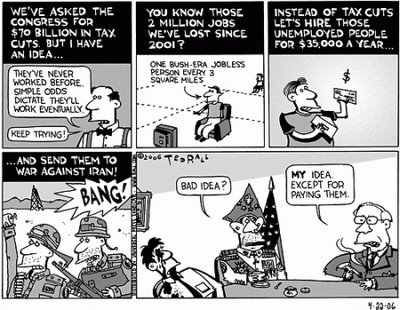
How many lies can Ted Rall make in one cartoon?

Or is he really that much of an idiot to believe his own tripe? Here's his "cartoon" from Saturday. And I use "cartoon" loosely, because as many before me have observed, his drawings have all the sophistication of an elementary school student's scribbles. (Remember, Rall is the one who accused Art Spiegelman of lacking talent.)


Let's deal with it one frame at a time. Here's the truth about tax cuts. As Jack Kemp pointed out in 2003, Kennedy cut taxes. (I'm not the first to note that today he'd be shunned by his own party.) The result: economic boom and increased tax revenues. Reagan massively cut tax rates, especially on the very top incomes upon which most people's jobs depend. The result: the end of stagflation, increased federal tax revenues, and the prosperity of the 1980s (often wrongfully maligned as an era of "greed"). And before them, Calvin Coolidge and Congress in 1925 lowered the top tax rate to 25%. The result: continued economic prosperity through the rest of the 1920s, until the Federal Reserve pulled the carpet out from under Americans (cutting the money supply by a third, triggering the Great Depression).

Compare this with what Franklin Delano Roosevelt did to create a new low in the Great Depression. As I wrote in April 2005:
Keynesian-apologist bunk like this blames the Depression's sudden worsening on a cut in federal spending. The claim is that FDR wanted a balanced budget. The raw data shows that FDR's "balanced budget" had an 8% spending drop in 1937 compared to 1936 to 1937, and a 10% drop in 1938 compared to 1937 (17% overall). However, "tax receipts" surged 37% in 1937 compared to 1936, and then 25% in 1938 compared to 1937 -- an overall increase of 72%. Yes, the federal government cut spending, but it was simultaneously raising taxes -- raising taxes a lot. The top tax rate soared to 79% in 1936, after being raised to 63% in 1932. Massive spending cuts by themselves would have sufficed, but not with simultaneous tax hikes. The higher taxes and constrictive regulations simply discouraged businesses and their owners from doing anything profitable with money. Business owners could expand their businesses, but the after-tax income wouldn't be worth the increasing marginal cost. Would-be investors could save money, but who would borrow it? Government making it unprofitable to create wealth is why the Depression worsened, not because FDR wanted a balanced budget.
Supply-siders like me point out that a balanced budget isn't everything. In fact, it's worse than government borrowing when it means tax hikes (which discourage economic activity) to finance continued high levels of spending.

Regarding the second panel, keep in mind that I'm just a regular Joe. I have no access to economic data to which any of you and Ted Rall are restricted. So when I look at BLS employment statistics, available to anyone in the world, and see that non-farm employment now is over 2 million greater than in January 2001, I can only think of one word to describe Rall's willful ignorance of plain facts: bullshit! I seem to be using that word a lot lately. Lately I've been really tired (not really overworked, but I have so much to do), and maybe liberals' idiocy is starting to get me.

By the way, Rall can't do simple mathematics, either. The United States has a surface area of 3,718,711 square miles (both land and water). So even were his stupidity true, it would be one "Bush era jobless person" every 1.86 miles.

At least his math was correct in the subsequent panels, but his perception of reality, as usual, was off. If the U.S. military recruited two million more people at annual pay of $35,000 each, the total cost would far exceed $70 billion. That's because the U.S. military has extremely high equipment costs per person. Compare the Pentagon's request of $440 billion for 2006, and the 1.4 million active duty personnel (with another 1.3 million or so reservists) in the U.S. armed forces. Keep this in mind the next time someone says that military personnel don't get paid enough. Not to denigrate military service, but when operating costs are extremely high, and your customers (American taxpayers in this case) are willing to pay only so much, you therefore cannot pay your employees very much. And it's possible because there is actually quite a labor pool of people who are willing to serve in the armed forces for not a lot of money (i.e. their employment value at the margin, as Don Boudreaux explained).

I suppose, though, that Rall would finance it with more tax cuts on the rich. Perhaps more tax hikes like FDR's, which plunged the U.S. deeper into the Depression? More tax hikes like Clinton's, which did nothing for the American economy, though Paul Krugman claims they "ushered in an economic boom"?

This is the economic argument. I'm not even getting into the moral argument: it's your money, so why should others have the authority (not "right" or "freedom") to take and spend it as they wish? "Theftinomics" is a word Rall made up to describe government economic policies that are based on theft and fraud. That's a perfect term, actually, for Rall's socialism (euphemistically called "progressive liberalism" by mainstream media). If someone makes $1 million without coercing anyone, without committing a crime, then why are any of us entitled to a penny of it? Yet governments at all levels insist on their cut, so they can redistribute it to everyone else.

It's said that a broken clock is still correct twice a day. Does it matter when a broken clock like Rall is correct but only for the wrong reasons?

Labels: , , , ,

Tuesday, August 30, 2005

The NYC mayoral race: how about "None of the above"?

New York City Mayor Mike Bloomberg, up for re-election this November 8th, has a radio ad that always catches my attention. It features an alleged New York couple who sing his praises, among which are:
  • "He created jobs in all five boroughs."
  • Getting two property tax rebates passed.
Those are downright misleading once you look at the facts. When Bloomberg "created jobs," does that mean he used part of his $4-plus billion net worth to hire people? Clearly not: the claim is that his policies have created jobs. But government cannot create jobs without destroying jobs elsewhere. Remember what Bastiat said: government spending is only a transfer of spending, because it necessitates that someone, somewhere, has less money to spend. Government may create a $40,000 per year job, but only by taking an aggregate of $40,000 elsewhere. So we can rule out Bloomberg "creating" jobs via government hiring.

Did Bloomberg's policies encourage the creation of jobs? This applet at the Bureau of Labor Statistics website can detail New York City's unemployment rate: it was 7.6% in January 2002 (when Bloomberg entered office), peaked at 8.6% in early 2003, and didn't fall below 8% until January 2004. There has been an overall drop in the city's unemployment rate during Bloomberg's first term, and it's true he inherited a struggling economy like Bush did, but the difference ends there. Bush fought for tax cuts that have spurred the U.S. economy into sustained expansion. Bloomberg's initial tax-hike policies actually worsened New York's post-9/11 economic woes. The city's employment eventually improved from natural economic recovery and a partial reversal of the tax increases. Does a doctor brag about saving a limb that he had accidentally amputated in the first place?

Raising various taxes was Bloomberg's solution to the gigantic budget deficits he faced as soon as he was inaugurated, and it's been said that he raised taxes more than any other New York City mayor. A November 2002 Wall Street Journal op-ed (reproduced here at the Manhattan Institute) warned about what he was doing. It noted that David Dinkins' tax increases destroyed 300,000 jobs, while Rudy Giuliani achieved economic growth by refusing to raise taxes, "relentlessly cut[ting] costs," and trimming the city work force while squeezing every last drop of productivity from the rest. But Bloomberg refused to make the necessary cuts in city employment: "The truth, he will find, is that his refusal to lay off 20,000 from the public sector will cause 200,000 private-sector layoffs."

Whatever happened to the Mike Bloomberg that said in March 2002, helping Gov. Pataki's campaign, "We are so highly taxed already that if you raise taxes, you will drive jobs and people out of this city and the total tax revenues will probably decline. ... Doesn't anybody read history?"

On November 11, 2003, the New York Daily News observed that "New Yorkers pay the highest taxes in the nation - by far. On average, New York state residents pay $141 in state and local taxes for every $1,000 they earn, the most anywhere. The main culprits are local income taxes that are a whopping 72% above the national average." The burden also hit businesses. Those fortunate enough not to close permanently were still shaky from 2001's terrorist attacks and recession, and many elected to leave the city rather than pay higher taxes. These were primarily smaller and mid-size businesses, not big firms that were established in Manhattan to the point of being iconic.

The surge in property taxes certainly didn't help, driving more residents out of the city (especially up here to Westchester). In November 2002, New York City faced a projected $6 billion budget deficit for the July 2003-July 2004 fiscal year. Bloomberg and the City Council hammered out a deal: an 18.5% hike in the city's property tax rate with about $800 million in spending cuts. The compromise was that Bloomberg would not cut $50 million in "services" spending that the Council wanted to maintain. This brings us to the third claim I cited: how can Bloomberg dare to take credit for two property tax "rebates" (a mere $400 each, the first of which went out last September), when only a couple of years before he was a major party in raising property taxes?

Incredibly, Bloomberg had been seeking a 25% increase in the property tax rate, with $844 million in spending cuts. Yet he insisted there was no government waste. The Daily News quoted him: "I find it offensive, those that say, 'Oh, there's a lot of waste.' There isn't. I don't know of any programs where some people don't benefit." Of course someone will benefit from any government spending, even if it's completely wasteful like trying to grow fruit and berries in rural Alaskan villages. Clearly Bloomberg does not understand that it's "waste" even when someone gains, because everyone else is economically injured more than the benefits.

The New York Metro had a favorable article defending Bloomberg's various decisions. One big contention between Bloomberg and Albany is Medicare. Bloomberg has wanted to shift part of the city's Medicare costs to the state, claiming that NYC sends $11 billion more to the state treasury than it receives in state spending. Well, it's certainly unjust for New Yorkers to pay a higher share of state taxes just because they tend to have higher incomes. That last link (to the Gotham Gazette) talks about New York City "saving $425 million" in the next fiscal year, but forgetting that the state will lose $425 million. Remember another thing Bastiat said: "The state is the great fictitious entity by which everyone seeks to live at the expense of everyone else."

Let's be honest and objective. Except for reversing tax increases that he initiated, Bloomberg's policies have had minimal effect on New York City's economic growth since he took office. The city recovered naturally along with the rest of the U.S., though it lagged behind the nation in things like unemployment. (That's not really too surprising, since the tax hikes made some people too expensive to employ. What a concept!) And Bloomberg got lucky with this year's tax revenues, which were not from tax increases, but increased tax revenues, mostly from the generally stronger performance of Wall Street firms. Their tax payments account for about one-third of the city's tax revenues.

Bloomberg's chances for re-election look very good: his approval ratings have been above 60% for the last while, and his Democratic opponents are too busy squabbling among each other. Virginia Fields destroyed her already slim chances with a scandal this July involving a doctored campaign photo (never publicly released, but leaked). It showed Fields at a rally, surrounded by people of various ethnicities; attempting to increase her appeal to all ethinic groups, someone put two Asians' faces over the faces of a Caucasian-looking man and woman. None of the four had any knowledge of the alteration, let alone gave consent. Then there was a twist: the "re-faced" man is a Latino, and an aide to Congressman Charlie Rangel -- who has endorsed Fields. The New York Post reported that "Rangel said he didn't recognize anyone in the [original] photo." Now, someone tell me how a Congressman doesn't recognize his own aide from a quite clear picture?

City Council Speaker Gifford Miller and Congressman Anthony Weiner just don't have the popularity to win the Democratic primary. The front-runner is still former Bronx Borough President Fernando Ferrer, a classic tax-and-spend-and-spend-some-more liberal. And let's be realistic: being Latino and emphasizing his humble roots, he has an immediate appeal to minorities that Miller and Weiner will never have. Ferrer's commercials promise he'll do something about minorities' high rates of school dropouts, but what does he have in mind, throwing more money at something that throwing money has never solved before? Similarly, his platform includes a promise to reduce class sizes, though recent studies have shown smaller class sizes have no benefit at all to student performance. (Consider that New York City has about 28 students per class, but just 14 students per teacher. [edited - thanks to ScottM for pointing out I had reversed them]. So what are the teachers doing half of the time?) Ferrer will nevertheless advocate hiring more teachers, as it will give him the very important backing of the teachers unions. More members mean more dues, and thus more money flowing into the unions' powerful coffers.

I don't live in the city and thus can't vote in the mayoral election, but I do work in Manhattan and have an economic interest. My choice between Bloomberg and Ferrer would be...neither. Imagine a voter option to reject the entire ballot: "None of the above - give me some more choices!" This presents problems like having to start a new campaign, which means holding elections long before inauguration, but it helps alleviate the problem of voters feeling obligated to vote for major-party candidates, otherwise they "waste their votes."

Labels: , , , ,

Tuesday, July 12, 2005

Krugman never met a spent tax dollar he didn't like

Paul is at it again, sputtering the usual distortions. Donald Luskin won't let him get away with it, (again) devastating Krugman's contentions and exposing the ivory tower-ensconced Princetonian for what he really is: the ultimate tax-and-spend socialist. The difference between the two is that Krugman has a socialist agenda to promote, while Luskin is a non-academic who, having to work in the real world, knows we must focus on maximizing tax revenue without having to hike tax rates. If the federal government tried to collect 28% of GDP in taxes, as Krugman has suggested, it would "utterly destroy the economy." And the U.S. would certainly take the rest of the world down with it.

Krugman would do well to read Frédéric Bastiat, patron saint of this blog. Bastiat wrote "What Is Seen and What Is Not Seen" over 150 years ago to destroy the myth that government spending is good for the economy: it's merely a transfer, at best. Bruce Bartlett wrote this past January, "A common estimate is that the federal tax system as a whole has a deadweight cost of about 20 cents per tax dollar." That is, every dollar collected in federal taxes reduces total U.S. economic output by 20 cents, for the plain reason that taxes discourage economic activity. That's even a low estimate compared to others. This 1996 Congressional report stated:
Recently, the Joint Economic Committee (JEC) released a report written by two academic economists, Lowell Gallaway and Richard Vedder. They carefully studied U.S. history to examine the relationship between government spending and economic growth. They concluded that at current spending levels the last dollar government spends reduces private sector GDP by $1.38. In other words, the economy experiences a net loss of 0.38 cents. From their analysis, it follows that in 1994, if the federal government were to reduce its spending by four percentage points, economic growth would have increased to 5.4 percent.
One of the report's footnotes cites Gallaway and Vedder as saying optimal federal spending for the U.S. is "17.57 percent." I think that's far too high, but curiously enough, that's where Krugman said we are.

Government spending has been known to hurt certain industries much more than the average. The National Center for Policy Analysis criticized Kerry's plan for massive federally subsidized health care, especially because the 1990s Medicaid expansion showed that a dollar of increased federal spending on Medicaid has not been matched by the private sector spending a full dollar less:
A study by Harvard University Professor David Cutler and Massachusetts Institute of Technology Professor Jonathan Gruber found that Medicaid expansions in the early 1990s were substantially offset by reductions in private coverage. They found that, for every additional dollar spent on Medicaid, private sector health care spending was reduced by 50 to 75 cents on the average. Thus taxpayers incurred a considerable financial burden, although little was accomplished.
Put simply, for every extra dollar the feds spent on Medicaid, the private sector could cut back by only 50 to 75 cents, not one dollar. The private sector still had to spend 25 to 50 cents to maintain the same level of service. So much for the "economy of scale" that socialists like to ascribe to government!

Even a basic Marxist model of capitalism illustrates how taxes prevent an economy from reaching full potential. A business produces profit, which is reinvested so it can become greater profit, which is in turn reinvested ad infinitum. My Marxist professor who harped on that, back in my undergrad days, would never admit that when government taxes profit, the business cannot expand in future cycles as much as it did before. That means it cannot hire as many new workers, which reduces the potential tax base.

Shouldn't government want people to work as much as possible? You'd think so, but big government is greedy and wants to tax now, when instead it could promote economic growth with lower tax rates, which in the end create higher total tax revenue. The Laffer Curve just plain works. Reagan proved it. The 1997 tax cuts, which the Republican Congress pushed Clinton into signing, proved it. George W. Bush's tax cuts are proving it as we speak.

Krugman and others claim otherwise in their straw-man argument, but the Laffer Curve does not state that tax cuts will always pay for themselves. It does say, though, that at a certain level of taxation, both tax revenue and economic production will be maximized. That's how we can reduce tax rates to a certain level, encouraging people to produce more economic output, and achieve more tax revenue than before. It's the same principle by which a retail store can experiment to determine a product's optimal price: if every increase of 10 cents discourages x people, how much can the store charge to maximize earnings? So pay no attention to the man behind the Princetonian curtain, especially when you consider his prediction record.

Krugman has predicted since March 2003 that we're headed for a "fiscal train wreck," which not only hasn't happened yet, but the basis for his insanity, the federal budget deficit, continually decreases in the 2005 projections. It was once extremely high by anyone's standard, but whaddya know: incoming revenue is outpacing Congressional spending, so each new deficit projection is less and less. A "right-winger" isn't claiming that, but the Congressional Budget Office itself. How much did Krugman weep to read the first paragraph of that report? I'll highlight the first part that he didn't want to admit:
In the first three-quarters of fiscal year 2005, the federal government incurred a deficit of about $251 billion, CBO estimates, $76 billion smaller than the shortfall recorded in the same period last year. Both revenues and spending are running ahead of last year’s pace, up by about 15 percent and 7 percent, respectively. With robust growth in revenues in May and June, CBO now expects that the 2005 deficit will be significantly less than $350 billion, perhaps below $325 billion, assuming that no other legislation is enacted that affects spending or revenues. CBO will release updated budget projections for the 2005-2015 period on August 15.
Krugman also cited a January 2001 "budget office" (the CBO?) report that forecasted $2.57 trillion in tax revenues for 2005, and that at current projections, we'll still be $400 million short. First, the CBO issued so many ridiculously optimistic projections in those days, based on the unsustainable "bubble" growth of the late 1990s. Second, the CBO projects federal spending for 2005 at $2.42 trillion. So if we get Krugman's predicted $2.17 trillion in tax revenue, that's a considerably smaller budget deficit of $250 billion, about 2% of GDP.

As I've noted, Krugman predicts economic Armageddon after economic Armageddon, none of which have come to pass. He needs such economic bogeymen to stay interesting. Well, Krugman can keep admitting his "forecasting record isn't that great," and maybe as I said, with enough time and a whole lot of predictions, he might finally predict something that will happen -- but more than a few of us will never forget his lies about his forecasting.

Where were Krugman's warnings in the 1980s when the federal budget deficits were worse than today? The federal budget deficit is higher today in terms of raw numbers, which our friend Steve Conover points out is not as meaningful as better measures. It's far more accurate to examine federal debt as an annual budget deficits as a percentage of current GDP, and total debt as a percentage of GDP.

Look at this CBO data, particularly through the 1970s and 1980s. Federal budget deficits, as a percentage of the economy, continued to soar under Democratic Congresses. Strangely enough, the deficit's growth, again measured as a percentage of GDP, started dropping in 1992 but really started dropping when the Republicans won control of Congress. Do we really think the deficits would have kept dropping if Hillary had had her way with our health care system? Now, I'm no cheerleader for the Republicans. The last couple of years of federal spending have been ridiculous, as the data shows, but 2005 looks to be a big reversal -- even by Krugman's numbers from my previous paragraph.

My twist on John Stuart Mill is, "Debt is an undesirable thing, but not the most undesirable of things." No rational person borrows merely for the sake of borrowing, but debt can be worthwhile when we want something today, if the interest is worth having it sooner. I would much prefer that the federal government not borrow at all, but we can't stop it cold turkey just yet. In the meantime, its debt is not the end of the world, especially not at these modest levels. Skeptical Optimist Steve Conover has been updating his chart for a while now, the debt-GDP ratios of the U.S. and other countries. What I like about his projections is that it wouldn't take much fiscal austerity to reduce the U.S. debt burden over a few decades; we can do it even with modest spending increases and sustained tax rates.

But Krugman couldn't care about any of this. Luskin's spot-on: Krugman and his fellow socialists just want to tax first, and determine spending allocation later. Like all good self-anointed bureaucrats, academics and activists who have undertaken a mission to save mankind (which means molding man into their desired image), success is measured by dollars spent and more people dependent on government.

Labels: , , , , , , , ,

Wednesday, March 23, 2005

John Edwards' hypocrisy

From the AP:
John Edwards, former senator and vice presidential candidate, has a new part-time job as head of the University of North Carolina law school's new Center on Poverty, Work and Opportunity.

Edwards, who represented North Carolina for one term in the Senate, began work Tuesday by moderating a panel discussion on the importance of savings and assets in moving families out of poverty.

"We have millions of Americans who work full time and still live in poverty, and that is absolutely wrong," said Edwards, a Democrat.
It's not "wrong" per se, but a fact of life. That doesn't mean we can't extend a helping hand, however. That sounds like a worthy cause, doesn't it? A "Center on Poverty, Work and Opportunity," with emphasis on helping impoverished families save and accumulate assets.

From its name, I presume that John Edwards will work toward Social Security privatization. After all, it is the way for lower-income people to save money that is theirs. That's the ultimate way for poor people to build up their own assets.

Oh, but John Edwards doesn't support Social Security privatization. He'd rather have poor people stay poor, and be supplicants (as Michael Tanner of Cato said) to the government for their retirement.

Will John Edwards support free trade, which benefits poor people the most? First, free trade creates jobs, and better ones to help poor people out of poverty. NAFTA did push some jobs to Mexico, but the U.S. had a net gain in jobs -- and mostly higher-paying ones at that. That's because it allows us to do more productive, better-paying work that Mexicans, Chinese, et al, cannot do as well. Meanwhile, our trading partners produce things more efficiently -- more cheaply -- than we can, and they trade for the things we produce better. And the low prices benefit poor people more than others.

Oh, but John Edwards doesn't support free trade. Not real free trade, no. He voted for the farce of "permanent normal trade relations" with China and Vietnam, but he believes free trade puts Americans at a disadvantage and even "hurts" them. And just what would this "National venture capital fund" do? Evidently it will use tax dollars, so I'd like to know just how you'll take people's money and redistribute it to Americans "hurt by trade" -- how would you determine who's worthy, and how much each receives? And more fundamentally, how do you justify forcibly taking money from one person and giving it to another?

Look at John Edwards' switch-hitting: he actually came out somewhat for NAFTA before he came out against it. That's worthy of John Kerry.

Well, maybe John Edwards supports across-the-board tax cuts for businesses, so that they can afford to expand? More jobs mean more opportunity for poor people, instead of wasteful government spending. But no, John Edwards doesn't believe in tax cuts for businesses. The Kerry-Edwards plan proposed tax credits, and only to certain businesses. It also proposed cutting "the corporate tax rate by 5 percent – providing a tax cut for 99 percent of taxpaying corporations," but paid for by a tax hike on the remaining 1%.

As Bastiat would remind us (go here and scroll down to 1.56), that is not the creation of wealth, but merely a transfer. These "tax credits" are a euphemism for subsidy, whereas a true tax cut is an incentive giving real economic benefit to everyone. The plan's provided scenario is mind-boggling in its ignorance of economics:
For example, a medium-sized manufacturing company employs 1,000 workers. If this company hires an additional 100 employees at $40,000 – bringing the total to 1,100 workers – they would get a tax cut of $3,060 per worker $306,000 in total.
So the Kerry-Edwards plan was to pay the payroll taxes of certain businesses...just where did the Dynamic Duo think that money would come from? And it is a transfer at best, because the requisite tax increases are a disincentive for the other businesses that must pay them. Also, why do Kerry and Edwards believe it's ok to discriminate against big businesses, like Wal-Mart? It seems to be solely because they're "big." What is intrinsically wrong with a big business, whether or not it uses "economy of scale" to the consumer's advantage? It's still people, and people working.

Why are liberals like John Edwards so against Social Security privatization, free trade, and real tax cuts for all businesses? Well, it doesn't matter that these are the most economically effective measures to benefit the poor, as well as the rest of society. That's just it: liberals oppose any public policies that would help the poor if such policies might possibly benefit one "rich" person, no matter how small the extent. Can't cut income taxes, that would help the "rich"; can't cut capital gains taxes, that would help the "rich"; can't cut property taxes, that would help the "rich" too. But the fact remains that we're all in this economy together, and I for one declare that "trickle-down" does work. Read carefully what I say in my entry there: I'm not saying the rich shouldn't pay any taxes while the rest of us do, but a heavily progressive tax structure eventually hurts poor people too.

I wonder about something. John Edwards is a multi-millionaire trial lawyer. Since he thinks millionaires don't pay enough taxes, will he donate his $40,000 annual salary from the UNC to the U.S. Treasury? Has he started to calculate what is his own "fair share" of taxes and start paying that, regardless of current tax law? Will he sign a pledge stating he will never "evade" taxes via tax-free investments, like munis?

Or he could demonstrate his compassion for the poor by donating his $40,000 annual salary from this "Center" to a charitable cause. If he will or already donates extensively, please correct me: I will applaud anyone, even a liberal, who puts his money where his mouth is. On the other hand, I will not refrain from criticizing liberals who want to tax some people to benefit others, without putting up their own money first.

Labels: , , , , , ,

Monday, March 21, 2005

The national debt, 50 years from now

Skeptical Optimist Steve Conover takes a look at the national debt over the next half-century. One of his scenarios assumes steady (which could even be average) numbers similar to today's GDP growth: 3.3% GDP growth, tax levels of 16.8% of GDP, 2.2% inflation, 4.0% average interest on the debt, and 5.2% growth in government spending. According to Mr. Conover's model, with those numbers, by 2055 the national debt will fall from 66% of GDP to 41% of GDP.

Update: I should add my answer to Mr. Conover's question, "Is sustained growth of 3.3% attainable? Are the inflation and spending assumptions sustainable?" I say, yes and yes. An average growth rate of 3.3% is perfectly normal growth, and not so high that the Fed will have to tinker much with inflation. Fiscal discipline, however, has to come from within the hearts of our government officials. In short, I think those are perfectly reasonable assumptions. It's true that this scenario presumes lenders' continued (constant?) willingness to continue loaning us money. However, as long as we remain the most creditworthy of the large economies, as long as the EU and Japan remain stagnant, our creditors will have no problem lending to us. One of my own ideas is that the limit on U.S. debt isn't whether the rest of the world is willing to lend to us, but whether they have any savings left to lend to us.

Another thing I'd like to update with is my frank admission that with Republicans controlling the executive and legislative branches, the federal budget has increased by a lot more than 5.2% annually. I really, really hope President Bush can use his veto pen and finally get Congressional spending under control.

However, I still find Mr. Conover's projection startling, and I think it's a real victory for supply-side economists. It's also a huge slap in the face to the new "fiscally conservative" Democrats. And to Paul Krugman, too, who's hardly a fiscal conservative but perenially insists we're headed for a "fiscal train wreck."

I've noted before that John Stuart Mill said, "War is an ugly thing, but not the ugliest of things." And my own twist is, "Debt is an undesirable thing, but not the most undesirable of things." Nobody goes into debt for simply the sake of having debt, but prudent debt isn't intrinsically bad. As long as banks and other countries are willing to lend money to our different tiers of government, we can achieve faster economic growth than what we pay in interest. That's the whole idea behind borrowing: the benefits exceed the cost of interest.

Mr. Conover's scenario might seem impossible. Each year, government spending increases 5.2%, government pays 4% interest on the national debt, the economy grows at a 3.3%, yet the national debt falls as a percentage of GDP. This is because GDP growth is measured in real terms, adjusted for inflation. Debt and interest payments are in nominal terms, not adjusted for inflation. So if the economy grows 3% and inflation is 2%, nominal growth is 5%, and enough to pay on a 4% bond. Also, government spending is also in nominal terms: Mr. Conover's scenario uses inflation plus 3%, so actually government is growing less than the economy. All you need is for real GDP growth to exceed the inflation-adjusted values of interest payments and government spending increases.

There's another reason the national debt can still shrink as a percentage of GDP, but I'm not sure how or if Mr. Conover accounts for it. I once said: "Raising taxes is not the solution you anti-supply-siders think it is. You completely ignore the 'I' word in economics. Keynes had it wrong: it's not inflation. It's incentive." [Update: corrected my own quote, oops] Taxes are, by nature, a disincentive to creating wealth. The whole idea behind supply-side economics, especially the Laffer Curve, is that cutting taxes gives people an incentive to work more and create more. Now, most Americans are so detached from their governments that a budget deficit, i.e. borrowing money, may not be as much of a disincentive as higher taxes are. We're fine so long as our economic growth exceeds our interest payments, that's a good thing.

There are still some Americans who embody Ricardian Equivalence, but very few. Ricardo theorized that it's the same effect if a government borrows or raises taxes: when people see their government taking on debt, they save more in anticipation of having to pay higher taxes so that government can pay off the debt. Since their savings are part of what government borrows, it's the same as if government increased taxes. I think that was true of most Americans once upon a time, but not today. I don't see that Americans today save more, consciously or not, even when budget deficits increase. Americans save so little compared to the rest of the world (by any standard, whether the BEA household rate or the Fed's flow of funds rate). Most of our debt is financed from anywhere but home, especially China, Japan and South Korea.

I'm only a humble foot soldier in the supply-side movement, but this is where I think Ricardo went wrong in his equivalence: he didn't account for incentive. Let's say I make $50,000 a year and save $1000 each year (2%). After an increase in the federal budget deficit, my own taxes will have to go up, say, $50, as my share of the increased interest payments. Let's even say Ricardian Equivalence happens, and that I save an extra $50 in anticipation. Why doesn't the government just tax me $50 more in the first place? It's incentive: supply siders say that with higher taxes, people overall are inclined to work less and produce less. People notice higher taxes more than budget deficits.

(This is actually leading to a very wacky idea that I need to talk to real economists about. Stay tuned for details.)

I've sometimes thought about the reverse of Ricardian Equivalence: when there's a government surplus, will people save even less, because they see that government won't have to borrow as much? I'd like to hear criticism of this idea, because I've never heard anyone talk about "Reverse Ricardian Equivalence" (my term for it). I just e-mailed Dr. Ikeda, one of my old professors, about it.

Labels: , ,

Monday, February 28, 2005

Eating the rich? Or just soaking them?

This is adapted from a reply I made on Jackie Passey's blog. Someone said he "would in fact like to eat the rich."

I was in my teens when Bill Clinton became the Democratic nominee for President. His "It's time for the rich to pay their fair share" line showed me that class warfare, this socialist-propagated mythos of rich versus poor, is alive and well. The first problem with "soak the rich" philosophies is that they ignore that money really does "trickle down" to those of lower incomes. And just because government can redistribute wealth doesn't mean it's efficient, let alone morally right to do so.

Donald Trump's wedding reception was in a ballroom that he had remodeled for $42 million. Who built that ballroom, especially the thousands of square feet of marble? Who sews fur coats, crafts jewelry, or builds luxury cars and boats? Not the rich. When they go out to dinner, who waits their tables? Who mows their lawns? All that labor is done by people of far lower incomes, whose jobs are made possible because the "rich" spend their wealth. My job wouldn't exist were it not for wealthy investors.

Consider when someone borrows money for a loan: where did those funds come from? The bank doesn't create the money out of thin air. What you're borrowing, of course, is what others have saved; and by definition the bulk of savings are from "rich" people. Whether you borrow $200,000 for a home mortgage or $10,000 for a car, it's more likely the money came from a "rich" person than someone of your income level. Those savings could also be lent to businesses (owned by entrepreneurs of any income level), which can mean jobs. So whether a "rich person" spends money freely or saves it, the money still flows around the economy.

Don't get me wrong. I'm not saying people of lower incomes should kiss every "rich" person's foot in gratitude, but we should recognize that other people's wealth does help those of lower incomes. When government taxes a wealthy person $1 more, that's $1 less that flows to a lower-income person, whether to support a job or provide a loan. You might think it's great when the government plays Robin Hood, taking a dollar from the rich and giving it to the poor, but the nature of the state is inefficiency, if not corruption. Friedrich Hayek wrote a great deal on "the knowledge problem," explaining that state bureaucrats necessarily function on imperfect knowledge. So between poor decision-making (that is, relative to the rest of society) and bureaucratic costs, a taxed dollar is greatly depleted by the time it's given the lower-income person. It would have been better had the rich person been allowed to spend or save the dollar as he saw fit, so that the lower-income person could have received the full dollar in labor, or borrowed the full dollar.
In What Is Seen and What Is Not Seen, Bastiat discussed something very similar, using the example of taxing farmers, then spending the money on parties in Paris, which gives jobs to cooks and the like. It's no different than had the farmers spent the money, c'est vrai? Mais non! "Do you not see that it is only a simple transfer of consumption and of labor? A cabinet minister has his table more lavishly set, it is true; but a farmer has his field less well drained, and this is just as true. A Parisian caterer has gained a hundred sous, I grant you; but grant me that a provincial ditchdigger has lost five francs. All that one can say is that the official dish and the satisfied caterer are what is seen; the swampy field and the excavator out of work are what is not seen." This is even assuming a fully transparent transfer of money by government.

Jobs are, in fact, created from pork barrel projects like Senator Byrd's proposed atomic clock from 1993. However, even the Navy said it was wholly unnecessary, there were valid criticisms that the cushy administrative jobs were going to Byrd's friends, and it would deprive taxpayers of $7 million that were needed elsewhere. Going back to Hayek, knowledge dispersed among a free market will find a better use for resources (not just money) than the imperfect knowledge of a few government bureaucrats. (In my original reply, I was in error. Byrd retracted his proposal, thank God, after ABC's World News Tonight and other news organizations brought it to national attention. But that's chicken feed compared to Byrd's $75 million telescope and all the other pork he's inserted into other Senate bills. He's not the only one to waste taxpayers' money, either.)

Dr. Walter Williams made perhaps the most concise and simply terrific moral argument against government-induced redistribution of wealth: "What's *just* has been debated for centuries but let me offer you my definition of social justice: I keep what I earn and you keep what you earn. Do you disagree? Well then tell me how much of what I earn *belongs* to you – and why?"

Labels: , , ,