Tuesday, February 13, 2007

Iranian lies -- but I repeat myself

Madman Mahmoud is at it again, and how does the Allah-Akbar Press report it?
"Iran leader softens his tone on Iraq"

Iran's hard-line president, who has berated the United States and refused to compromise on his nuclear program, is now softening his tone, saying Monday he wants dialogue rather than confrontation in Iraq. Tehran also denied it gave sophisticated weapons to militants to attack U.S. forces.

President Mahmoud Ahmadinejad insisted that turmoil in Iraq is bad for his country and dialogue - not force - was the solution to the region's conflicts.

"We shy away from any kind of conflict, any kind of bloodshed," Ahmadinejad told ABC's "Good Morning America." "As we have said repeatedly, we think that the world problems can be solved through dialogue, through the use of logic and a sense of friendship. There is no need for the use of force."
Say this in your best Captain Kirk voice:

Riiight.


Ah yes, those Iranians are certainly staunch believers in solving problems through dialogue, logic and a sense of friendship. Sarcasm aside, Ahmadinejad is technically correct: Iranians don't see a need to use force, but it's their preference.

"I think this was childish of the U.S. government to do something like arresting defenseless people, not allowing them to talk to anyone," he said. And just what were those camel-fuckers doing to the Americans they seized in 1979?

Be wary of jihadists who want to discuss "peace": it's been their practice for centuries to use that as a distraction while they regroup and rearm.

Meanwhile, Agence France-Presse helps perpetuate Mahmoud's latest lie:


Yahoo News carried this picture with this caption: Iranian President Mahmoud Ahmadinejad puts on an Arab outfit during a public meeting January 2007 in the southwestern city of Sousangerd. The European Union welcomed possible new talks to curb Iran's nuclear ambitions but pushed ahead with UN sanctions to punish Tehran for its refusal to stop enriching uranium.(AFP/File)

The other day, Ahmadinejad claimed that Iran and Iraq share a "brotherhood, common history, culture and beliefs" -- sure, about as much as France and Germany do. Iran is Persian while Iraq is Arab. Until about the middle of the second millenium AD, they were spending centuries conquering each other, making the 1980s war look like a mere skirmish. They don't even share a common language: Farsi is the language of the former, while Arabic is the language of the latter. "Common history" is no more than the Arabs once conquering what is now Iran, allowing the Persians to maintain their own culture (including language). Then again, the Mongols did the same after conquering present-day Iran, but who touts a "common history" between Mongols and Persians?

Labels:

Saturday, November 26, 2005

Two words for Mahmoud Ahmadinejad

I would give him three, specifically what Dick Cheney properly told Pat Leahy, but my blog isn't the place for such language, no matter how apropos.
Iran President: Charge Bush for War Crimes

TEHRAN, Iran - Iran's hard-line president said Saturday the Bush administration should be tried on war crimes charges, and he denounced the West for pressuring Iran to curb its controversial nuclear program.

"You, who have used nuclear weapons against innocent people, who have used uranium ordnance in Iraq, should be tried as war criminals in courts," Mahmoud Ahmadinejad said in an apparent reference to the United States.

Ahmadinejad did not elaborate, but he apparently was referring to the U.S. military's reported use of artillery shells packed with depleted uranium, which is far less radioactive than natural uranium and is left over from the process of enriching uranium for use as nuclear fuel.

Since the Iraq war started in 2003, American forces have fired at least 120 tons of shells packed with depleted uranium, an extremely dense material used by the U.S. and British militaries to penetrate tank armor. Once fired, the shells melt, vaporize and turn to dust.

"Who in the world are you to accuse Iran of suspicious nuclear armed activity?" Ahmadinejad said during a nationally televised ceremony marking the 36th anniversary of the establishment of Iran's volunteer Basij paramilitary force.

Iran has been under intense international pressure to curb its nuclear program, which the United States claims is part of an effort to produce nuclear weapons. Iran denies such claims and says its program is aimed at generating electricity.
Two words for you, Mahmoud: Pearl Harbor. Since you're evidently unfamiliar with world history, I'll briefly educate you that the U.S. was engaged in peace talks with Japan when we were suddenly and cowardly attacked. President Franklin Roosevelt began, asking Congress to declare war:
Yesterday, December 7, 1941 - a date which will live in infamy - the United States of America was suddenly and deliberately attacked by naval and air forces of the Empire of Japan.

The United States was at peace with that nation and, at the solicitation of Japan, was still in conversation with its Government and its Emperor looking toward the maintenance of peace in the Pacific. Indeed, one hour after Japanese air squadrons had commenced bombing in Oahu, the Japanese Ambassador to the United States and his colleague delivered to the Secretary of State a formal reply to a recent American message. While this reply stated that it seemed useless to continue the existing diplomatic negotiations, it contained no threat or hint of war or armed attack.

It will be recorded that the distance of Hawaii from Japan makes it obvious that the attack was deliberately planned many days or even weeks ago. During the intervening time the Japanese Government has deliberately sought to deceive the United States by false statements and expressions of hope for continued peace.
Mahmoud, I'll tell you just who are are. We're the United States of America. We're the good guys. You (and here I'll specify you and the other Iranian leaders and try not to attack the Iranian people in general) are the bad guys.

The last sixty years have proven we have never aggressively used nuclear weapons, and while we have had some foreign policy failings, we're far from the imperialist nation that you dream of while puffing away at the hashish. You, on the other hand, couldn't be trusted with so much as a spitball. You claim you want nuclear energy for peaceful purposes, then wonder why we question your Chavez-like maneuver. Why do you insist your nuclear intentions are for energy purposes when it would be far cheaper to use all the petroleum in your back yard? Do you not even have the bravery of North Korea's Kim Il Sung, who eventually admitted that their nuclear program is to develop weapons?

Updated: you brought up the depleted uranium shells, Mahmoud. They're certainly not the nicest things to use, but you know something? That's the nature of war: you do a lot of terrible things to win it. Wars are not won by spitballs and calling each other names. At least when we kill civilians, it's by accident and exceedingly rare, because we give actually give a damn about them, contrary to your "useful idiots" like liar Jimmy Massey. We voluntarily refrain from using our full military capabilities when we could kill civilians, or surrendering enemy forces. Tragically that has allowed you and other cowards to take advantage of us, but that's part of being the good guys. At other times, like Hiroshima and Nagasaki, we'll do what we can so that a million American GIs don't have to die invading Japan -- and several million Japanese to boot. Accuse us all you'd like in your delusions, Mahmoud, but we're nothing like your fellow terrorists who regularly commit genuine atrocities, who attack a few dozen American soldiers, knowing perfectly well it will also kill children who are getting food and candy at that Iraqi hospital. But who are we to accuse, when your government, after all, does far more terrible things to far more people as a matter of public policy?

Though leftist moonbats would disagree, we're not run by a religious dictatorship. The United States has many failings about which I've blogged extensively, but who are you to accuse us? What you accuse us of in Abu Ghraib and Guantanamo Bay (mountains out of molehills if ever there were any) is five-star hotel service compared to what you do to dissident students. And we do not oppress our women. We don't force them to wear a hijab or else; you'd like them to think the head scarf is a good and moral "tradition," but it's actually as "traditional" as bell-bottoms in the West. When someone like Shirin Ibadi can become the leader of your nation, come back and we'll talk.

We've never taken over any embassies, let alone one of yours, and held innocent people hostage for 444 days. Even had we, we wouldn't be cowardly enough to release them on the inauguration day of the enemy's new president, specifically one with cojones and who wouldn't tolerate such a terrorist action.

You know what, Mahmoud, you and your fellow leaders really can go ____ yourselves.

Sunday, January 28, 2007

And the Iranians take a page from John Kerry's playbook

First, An Iranian lawmaker announced that it was installing 3000 centrifuges at a uranium enrichment plant. Then, an Iranian nuclear official denied it.

What explains the flip-flop? Did Iran actually install the centrifuges before it didn't install them? Or, imagine this exchange when a certain Iran nuclear official pays a visit to a certain Iranian lawmaker as part of damage control.

Simorgh: Alaeddin, have you always had camel dung for brains?!

Boroujerdi: Hossein, what in the name of jihad are you talking about?

Simorgh: Look, Ahmadinejad is as angry as with you as a father would be with his raped daughter. Why did you announce we're going ahead with the centrifuges?

Boroujerdi: Well the whole world knows it, right? Even our friend ElBaradei admits it.

Simorgh: What are you, the son of an infidel? Let ElBaradei talk all he wants, because this Western illusion of an "international community" either doesn't believe him or doesn't care a dinar's worth. Meanwhile, we need you to keep quiet so Ahmadinejad can keep play the stall game.

Boroujerdi: Who needs to stall? Soon enough we'll have nuclear weapons, and Hezbollah can destroy Western cities.

Simorgh: You fool! Didn't you ever think that the Jewish state, which we talk about destroying while thumping our chests, could turn our cities into glass before we know it? So stop braying like such a talkative donkey, before you make the infidels feel really threatened.

Labels: ,

Monday, February 13, 2006

Trusting Iran

Q: How is Iran like Ross Perot?

A: They're both in. Then they're both out. Wait, no, back in again. Oh, to hell with us all, they're back out again!
Iran Reaffirms Nuclear Treaty Commitment

TEHRAN, Iran Feb 12, 2006 (AP)— Iran reaffirmed its commitment to the Nuclear Nonproliferation Treaty on Sunday, a day after its hard-line president implied Tehran was considering withdrawing from the pact after being reported to the U.N. Security Council.

The declaration by the Iranian Foreign Ministry came as inspectors from the U.N. nuclear watchdog arrived in the Islamic republic over the weekend to evaluate what controls remained on nuclear sites and equipment after Tehran reduced the agency's monitoring power to a minimum, diplomats said.

A diplomat told The Associated Press Saturday that some seals and cameras had been removed within the last few days, suggesting that happened without IAEA supervision. But others familiar with the probe said Sunday they doubted the Iranians would make such a move before the arrival of the inspectors.

The diplomats spoke on condition of anonymity because they weren't authorized to speak on the issue.

Foreign Ministry spokesman Hamid Reza Asefi urged a peaceful solution to the dispute over his country's nuclear program.

"We are still committed to the provisions of the NPT. But we can't accept its use as a (political) instrument. We will cooperate in the treaty and the safeguards' framework," Asefi said at a weekly news conference.

On Saturday, President Mahmoud Ahmadinejad rejected U.S. and European pressure to freeze the country's nuclear program and hinted that Iran might withdraw from the treaty.

"The nuclear policy of the Islamic Republic so far has been peaceful. Until now, we have worked inside the agency (IAEA) and the NPT regulations," he said in a speech before tens of thousands of Iranians marking the 27th anniversary of the Islamic Revolution.

"If we see you want to violate the right of the Iranian people by using those regulations (against us), you should know that the Iranian people will revise its policies," he said.

He did not specify what changes Tehran envisioned, but it was believed to be a threat to withdraw from the NPT and the IAEA....
Trusting Iran on its nuclear ambitions is like trusting gang members to obey gun control laws. It's utter naïveté to think that Iran wouldn't remove the seals until the inspectors arrived, let alone to think Iran's nuclear program is for peaceful purposes -- with all the cheap oil in their back yard, why do they want to bother with expensive nuclear energy? Am I the only one who sees significance in the timing of "Madman Mahmoud," i.e. the anniversary of the day they declared war on the United States?

I'm sure U.S. intelligence analysts similarly believed on November 3, 1979, that Iranians would never dare take American citizens hostage in our own embassy. Let me relate a little family story showing my father's contempt for the country Iran became. When news of the hostage crisis broke out, my father was in a bar with some friends. There was a Middle Eastern-looking man who said he was glad it happened, that he hated the United States. My father thought he was Iranian and was about to go over and literally beat the crap out of him. One of my father's friends told him not to bother, though, that "He's not even an Iranian."

Though my father was an atheist, he had a bit of agnosticism at times. I think it was more that he wanted a hell to punish evil people, rather than a heaven so people can be with God. Dad growled as we watched the news of Khomeini's death, "I hope that bastard rots in hell!" My father truly hated Khomeini, as I always have, especially for what Khomeini did to a country once friendly with the United States. In the 1960s, my father traveled quite a bit through the Middle East, including Beirut and Tehran. He really enjoyed those cities, which were jewels then. Today they're but shadows of the beauty and wealth they were just starting to enjoy. It's a real credit to Islam's centuries of suppression of Middle East art, philosophy and scholarship, its own equivalent of Europe's Dark Ages.

Previous:
Iran: it's all your fault, you made us do it!
Two words for Mahmoud Ahmadinejad

Monday, March 10, 2008

Latin America: like the French, they're there when they need you

Tony Saca, el presidente of El Salvador, wants the U.S. to create a "Marshall Plan" to invest massively in South America. There's only one phrase to describe what he and other Latin Americans want of the United States: wealth redistribution. Free trade is one thing, but when other nations bring up the Marshall Plan and "investment," Americans had better watch out for their wallets.
WASHINGTON -- El Salvador's President Tony Saca, a close U.S. ally, can scarcely contain his frustration.

He calls U.S. politicians "shortsighted" for failing to reform U.S. immigration laws. He says Latin American populism is "a pendulum swing towards disaster" that deserves more U.S. attention.

"The United States, in my judgment, should invest enormous resources in Latin America, along the lines of a Marshall Plan," he said in a recent interview. "Generally speaking, when you want to have a neighborhood that gives you peace of mind, you have to invest in that neighborhood."
"Extortion" is the only word to describe this. If you Americans don't appease us, he's saying, we're going to make you very sorry. It's no different than American citizens demanding that the government "invest" money in poor neighborhoods, with the implied threat that it prevents riots. Real, voluntary investment is one thing, when entrepreneurs realize a profit opportunity and seize upon it. But when government "invests" in American neighborhoods, or Latin American countries, it's as voluntary as a mugger stealing my wallet to give to Greenpeace (or any other organization I would never willingly give money to).

Saca isn't even to the level of being a "mojado." At least illegal immigrants from Latin America make the effort to come to the U.S. Saca wants to stay at home and receive American dollars.

I'm pretty open on immigration, believing the United States should welcome people who yearn for real freedom, but what I do not believe in is the redistribution of wealth -- whether it's by my neighbors "voting" to seize my property, by "Pablo" and "Maria" coming across the border so my tax dollars can pay for their health care and their children's education, or Latin Americans who feign "friendship" just so the U.S. will tax me to send them more money. American governments are as stupid and naive as a schoolboy who considers classmates his "friends" when they're merely taking advantage of toys and treats he gives them. It's worse with government, though, because the schoolboy's parents can realize his errors and put an end to it. Government, with its usurped power to lay its hands upon any and all tax dollars it can, has no such limitation.
There may be little the United States can do for Saca. President Bush has increased aid to Latin America by record amounts and visited Latin America more than any of his predecessors, but he remains unpopular and unable to pass initiatives that Latin Americans want, like immigration reforms and free-trade pacts. His legacy may be the biggest loss of U.S. influence in the Western Hemisphere in recent memory.
This is no different than schoolyard "friends" who are never satiated with what they're given, complaining "I thought you were my friend!" when the schoolboy in fact has already given much.
"Requiem for the Monroe Doctrine" is how academic Daniel Erikson put it in an article for Current History, referring to the 1823 declaration by President James Monroe that put the Western Hemisphere off-limits to outside powers.
Erikson is the latest demonstration that "academics" tend to not know what the hell they're talking about. The Monroe Doctrine wasn't about the United States continually taking from American citizens to give "aid" to Latin America. The Doctrine was a warning to European nations that they were to cease colonization in the Americas and henceforth not interfere in the affairs of nations in the Americas, and that the United States would forcibly defend them against European incursions. Unfortunately, this sense of "guardianship" bred such arrogance that the U.S. did plenty of its own meddling in Latin American affairs during the 20th century, but that's a topic for another time.
Trade between South America and China is booming. Governments from Canada to Iran are cutting deals in the region, and Venezuelan President Hugo Chávez has made challenging U.S. interests his foreign-policy mission, through everything from sweet oil deals to a TV news channel that rivals CNN.
If you read the rest of the article, the U.S. is still the most important trading partner of all Latin American nations. If they don't like what the U.S. is doing, fine, but the fact is that they need the U.S. a lot more than the U.S. needs them.

If Latin America can do so well without the U.S., why are economists worried that any U.S. economic slowdown will trickle south to Latin America?

Furthermore, why should the U.S. fear additional trade anywhere? "A rising tide lifts all boats," whether it's China trading with Mexico, or Canada importing ethanol from Brazil. This "news" article is employing the old liberal fallacy that if your neighbor grows more prosperous, it somehow "steals" or at the very least "competes" with your own prosperity. Nothing could be further from the truth. If China grows more prosperous, that's more real wealth flowing through the global economy. Everyone -- that is, everyone competitive -- can benefit from the increased wealth, which creates a greater capability to buy goods and services from others, and invest in others who provide goods and services.

What also couldn't be further from the truth is believing that Chavez is a threat to the U.S. For all his saber-rattling, as McQ noted at QandO, the U.S. is still his most important buyer of Venezuelan crude, and one of the few buyers who can actually do something with Venezuela's somewhat unique type of crude oil. And if you want to talk about Chavez's alleged competitor to CNN, playing along with the ludicrous notion that CNN is some gold standard of journalism, Chavez's "news" isn't based on competition, but shutting out the competition so it can control what's broadcast, including broadcasting soap operas so that the regular Venezuelan Jose en la calle ("Joe on the street") doesn't know about the anti-Chavez protests.
Think-tank specialists are debating whether Bush, globalization or both are to blame, and whether a change in the United States' unpopular position on Cuba might help. Democrats say the Bush White House has ignored the region. But the reality is that whoever wins the White House in November will confront a dramatically different geopolitical situation from the one that Bush faced when he was inaugurated in 2001.
The "reality," as the article admitted just a couple of paragraphs before, is that Bush has been throwing more money at the problem than anyone before ("President Bush has increased aid to Latin America by record amounts and visited Latin America more than any of his predecessors"), but his political opponents at home have prevented him from pursuing his desired policies toward Latin America.
"The world has changed in fundamental ways, and the big question is whether the next administration can understand that and adjust to that," Michael Shifter, with the Inter-American Dialogue think tank, told a recent gathering in Washington.

"The United States is not as important as it used to be. A lot of countries -- I'm talking about Brazil, Mexico, Venezuela -- have much more complicated international relations," he added. "There are much more options than there were before."
If the United States is so now unimportant, then let Latin Americans prove it. They can stop trading with the United States, and they can stop trying to immigrate here. Let's see who missed the other side first, shall we?
In the 1990s, most of Latin America and the United States shared a common purpose of promoting free trade, democracy and free-market reforms known as the "Washington Consensus."

But many Latin Americans became disenchanted with economic reforms of the 1990s and resented the Bush administration's focus away from the region after the Sept. 11 attacks. The Iraq invasion only angered Latin Americans more.
Naturally. They wanted to be the center of attention, and they looked at all the money being spent on Iraq and wished they could have the money spent on them.
"There was a rejection of Washington Consensus-era policies," says Geoff Thale, with the left-leaning advocacy group Washington Office on Latin America. "We haven't had anything to offer in its place."
Contrary to the article's implications (since it is, after all, talking about "free trade"), Thale is a socialist who doesn't care about free trade so much as he wants the United States to wave a magic wand and fix Latin America's self-induced problems of "poverty" and "income equality."

That's right: Latin America's problems are self-induced. Back in 1996, Peter Hakin wrote a piece for Foreign Affairs that half-blamed the U.S. but also pointed out that "The United States is not the only culprit, however. Latin American leaders have also performed badly. Most Latin American governments have only partially completed the political and economic reforms needed to sustain robust growth and healthy democratic institutions. They have mostly neglected the region's deep economic inequities and social tensions. Too often, Latin American governments have only grudgingly cooperated with the United States and one another. Some of the region's leaders have turned to populist and anti-American rhetoric to win supporters and votes."

Back to the Miami Herald's propaganda:
At the same time, other countries have stepped up their diplomatic and commercial outreach, with Europeans and Canadians pointing out that their foreign policy is more aligned with Latin America's preference for multilateral actions.
The same "multilateral actions" that failed to stop Hitler in 1938 are failing to control Chavez today. Just because several nations come together in agreement does not mean the agreement is correct or just.
The European Union has signed trade and investment agreements with Mexico and Chile, and is negotiating similar pacts with Central America and the Andean Community of Nations, which includes Bolivia, Ecuador, Peru and Colombia. The Europeans have also signed an "Economic Partnership Agreement" with the 15-member Caribbean Community.

Canadian Prime Minister Stephen Harper, declaring Latin America a priority of his administration, last summer embarked on a week-long tour of Chile, Colombia, Barbados and Haiti.
As I said above, this is nothing to fear. My neighbors' prosperity does not steal from my own, and in fact may sooner or later help to increase my own.
He cast Canada, which is close to signing a free-trade agreement with Colombia, as a middle course between the United States' hard-edged capitalism and Venezuela's state-centered populism.

"Canada's very existence demonstrates that the choice is a false one," he said.
And in the time for Harper to say this, another Canadian went south of the border for American health care, rather than risk death while waiting at home in Canada.

Logically speaking, Harper's a moron, i.e. on par with your typical Canadian PM. There are always choices, good and bad, righteous and evil. Now as a matter of political philosophy, he's even more of a moron. The only choice is between freedom and coercion. It's still coercion, still tyranny, whether you call it "democracy," "socialism," "fascism" or anything else you want.
Canada is the region's second-largest investor, owning assets worth more than $96 billion. The Canadians are in free-trade talks with Caribbean nations and trade more than $1 billion a year with Cuba.
And why doesn't the article mention here who is the largest investor? Because it happens to be the United States.

Then there's China.

Bilateral trade between China and Latin America jumped from $200 million in 1975 to $47 billion in 2005. According to the U.N. Economic Commission for Latin America and the Caribbean, between 2000 and 2006 Brazil increased its imports from China six-fold, to $8 billion. China is Chile's second-biggest market.
It's not all Latin America, despite what the article would have you think. The main driver is China as an emerging export powerhouse. Still, it's wonderful that China and Latin America have grown so prosperous. What rational person wouldn't be happy that the Chinese are exporting so much to Brazil, and that Brazilians and Chileans have become wealthy enough to afford each other's products?

Even so, these statistics aren't as great as you'd think. For one, they're over thirty years, which is hardly a "jump." Now adjust the 1975 figure for inflation, and it becomes more like $790 million. You should experience no more surprise than looking at pictures of an 8-pound newborn, then pictures of it grown up to be 250 pounds at 30 years old.
While seeking raw materials for its industries, China has kept a low political profile, maintaining friendly ties with Cuba and Venezuela but not directly challenging U.S. interests.

China also has historic ties with big left-wing parties in Mexico, Peru and Argentina, writes Argentine scholar Sergio Cesarín in a recent Woodrow Wilson International Center report on China's rise in Latin America.

"When Chinese leaders speak out about their aims and goals in the region, they utilize concepts like growth, mutual benefits, non-interference in internal affairs and, most importantly, development," he writes. These are more palatable to left-wing leaders than free trade or free-market reforms recommended by Washington, he adds.

In 2005, Air China started weekly flights between Beijing and Sao Paolo, the first such route between China and Latin America by a Chinese carrier. Presidents Hu Jintao of China and Luiz Inácio Lula da Silva swapped visits in 2004.
The U.S., surprisingly, could take a real lesson from China here. China, at least not overtly, isn't looking to interfere with the governments; it's only looking to trade peacefully.
Since 2005, Chávez and Iran's President Ahmadinejad have visited each other seven times, signing deals on issues as varied as tractor manufacturing and oil exploration and establishing a direct flight between Caracas and Tehran, with a stopover in Damascus. Ahmadinejad and other Iranian officials have also visited Chávez's allies in Nicaragua, Ecuador and Bolivia.
Tyrants tend to ally with other tyrants. Why shouldn't we be surprised that a known terrorist like Madman Mahmoud wants to be friendly with the likes of socialist dictators Chavez, Daniel Ortega and Evo Morales, and terrorist ally Rafael Correa?
The United States, of course, remains the hemisphere's dominant power. Brazil imported six times more from the United States than China. Immigrants to the United States sent $45 billion in remittances to their families in the region last year.
Of course. Without the United States, the main economic engine of the world, where would Latin America be?
And Bush administration officials dispute the notion that they've ignored the region.

The State Department routinely lists achievements like a $3.4 billion debt-relief package for the hemisphere's five poorest countries, an ethanol-promotion deal with Brazil and a new $1.4 billion anti-drug-trafficking aid package for Mexico and Central America awaiting congressional approval.

Total U.S. aid to Latin America jumped from $1.2 billion in 2001 to -- if Congress approves a budget request -- $2.7 billion in 2009, according to the aid-tracking website justf.org.
But as I noted above, this is not about encouraging Americans to make true investments in Latin America. It's taking Americans' money against their will and giving it to Latin American governments. And as long as Latin American governments anticipate the steady stream of money continuing, they have no need to pursue necessary economic reforms, let alone be prudent about how they spend the "aid."
Bush has negotiated numerous free-trade deals and met his Brazilian counterpart Luiz Inácio Lula da Silva nine times. Bush's trip to Latin America last year was his eighth, more than any president in U.S. history.

The free-trade umbrella now includes Chile, Central America, the Dominican Republic and Peru, with Colombia and Panama waiting in the wings.
What would go a long way is if the U.S. government stopped the half-dollar tariff on Brazilian ethanol. For a couple of years, Bush has talked about reducing the tariff, but it's gone nowhere.
But all that doesn't impress the critics.

"Certainly, there is no consistent pattern of interest or concern in the administration for Latin America," said Riordan Roett, of the Johns Hopkins School of Advanced International Studies and an informal advisor to Sen. Barack Obama's campaign. "Maybe we can't expect this, but there's been no grand scheme, broader integration between the U.S. and Latin America. We're each kind of going our own way."
"Consistent" meaning what? Bush has gone above and beyond liberals' own standards of "foreign aid." Or does Roett use "integration" to mean even more forcible redistribution of Americans' wealth to Latin America?

Why should sovereign American individuals, let alone Brazilians and Colombians and everyone else in the Americas, be subjected to the U.S. and Latin American governments' "grand scheme, broader integration" of their lives?
Luigi Einaudi, a former U.S. diplomat and head of the Organization of American States, says the United States would generate more goodwill if it shuttered the Guantánamo Bay detention center in Cuba, passed a free-trade agreement with Colombia and stopped deporting 70,000 "criminal aliens" every year to countries in Latin America and the Caribbean ill-equipped to receive them.

Some critics say changing the Cuba policy also will help. A new Cuba approach, says Lawrence Wilkerson, a former chief of staff to Secretary of State Colin Powell, would be a "superb opening toward refurbishing" the Latin America policy that he describes as "bordering on failure."
While it might "generate more goodwill" to shut down Gitmo, it's still fact that a lot of the "detainees" were captured on the battlefield. They're now being given opportunities for trial, albeit military trials, but most were, after all, taken prisoner while fighting American soldiers. It's true that some have been released after having been found innocent (typically turned over to Americans by neighbors with whom they've had feuds), but we've also released "detainees" only to fight and capture them again.

But that, "free trade with Colombia" and Cuba relations are red herrings. The main thing is that Latin America wants unfettered immigration to the U.S. It isn't out of some notion of "freedom," but because their own economies can't sustain the populations, and they need their people to head north and send American dollars back home.
One program initiated by Bush is seen as working: the Millennium Challenge Corporation, which gives aid to countries that pass a set of 17 development indicators, put together by outside watchdogs like Transparency International.

John Danilovich, who heads the program, says MCC is so popular that even Nicaraguan President Daniel Ortega, an old Cold War foe and Chávez ally, had to admit as much when he visited an MCC program in the northern town of Chinandega.
Once more, it's government taking money from Americans and giving it to Latin Americans. And of course Ortega would be very pleased at the "success." Who doesn't like free money? Returning to the example of schoolchildren, a classmate will happily pretend to like someone, if it means candy and getting to play with toys.
With Danilovich at his side, Ortega ended his speech at a local plaza with the words "Viva Estados Unidos!"
While this sounds very friendly toward the United States, an examination of the Spanish reveals what Ortega really said. He was not referring to the United States. He said only "Estados Unidos," not "los Estados Unidos" or "los Estados Unidos del Norte de America." The latter is the United States' proper name in Latin American circles: "the United States of North America." Along the same lines, Mexico is officially "Estados Unidos Mexicanos," and what Ortega is actually referring to is a union of states, nations, across the Americas.

Labels: , , , , ,

Saturday, November 08, 2008

The world congratulates Obama

Fidel Castro, Madhmoud Ahmadinejad (a.k.a. "Madman Mahmoud the Used-Camel Salesman of Tehran"), and even Burma's head dictator are congratulating Obama on winning the election.

Doesn't it warm your heart to think on how enemies of freedom, and an avowed enemy of America, love our president-elect?

Saudi columnist Dawood al-Shirian wrote, "Americans have struck a deadly blow to racism all over the world." Oh? So when Obama received congratulations from the leaders of the UK, France, Germany, Spain, Italy, Greece, Poland, Egypt, and Pakistan, we were merely following in their footsteps, right?

In all those countries, the highest-ranking blacks I know of are Rama Yade, France's junior minister for human rights, and Jean Léonard Touadi, who only this year was the first black man ever to be elected to Italy's Parliament. So to whosoever in these aforementioned countries wants to make our 2008 presidential election into a racial issue, perhaps you ought to look at your own governments first.

And when will South Africa overcome its racism by the overwhelming black majority electing a white man?

Note: I don't really care about any racial aspects of the election. I'm just pointing out others' hypocrisy.

Labels: ,

Saturday, January 07, 2006

'Tis a little late, but here's "Santa Khomeini"

The Rev. Billy Graham will be remembered as a man who loved God and therefore traveled the world preaching Christ and God's love for man. Pat Robertson apparently can get his name in the news only for preaching his personal messages of hatred, disguised as warnings of "God's wrath." Robertson, remember, agreed with Jerry Falwell that gays, lesbians and other "Christ-haters" in New York "helped bring" the "wrath of God" in the form of the 9/11 terrorist attacks. This past November, Robertson warned a Pennsylvania town that, because they rejected teaching intelligent design in their public schools, they shouldn't bother turning to God if a disaster strikes them. What I think Robertson needs to do is read Matthew 7:1-5 and think hard on who really deserves God's wrath.

Most recently, in virtually the same breath that he professed to love Ariel Sharon as a friend, Robertson said that Sharon's stroke is punishment for "divid[ing] God's land." Politics makes strange bedfollows, and Robertson fits right in with Palestinian terrorist leader Ahmed Jibril, a who called the stroke "a gift from God," and also Iranian ultra-looney fanatic President Mahmoud "I give new meaning to Islamofascist" Ahmadinejad (who said after the stroke that he wished for Sharon's death).

Their unity reminds me of something my father clipped out of the newspaper many years ago. I had forgotten to make this an entry at Christmastime.
Santa Khomeini: A Jolly Old Elf
by John Farmer
Newshouse News Services
(Found in the Salt Lake Tribune, Thursday, December 25, 1986)

With the usual apologies to Clement Moore:

'Twas just before Christmas, the White House was dark.
Sandinistas, they feared, lurked in Lafayette Park.
Not a hall was bedecked with one bough of holly.
This was the year of the Iranian folly.
Where stockings once hung by the chimney with care.
Now Ollie North swung, by his thumbs and his hair.
In the basement Don Regan sat moaning his fate -
He'd left Wall Street's loot for a new Watergate.
Any job in D.C., they said, was a cinch.
Which shows what they know up at old Merrill Lynch.
Upstairs Ron in jammies and Nancy in snood.
Were in anything but a Christmasy mood.
"You blew it," she said. "How could you have done it?
"Just a little ol' arms deal, anybody could run it."
"I swear," said the prez, "I knew nothing about it.
"And I'll stick to that line, who could possibly doubt it?"
"But the polls," said Ms. Reagan, "they're going berserk.
"What you've got on your hands is another Dunkirk."
"Don't worry," said Ron, "you know that I'm smarter.
"Than to the suffer the rap - I'll blame Jimmy Carter."
So they both settled down for the long winter's night.
When a crash at the chimney caused a terrible fright.
They leapt up as one, to the fireplace dashed,
Where the president stared, then a quick smile flashed.
For there in the soot, with a bag and a beard,
Was a wizened old man whom millions revered.
"Not to worry," said Reagan, "our troubles are over.
"Look, Santa's here now, we'll all be in clover.
"He's even brought presents and much needed good cheer.
"And would you believe it, he's early this year."
"No, no," said Ms. Reagan, "don't be an old zany.
"That's not Santa, you see, it's Ayatollah Khomeini."
The Imam it was, who with both hands upraised,
Said, "Nothing's broken, I think, Allah be praised.
"Can you tell me," he asked, "is this D.C. or Dayton?
"All I know is I'm bound for the land of Great Satan."
"What brings you to town?" asked Reagan politely.
And Khomeini, with frown, spoke up forthrightly.
"I'm here to talk turkey, and I don't mean a meal.
"I mean I was had in that dirty arms deal."
"How so?" asked the prez. "We gave quid for quo.
"You got the guns and we got the dough."
"No, no," said Khomeini, "I'm due damages treble.
"My money has gone to some Nicaraguan rebel.
"That wasn't the deal, it's a CIA scam,
"And now in Iran I'm in a hell of a jam."
But Reagan, now irked, gave Khomeini a glare.
The deal never worked, he said in despair.
"It sounded all right to North and Poindexter,
"But that kind of thing, why, Congress rejects, sir.
"This town has gone crazy, it couldn't be meaner.
"For each of my guys there's a committee subpoena.
"You think you got troubles?" he went on with a roar,
When a commotion occurred at the Oval Office door.
And there at the entrance stood the White House loose cannon:
Ayatollah Khomeini, meet Patrick Buchanan.
"Welcome!" roared Patrick, and Khomeini took fright.
"It's a pleasure to greet the Religious Right.
"You're my kind of guy, you're stern and devout.
"And, boy, have you guys got political clout.
"I can see that you're with us, just by your demeanor.
"But, hey, couldn't you keep yourself a bit cleaner?"
The prez intervened to ease his guest's terror,
But Buchanan persisted, admitting no error.
"We won't rest," he went on, " 'til we find and harass.
"Every Republican doubter who fled to high grass."
But Khomeini just beamed, eyed Pat with esteem.
"Spoken," he said, "like one of my team."
To Reagan he added, "He's a little erratic.
"But he fills every chief's need for one good staff fanatic."

So together they searched for some damage control.
A way out for each with a credible role.
They had to concoct some way to explain.
That awful arms deal that had caused them such pain.
And just when it seemed they were lost in the soup.
The ayatollah suggested a way to recoup.
"What harm is involved," he said, in reflection,
"If the deal never gets any closer inspection?
"Keep it all quiet, if you get my drift,
"Have everyone called plead his right to the Fifth.
"For my part, I promise the word will be mum.
"To entreaties for news I'll be deaf, I'll be dumb.
"If the mullahs make trouble with questions intensive,
"I'll distract them all with a Christmas offensive."
So saying, the Imam, up the chimney he rose,
First the top of his head, then the tips of his toes.
As he soared out of sight on his old prayer rug,
He drew from a bottle a deep chug-a-lug.
"I don't drink a whole lot," he said with a smile.
"But I make an exception every once in a while.
"And here's to the New Year, and better relations.
"To weapons for me, and for you, California vacations.
"So Merry Christmas to all this devotional night.
"And remember the Fifth - it's your Constitutional right."

Tuesday, September 19, 2006

Mainstream Media 102: How to make stuff up

(Updated 11:55 p.m. EDT)

Previous:
Mainstream Media 101: How to twist words

It's lunchtime, I'm catching up on the news, and Yahoo News' headline "Bush Says Stable Mideast Was a Mirage" made me immediately suspicious.


Here's the full, unedited text of the article, shown on the San Francisco Chronicle's website:
Bush Says Stable Mideast Was a Mirage
- By NEDRA PICKLER, Associated Press Writer
Tuesday, September 19, 2006

(09-19) 09:34 PDT NEW YORK, (AP) --

President Bush addressed the 61st meeting of the United Nations General Assembly Tuesday with a call for nations to unite to work for a more peaceful world where "extremists are marginalized by the peaceful majority."

Citing the Universal Declaration of Human Rights, Bush outlined to world leaders his vision of a 21st century framework for global security.

Before his speech, Bush pressed Iran anew to immediately begin negotiations on its nuclear program. He warned that any delay on the part of Tehran would bring consequences.

Iran's defiant pursuit of a nuclear program was at the top of the agenda when Bush talked with French President Jacques Chirac on the sidelines of the three-day U.N. General Assembly meeting. The French leader is balking at the U.S. drive to sanction Iran for defying Security Council demands that it freeze uranium enrichment.

"Should they continue to stall," Bush said of Iranian leaders, "we will then discuss the consequences of their stalling." The president, speaking after his meeting with Chirac, said those consequences would include the possibility of sanctions.

Chirac proposed on Monday that the international community compromise by suspending the threat of sanctions if Tehran agrees to halt its uranium enrichment program and return to negotiations. The U.S. and other countries fear Iran is trying to build nuclear weapons, while Tehran insists its uranium enrichment program is to make fuel for nuclear power plants.

Bush said that Iran must first suspend uranium enrichment "in which case the U.S. will come to the table."

But he also stressed that he and Chirac "share the same objective and we're going to continue to strategize together."

"Time is of the essence," the president said. "Now is the time for the Iranians to come to the table."

Both Bush and Chirac stressed they are working together, and the French president said twice that they see "eye to eye."

Chirac said there never has been any ambiguity in the European Union's position toward Iran's nuclear program.

The French leader also said the European Union would not negotiate with Iran until it suspends uranium enrichment. "We cannot have negotiations if we do not have on one hand prior suspension," Chirac said.

Bush said that he and Chirac also discussed the bloodshed in the Darfur region of Sudan, and hostilities between Israel and Palestinians.

Besides Chirac, Bush also was meeting with Iraqi President Jalal Talabani, U.N. Secretary-General Kofi Annan and General Assembly President Sheikha Haya Rashed Al Khalifa.

Bush's speech was the last in a series on the war on terror, timed to surround last week's fifth anniversary of the Sept. 11 attacks and to set the tone for the final weeks of the U.S. midterm elections.
Other than the headline, I don't see "mirage" in there, do you? I don't see a single hint of the word. Now if you look here, the article has a different headline and a later timestamp:
Sep 19, 12:58 PM EDT

Bush appeals to Muslims in U.N. speech

By NEDRA PICKLER
Associated Press Writer

UNITED NATIONS (AP) -- President Bush on Tuesday appealed directly to Muslims to assure them that the United States is not waging war with Islam as he laid out a vision for peace in the Middle East before skeptical world leaders at the United Nations.

On the sidelines, Bush pressed Iran to return at once to international talks on its nuclear program and threatened consequences if they do not.

But his speech to the United Nations General Assembly was less confrontational and aimed at building bridges with people in the Middle East angry with the United States.

"My country desires peace," Bush told world leaders in the cavernous main hall at the U.N. "Extremists in your midst spread propaganda claiming that the West is engaged in a war against Islam. This propaganda is false and its purpose is to confuse you and justify acts of terror. We respect Islam."

Addressing Iraqis specifically, Bush said, "We will not abandon you in your struggle to build a free nation."

Bush said Iran "must abandon its nuclear weapons ambitions." Iranian President Mahmoud Ahmadinejad was scheduled to speak to the body later Tuesday, but he was not at the country's table in the hall when Bush spoke.

Speaking to Iranians, Bush said their country's future has been clouded because "your rulers have chosen to deny you liberty and to use your nation's resources to fund terrorism and fuel extremism and pursue nuclear weapons."

On the crisis in Sudan's violence-wracked region of Darfur, Bush delivered strong warnings to both the United Nations and the Sudanese government, saying that both must act now to avert further humanitarian crisis.

Bush said that if the Sudanese government does not withdraw its rejection of a U.N. peacekeeping force for Darfur, the world body should act over the government's objections. The U.N. Security Council last month passed a resolution that would give the U.N. control over the peacekeeping mission in Darfur, now run mostly ineffectively by the African Union. But Sudan has refused to give its consent.

"The regime in Khartoum is stopping the deployment of this force," Bush said. "If the Sudanese government does not approve this peacekeeping force quickly, the United Nations must act."

With more than 200,000 people already killed in three years of fighting in Darfur and the violence threatening to increase again, Bush said the "credibility of the United Nations is at stake."

Iran's defiant pursuit of a nuclear program was at the top of the agenda when Bush met earlier with French President Jacques Chirac at the Waldorf Astoria hotel where the U.S. delegation was staying. The French leader is balking at the U.S. drive to sanction Iran for defying Security Council demands that it freeze uranium enrichment.

"Should they continue to stall," Bush said of Iranian leaders, "we will then discuss the consequences of their stalling." The president, speaking after his meeting with Chirac, said those consequences would include the possibility of sanctions.

Chirac proposed on Monday that the international community compromise by suspending the threat of sanctions if Tehran agrees to halt its uranium enrichment program and return to negotiations. The U.S. and other countries fear Iran is trying to build nuclear weapons, while Tehran insists its uranium enrichment program is to make fuel for nuclear power plants.

Bush said that Iran must first suspend uranium enrichment "in which case the U.S. will come to the table."

But he also stressed that he and Chirac "share the same objective and we're going to continue to strategize together."

"Time is of the essence," the president said. "Now is the time for the Iranians to come to the table."

Both Bush and Chirac stressed they are working together, and the French president said twice that they see "eye to eye."

Chirac also said the European Union would not negotiate with Iran until it suspends uranium enrichment. "We cannot have negotiations if we do not have on one hand prior suspension," Chirac said.

Bush's challenge is to build international support to confront multiple problems in the region: the Iran issue, a stalled Israeli-Palestinian peace process, armed Hezbollah militants in Lebanon and unabated violence in Iraq.

Bush planned to meet later Tuesday with Iraqi President Jalal Talabani.

Bush's speech was the last in a series on the war on terror, timed to surround last week's fifth anniversary of the Sept. 11 attacks and to set the tone for the final weeks of the U.S. midterm elections.

Bush was speaking in the same room where four years and one week ago he made another plea for action in the Middle East. On that day, Bush said Saddam Hussein had stockpiles of deadly chemical and biological agents that the United Nations must confront.

He was wrong, but still forged ahead with war against Iraq without the support of many other nations. And he is still trying to rebuild credibility with the body, experts say.

"The sense outside of the U.S. is that the United States is responsible for many of the failures in Iraq, first by going in mostly alone and then by incompetent administration," said Jon Alterman, a Mideast expert at the Center for Strategic and International Studies in Washington.

"The problem with the way he's talked about democracy in the Middle East is not that people see it as undesirable," Alterman said, "it's that people see it as naive. He needs to persuade cynical people that not only is he sincere, but it's achievable, and here's what they need to do to make it so."
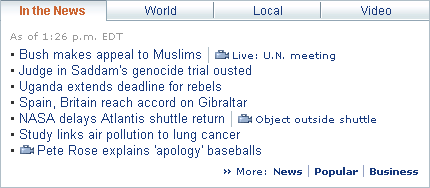
And here's what it looks like on Yahoo's news headlines:


So what's the matter, couldn't they back up their original claim? Was the original headline just plain bullshit, which we've come to expect from mainstream media?

All this notwithstanding, nobody ever claimed Iraq would be easy. Nobody ever claimed it would be bloodless, contrary to Pat Robertson's myth that Bush told him there would be "no casualties." (As the article shows, Robertson also said, "I mean, the Lord told me it was going to be A, a disaster, and B, messy.") What President Bush and his administration did say is that the people of Iraq would welcome us as liberators -- and they have, with the exception of the insurgents. The elections proved it: tens of millions of Iraqis risking their lives to vote in truly free elections (with many voting for the first time).

Update: It looks like President Bush did use the word mirage, just not in the way the headlines implied. You can find the full text of the remarks on the White House website:
Some have argued that the democratic changes we're seeing in the Middle East are destabilizing the region. This argument rests on a false assumption, that the Middle East was stable to begin with. The reality is that the stability we thought we saw in the Middle East was a mirage. For decades, millions of men and women in the region have been trapped in oppression and hopelessness. And these conditions left a generation disillusioned, and made this region a breeding ground for extremism.
So in fact President Bush was not talking about stability in post-Saddam Iraq being a "mirage," but that Middle East stability is a "mirage" because it was never "stable to begin with."

What really happened that necessitated changing the headline within 30 minutes? Perhaps an idiot reporter and her equally stupid editor think they had a great "Gotcha!" headline (implying that Bush admitted some sort of "failure" in Iraq), then they realized how obvious it was that they quoted Bush out of context?

Maybe this reporter didn't keep good enough notes, and in rushing to submit the first article about Bush's speech, she somehow didn't realizing she didn't say one damn thing about the most important word in the headline -- a quoted word, in fact. Maybe it was an innocent mistake, and I can dismiss occasional occurrences as such. However, when something happens over and over, even "incompetence" isn't enough to excuse it.

Those of you who read me regularly know I'm far from a Bush shill. Basically, I support him when he pushes for tax cuts and privatization, but I cringe when he moves toward big government. Nonetheless, I cannot believe how mainstream media consistently goes after the man. And I thought they were merciless and vicious toward his father! It was bad enough that every nightly news broadcast in 1992 seemed to feature something on the allegedly "bad economy" (which Bush had nothing to do with). With George W. Bush, no matter what he's said since he announced his candidacy, mainstream media tries to find some way to spin it.

Just remember:

Labels: